ASIC
Turkish customs confiscate over 500 smuggled Bitcoin mining rigs



Turkish customs enforcements brought down an illegal smuggling operation in what is said to be a record bust against illegal Bitcoin (BTC) mining equipment in the country.
After receiving a tip, Turkey’s Customs Protection’s anti-smuggling and intelligence teams raided a warehouse earlier this week in Karabağlar, İzmir, where they found 501 ASIC Bitcoin mining rigs in closed cardboard boxes.
Customs enforcement reported the estimated value of the seized equipment at 5 million Turkish liras, or $600,000. Four suspects were detained as part of the investigation. Reports claim that law enforcement is carrying out another active operation in İstanbul, the biggest city and a major customs checkpoint in Turkey.
Application-Specific Integrated Circuits, or ASICs, are the most popular way to mine Bitcoin, but they are also known for their high electricity usage, a widely known issue that has caused Elon Musk to pull back on his decision to accept Bitcoin payments for Tesla cars.
Once known as a crypto-friendly country, Turkey has recently stepped up its monitoring of crypto frauds and transactions. Last month, Turkish crypto exchange Thodex halted operations with over $150-million missing, rendering thousands of users unable to access their funds.
Shortly after Turkish police detained 62 suspects in the Thodex investigation, another local exchange, Vebitcoin, shut down in the same manner.
More recently, the Turkish Minister of Treasury and Finance Lütfi Elvan announced that the Financial Crimes Investigation Board, or MASAK, has full authority to audit and oversee crypto exchanges. As a countermeasure for fraud and illegal money trafficking, any crypto exchange with a presence in Turkey is now obliged to inform MASAK about crypto transactions over 10,000 Turkish liras ($1,200).
Local blockchain and crypto experts agree that Turkey needs a clear regulatory framework to prevent fraud in the ecosystem.
Source link










The proof-of-work (PoW) consensus model is the mechanism that kicked off the revolution that launched Bitcoin (BTC) in 2009 and it was the model of choice behind many of the popular projects in the early fledgling years of the crypto ecosystem.
As time progressed, other consensus models like proof-of-stake (PoS) rose in popularity, especially as the cost of running mining rigs, the constant need to update equipment and environmental concerns led to the PoW model falling out of favor with many.
As a result, projects looking to employ a proof-of-work model have had to adapt to stay aligned with the demands of the wider market. This has led to the emergence of projects that offer a more environmentally and economically friendly approach to PoW, while also aiming to build Web 3.0.
Let’s take a look at some of the projects that allow people to contribute their resources toward securing the network and earn a yield in the process.
Helium
Helium is a decentralized blockchain-powered network for the Internet of Things (IoT) devices that utilizes a global network of low-energy wireless “hotspots” that broadcast data via radio waves to be recorded on its blockchain.
The network uses a new work algorithm that has been dubbed “proof-of-coverage” to validate that hotspots are providing legitimate wireless coverage and that miners receive the platform’s native HNT token for helping to provide coverage for the network.
The Helium network saw tremendous growth throughout 2021. Currently, there are more than 309,000 nodes in operation.
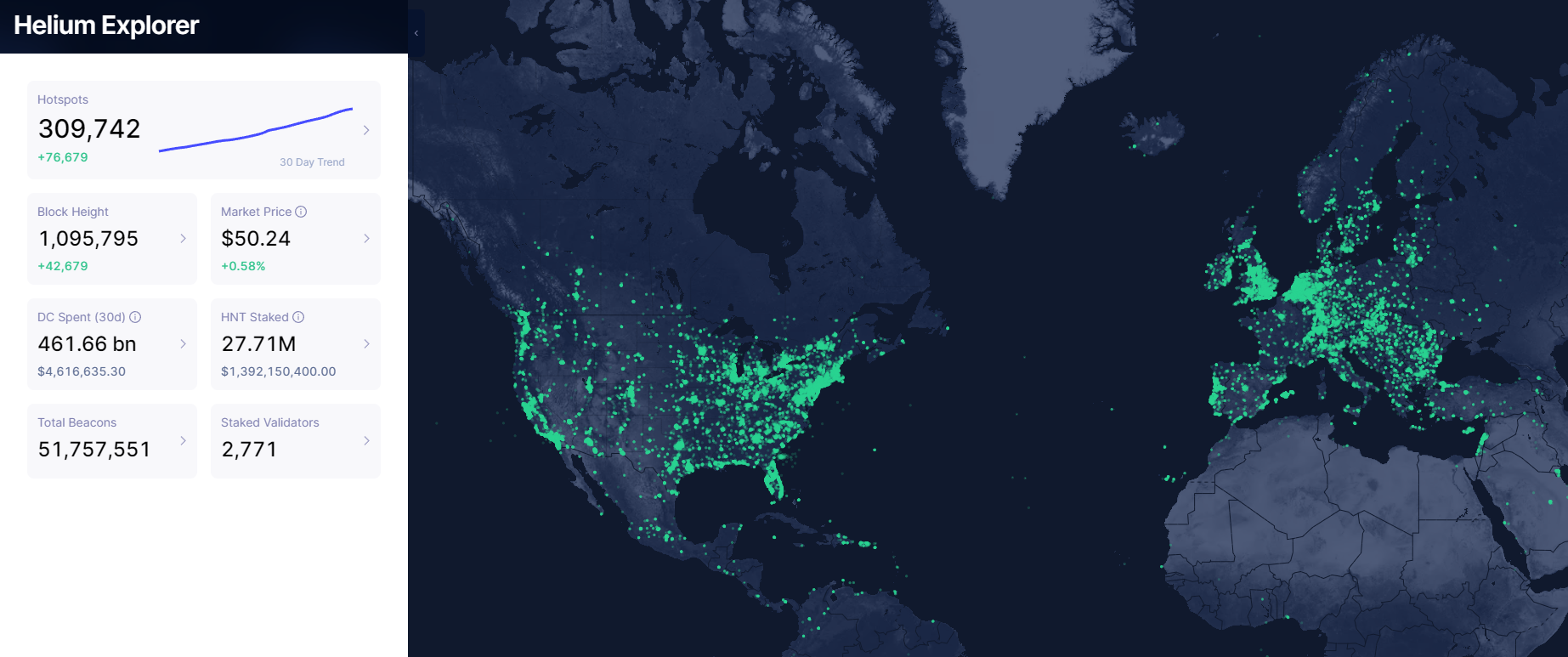
More recently, the Helium network expanded its capabilities by adding support for 5G wireless capabilities which included the launch of a new line of miners capable of transmitting the 5G signal.
On Oct. 26, Helium announced that it had partnered with the satellite television company Dish Network, making Dish the first major carrier to join the Helium network and offer its subscribers the opportunity to run Helium nodes in exchange for HNT tokens.
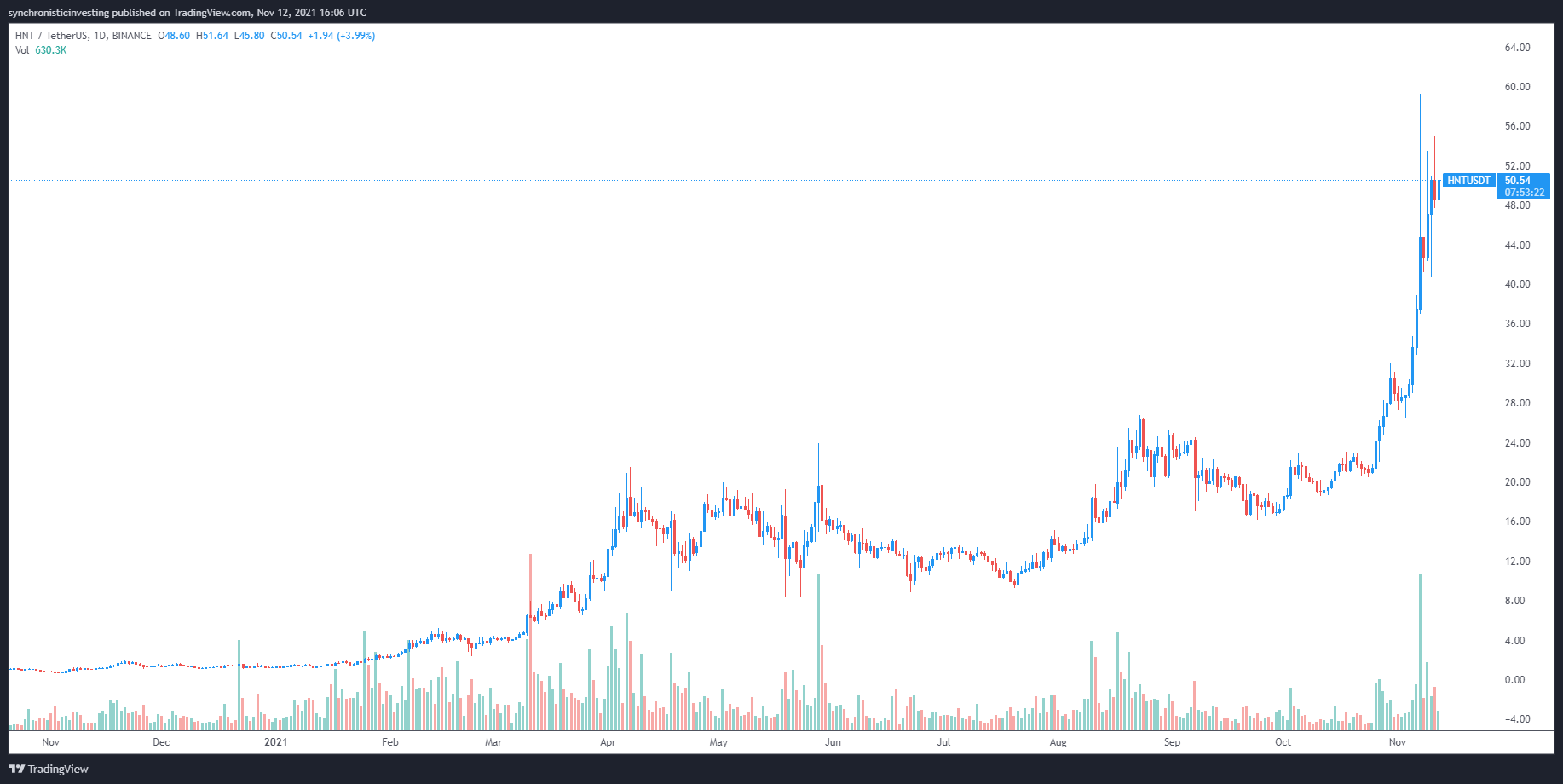
Shortly after these developments, HNT price rallied to a new all-time high at $53.11 on Nov. 9.
Kadena
Kadena (KDA) is a scalable PoW layer-one blockchain protocol that claims to be capable of processing up to 480,000 transactions per second (TPS) thanks to the use of braided chains.
Unlike the top PoW cryptocurrency Bitcoin, Kadena also offers smart contract capabilities similar to those found on Ethereum and features its own smart contract programming language called Pact.
Being smart contract capable means that the Kadena network is capable of hosting decentralized finance (DeFi) and nonfungible token (NFT) protocols, as well as a host of other specialized projects from stablecoins to payment processors.
Some of the goals of the project have been to address the major issues plaguing the Ethereum network such as high transaction costs and network congestion, and claims to offer marginal transaction fees for consumers while also introducing a “crypto gas station” feature that lets businesses create accounts that exist to fund gas payments on behalf of its user base when certain conditions are met.
Kadena utilizes the Blake (2s-Kadena) algorithm as its consensus model which requires native ASIC miners and cannot be mined using GPUs or CPUs.
Recently, KDA launched a wrapped version of its token called wKDA that is capable of interacting with all Ethereum Virtual Machine- (EVM-) compatible networks and their associated DeFi protocols.
In the future, the team behind Kadena also has plans to add cross-chain support for other popular blockchain networks including Terra, Polkadot, Celo and Cosmos.
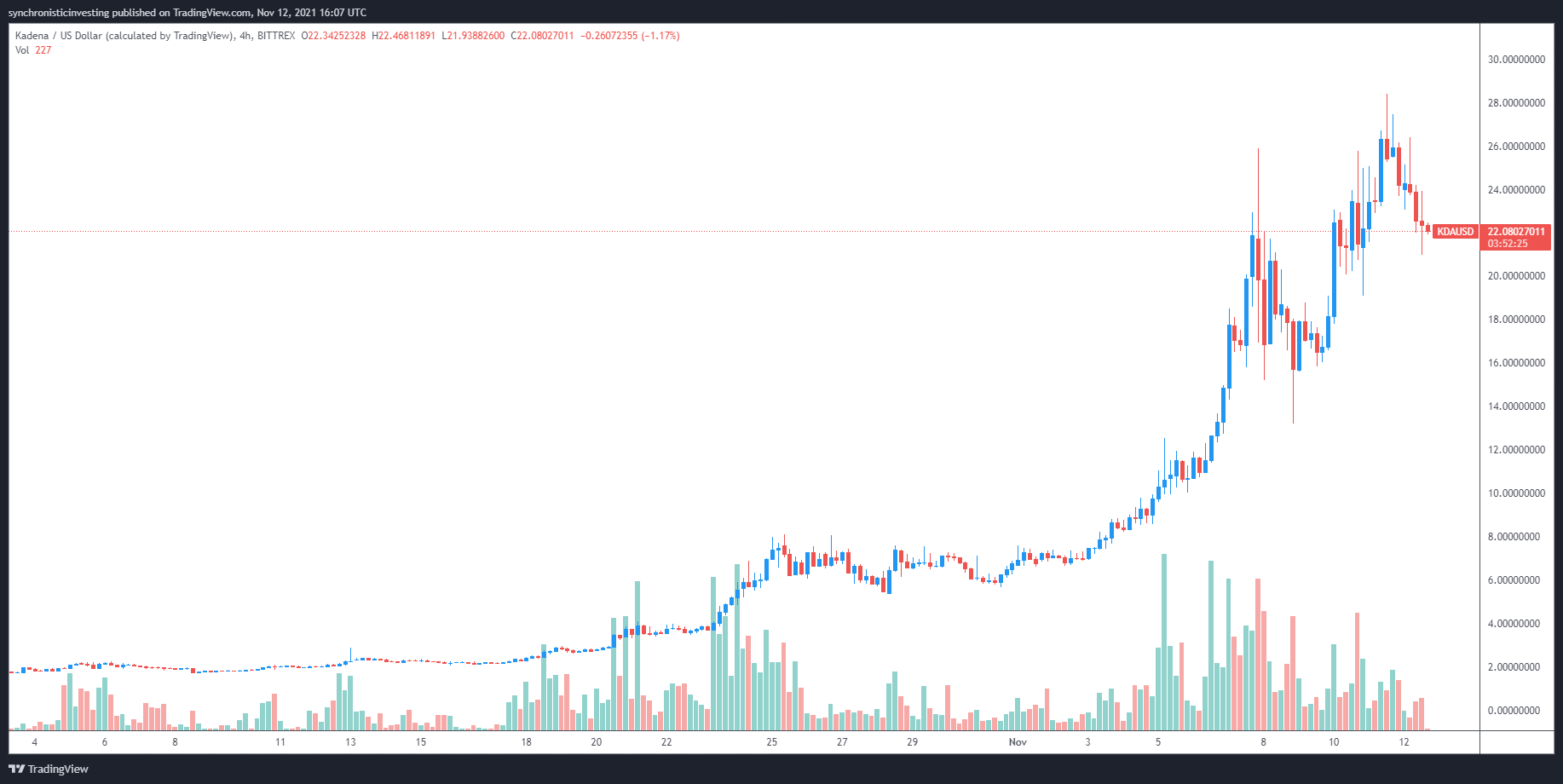
Data from Cointelegraph Markets Pro and TradingView shows that as a result of the recent developments, the price of KDA had surged 1,280% from a low of $2.05 on Oct. 17 to a new all-time high at $28.44 on Nov. 11.
Flux
Flux (FLUX) is a native GPU mineable PoW protocol that is focused on scalable decentralized cloud infrastructure for Web 3.0 applications.
According to the project, the Flux ecosystem is comprised of a suite of decentralized computing services and blockchain-as-a-service solutions which offer an Amazon Web Services-like development environment, as well as the FluxOS second-layer operating system that is capable of running “any hardened dockerized application.”
The Flux network uses the ZelHash algorithm, which is a GPU minable implementation of Equihash 125,4 and can be mined through a Flux community pool or on a variety of third-party pools created by teams that support the Flux mining ecosystem.
The block time on the Flux network is two minutes and the current block reward is 75 Flux, with 50% going to node operators and 50% going to miners.
On Nov. 9, the project introduced “Light Nodes,” which enable Flux nodes to be managed using light wallets so that operators can start and monitor node metrics from any device capable of running the FluxNodes app.
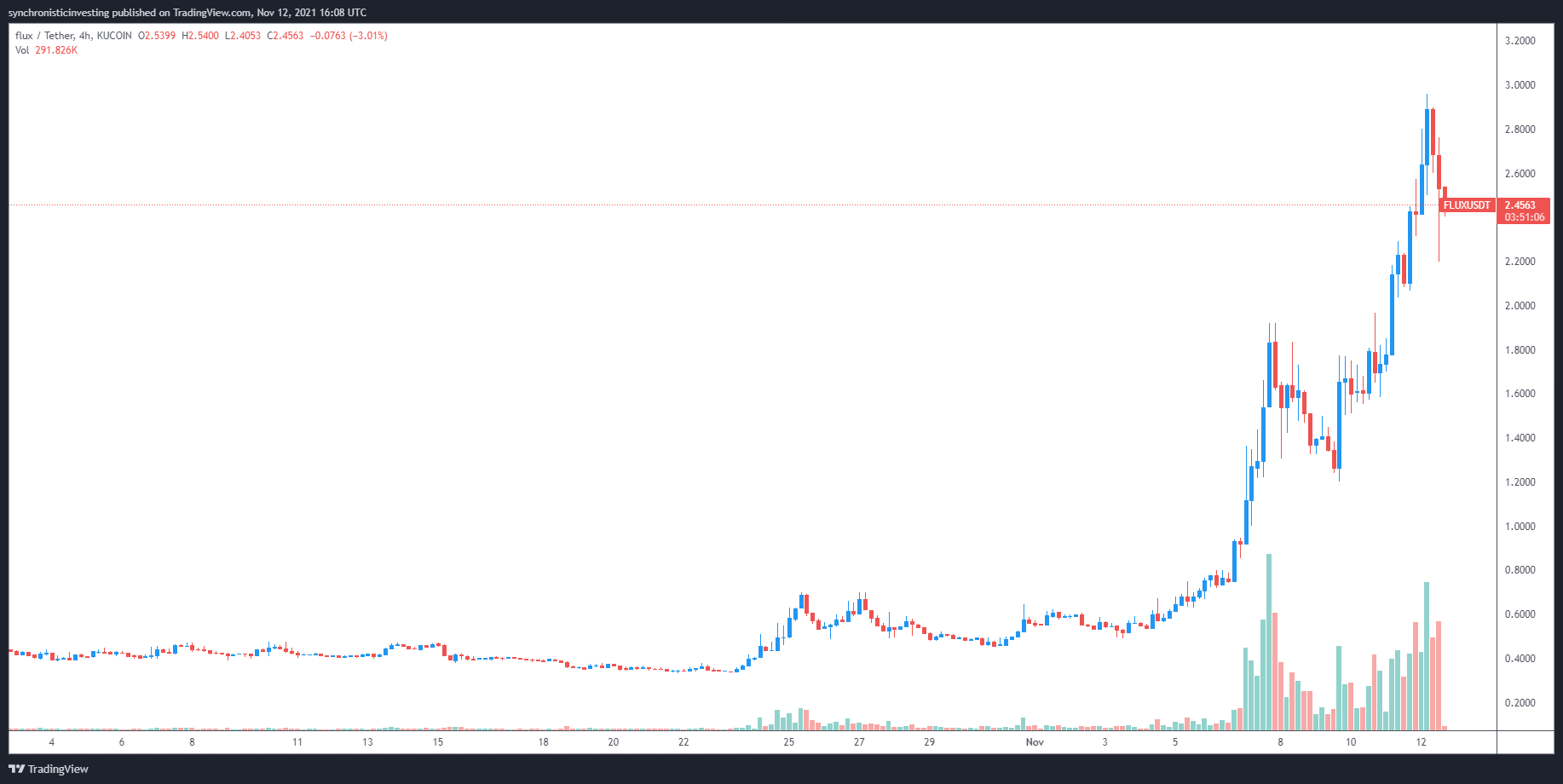
Data from Cointelegraph Markets Pro and TradingView shows that since Oct. 24 when it was revealed that Apple Pay would be integrated with the Flux network’s Zelcore wallet, the price of FLUX has surged 802% from $0.33 to a new all-time high at $2.96 on Nov. 12.
While the PoW model of consensus is no longer the dominant model used by major projects in the crypto ecosystem, these three examples show that it still has a lot to offer because the new platforms are environmentally friendly and economically sustainable.
Want more information about trading and investing in crypto markets?
The views and opinions expressed here are solely those of the author and do not necessarily reflect the views of Cointelegraph.com. Every investment and trading move involves risk, you should conduct your own research when making a decision.
Source link

Blockchain and high performance computing firm Northern Data has announced it will acquire Bitcoin miner Bitfield.
According to a Sept. 27 press release, all major shareholders signed a binding purchase agreement for the entire Bitfield enterprise to be sold at a value of roughly $460 million. Northern Data will acquire an equity interest of between 86% and 100% in Bitfield as per the agreement.
Northern Data claims it has become “a leading global Bitcoin mining company” through the acquisition, with the firm gaining immediate access to 6,600 operational ASIC miners. A further 26,000 brand-new miners are expected to be deployed primarily at sites in Canada and the U.S. by the start of Q2 2022.
“With this acquisition, we add Bitcoin mining to our three existing businesses – Bitcoin hosting and services, Altcoin mining and Cloud Computing” said Aroosh Thillainathan, founder and CEO of Northern Data AG.
Norther Data Management expects revenues to amount to approximately between $210 million and $260 million in 2021.
Related: Bitcoin miner Greenidge set for Nasdaq listing through merger
Bitcoin mining difficulty surged over the last 2 months from a year low of 85 million terahashes per second (TH/s) on July 3 to a local high of 140 million TH/s on Sept. 21 according to a seven-day average — its highest level since early June. The total hash rate of the Bitcoin network is 136 million as of this writing.
After China’s initial crack down on Bitcoin mining, the difficulty to mine Bitcoin plummeted as Chinese miners left the network but the recent climb of the hash-rate proves that miners are getting back online.
Source link

South Korea’s Prospective New President Mulls ‘Giving a Crypto to all Citizens’

3 Proof-of-work protocols focused on building Web 3.0

Cryptocurrencies Are Banned in Indonesia for Muslims, NRC Declares

HOW TO SIGN-UP FOR SAFEMOON WALLET BETA TESTING? - EXPLAINED

Pillar V2, First Community-Run Multichain Wallet Cuts Gas Fees by 99%

Crypto wallet Zumo adds support for Bitcoin SV (BSV) after BTC and ETH » CryptoNinjas
-
 distributed ledger6 months ago
HOW TO SIGN-UP FOR SAFEMOON WALLET BETA TESTING? - EXPLAINED
-
 Press Releases5 months ago
Pillar V2, First Community-Run Multichain Wallet Cuts Gas Fees by 99%
-
 News5 months ago
Crypto wallet Zumo adds support for Bitcoin SV (BSV) after BTC and ETH » CryptoNinjas
-

 Usecase5 months ago
E-Oracle | Crypto Space Use Cases in Pipeline | Mr. Karn Dwivedi | Top Earners | Rahul_+917204321080
-

 Education5 months ago
Karan Dwivedi Zoom Meeting Crypto Bulls, ESPN Global, Master Nodes
-
 liquidity5 months ago
Daily Farm Update | Token n Farm Launches | BSC & Polygon
-

 liquidity6 months ago
How To Add and Remove Liquidity on Quickswap Exchange (Quickswap Exchange Tutorial)
-

 automata5 months ago
Binance Launchpool hosts ATA Token Launch and $2.4 million Raise for Automata Network





































_1629359065.png)