Bitcoin News
‘Locked-Out’ Users Sue Coinbase For North of USD 5M


Six Coinbase users are taking the crypto exchange giant to court to seek more than USD 5m in compensation for themselves and other users who were allegedly locked out of their accounts for several months or longer at a time.
According to a complaint filed on Friday in San Francisco, USA, federal court, and first reported by Decrypt, the plaintiffs - Michael Leone, Joseph Treseder, Travis Reece, David Beavers, Fazal Us Saboor Ali, and Keisha Pinkney - accuse the exchange of preventing them from accessing their accounts for arbitrary reasons and prolonged amounts of time, as they have been unable to “invest, spend, save, earn, and use or even withdraw their funds” from the platform.
The exchange violated its “duty to provide access to the Coinbase platform to conduct authorized transactions,” they claim.
Therefore, they seek “any and all available relief, including equitable relief and recovery of damages caused by Defendants’ actions,” said the document, adding that “the amount placed in controversy by the Complaint exceeds, in the aggregate, USD 5 million, exclusive of interests and costs.”
The case highlights ongoing reported Coinbase’s customer support issues. All plaintiffs claim that they, after they were barred from using the service, they contacted customer support, which, in most cases, responded with an automated response which said that their issues were “under review.”
In some cases, customers were forced to go through the identity verification process once more, while other claims revolve around login issue, as some of the plaintiffs claim to have received error messages when trying to log in to the platform - even though the support staff claimed that the account issues had been solved, they said.
In some cases, the plaintiffs claim, they had regained access to their accounts but found that they had no crypto funds, or their accounts were erased without explanation.
As a result of such “negligence,” the plaintiffs and class members were locked from trading and in some cases, regained access only when the value of their cryptoassets has dropped significantly.
“Defendant’s conduct amounted to gross negligence where they breached the duties as alleged herein and by failing to create and enforce an adequate plan to prevent security breaches and lock outs that prevent Plaintiffs and the Putative Class from accessing their Coinbase accounts and/or funds where they know that, “[a]s a newer asset class, crypto is widely considered to be volatile –with the potential for significant upward and downward movements over shorter time periods,” and knew or should have known that their breaches would likely inflict substantial damages upon its consumers,” the complaint reads.
In late March, Alesia Haas, the company’s chief financial officer (CFO), said that the exchange is hiring new customer support agents, as well as making investments on the product side “to reduce the friction that we see a lot of customers call in and offer complaints about.”
____
Learn more:
- Coinbase Says It Aims to Improve Customer Service, Integration with Pro
- Crypto Exchanges to Spend 2021 Focusing on DeFi, UX, and New Services
- Coinbase Goes After Institutional Customers Amid Investment Surge
- Coinbase Says It Is Targeting More Users, Not Lower Fees
- Coinbase to Face Class Action Suit over XRP Listing
- Coinbase Says That 60% of Its Bitcoin Buyers Go Into Altcoins
Source link
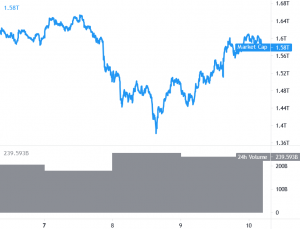
Bitcoin price settled above the USD 35,000 resistance zone. As a result, BTC gained bullish momentum and it cleared the USD 36,500 resistance. It even cleared USD 37,000 and it is currently (04:35 UTC) facing a strong resistance near USD 38,000.
Besides, most major altcoins are recovering steadily. ETH settled above the USD 2,500 level and it even cleared the USD 2,550 resistance. XRP/USD broke the USD 0.88 resistance and it may soon clear USD 0.90.
Total market capitalization
Bitcoin price
After a close above USD 35,000, bitcoin price extended its upward move. BTC climbed higher steadily above the USD 36,000 and USD 36,500 levels. There was a spike towards the USD 37,500 level, but the price failed to extend gains. The main resistance on the upside is near USD 38,000, above which the price could test USD 40,000.
On the downside, the price might remain stable above the USD 36,500. The next major support is now forming near the USD 35,500 level.
Ethereum price
Ethereum price gained momentum for a close above the USD 2,500 level. ETH even cleared the USD 2,550 resistance and it is now showing positive signs. An initial resistance is near the USD 2,620 level. The first major resistance for a larger increase is near USD 2,650.
If there is a fresh decline, the USD 2,500 level might provide support. The next key support is near the USD 2,440 level.
BNB, LTC, DOGE, and XRP price
Binance Coin (BNB) is back above the USD 350 resistance level and it even cleared USD 365. BNB is now approaching the USD 380 level. A successful break above USD 380 could lift the price towards the USD 400 resistance zone in the near term.
Litecoin (LTC) is up over 10% and it cleared the USD 165 level. LTC is trading above USD 170 and it might test the USD 180 level. If the bulls remain in action, there are chances of a move towards the key USD 200 level.
Dogecoin (DOGE) gained pace above the USD 0.320 and USD 0.335 levels. It is now facing hurdles near USD 0.350. A close above USD 0.350 might open the doors for a move towards the USD 0.400 level. On the downside, the bulls might remain active near the USD 0.320 level.
XRP price gained over 7% and it surpassed the USD 0.880 resistance. It is now testing the USD 0.900 resistance, above which the price could gain bullish momentum. The next key resistance is near the USD 0.950 level. Conversely, it could revisit USD 0.850.
Other altcoins market today
Many altcoins gained over 10%, including BTG, KSM, ZEN, ZEC, RUNE, RVN, QTUM, DOT, NEO, XMR, ETC, WBTC, BTCB, NEXO, and CRV. Out of these, KSM is gaining pace and it even cleared the USD 500 level.
Overall, bitcoin price is trading above the USD 36,500 pivot level. If BTC clears the USD 38,000 resistance, it could accelerate higher towards USD 40,000 in the near term.
_____
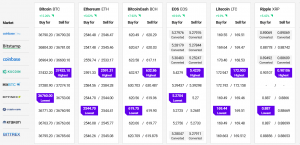
Find the best price to buy/sell cryptocurrency:
Source link
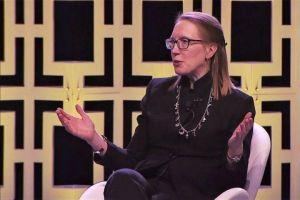
A senior official from the US Securities and Exchange Commission (SEC) has voiced her opposition to attempts by her fellow regulators to enforce strict regulation on cryptoassets instead of promoting self-regulation. The latest statement by Hester Peirce, one of two Republicans among the five SEC commissioners, indicates a growing discord on crypto policy among the agency’s top brass.
Peirce told The Financial Times she was worried about the push by a number of the SEC regulators to play a more active role in the cryptocurrency market, and how this trend could potentially thwart innovation and discourage investors.
“I am concerned that the initial reaction of a regulator is always to say ‘I want to grab hold of this and make it like the markets I already regulate’,” she said. “I am not sure that’s going to be great for innovation.”
While Peirce did not name any commissioners she disagreed with, her comment came amid a campaign by Gary Gensler, the new SEC’s chair, to place cryptoassets within a tighter regulatory framework.
On May 26, appearing before the Subcommittee on Financial Services and General Government of the Appropriations Committee at the US House of Representatives, the lower chamber of the country’s parliament, Gensler (re)told lawmakers that cryptocurrencies are a “highly volatile and speculative asset class,” and that many tokens are investment contracts that fall under the US securities law.
Referring to the value of the global cryptoassets market, the regulatory tsar said the figures on the reported trading volume are not audited or reported to regulatory authorities as the exchanges are not registered with them. “That is just one of many regulatory gaps in these crypto asset markets,” he said.
Commenting on Gensler’s remarks, Peirce said she was “concerned about trying to make it harder for people to do truly peer-to-peer transactions,” and that she believed “regulation doesn’t all have to happen at government level.”
“You can have pretty effective self-regulation,” she said.
And Gensler is not the only one pushing for more and tougher crypto regulations. For example, in May, three major federal bank regulators - Office of the Comptroller of the Currency (OCC), the Federal Reserve, and the Federal Deposit Insurance Corporation - held the first meeting of “an inter-agency sprint team,” focused precisely on crypto regulation.
Peirce joined the agency in 2018 after being appointed by former US President Donald Trump, quickly earning the ‘Crypto Mom’ monicker for her willingness to push for the blockchain technology within a regulatory framework.
Last April, on Peirce’s initiative, an updated version of the token safe harbor proposal was released, which aims to enable crypto businesses to offer tokens under initial coin offerings (ICOs) in compliance with the SEC’s rules, earning Peirce praise from various crypto industry representatives.
____
Learn more:
- SEC’s Hester Peirce on Why US is Behind the Curve on Crypto
- El Salvador Passes Bitcoin Bill: Countdown to Legal Tender Status Begins
- Crypto Industry’s Lobbying Power Grows As Former Officials Change Sides
- Paxos, Protego & Anchorage Face ‘Regulatory Volatility’ in US
Source link
There is a great number of issues debated today following the major news that El Salvador recognized the world’s number one cryptocurrency, bitcoin (BTC), as legal tender. This may bring some important changes when it comes to how bitcoin is treated on the legal stage globally. However, in what manner and to what extent is not exactly clear yet.
As reported, the Legislative Assembly of El Salvador passed the Bitcoin law today. Also, the 90-day countdown to promulgation has already begun, meaning that, in September, BTC will be recognized as a satisfactory payment for any monetary debt.
The new law also allows prices to be expressed in BTC and taxes to be paid in it, while exchanges in BTC will not be subject to capital gains tax.
“It will be interesting to see how tax authorities around the world react to this,” Richard Howlett, a solicitor at Selachii Legal Limited, a London-based law firm, told Cryptonews.com.
According to him, if El Salvador would declare that their legal tender is BTC only, then it would set an argument that BTC elsewhere is not subject to capital gains tax also.
“However, I fear that governments worldwide would not want to lose the capital gains tax income and would likely state that they do not recognize it as a currency and it remains classed as an asset,” Howlett said, adding that it would take some form of legal precedent to change this.
“If a court agrees it is not subject to capital gains tax as it is a currency, then there will be lots of very happy crypto owners!”
Niklas Schmidt, Partner with the Austrian law firm Wolf Theiss, and author of two books on crypto, also noted that the fact that El Salvador’s legal tender is now BTC means that legal provisions in statute books making reference to other jurisdictions’ legal tender will now possibly also cover bitcoin.
“There are many rules which apply to currencies and where previously you could say that bitcoin is not encompassed. Now that bitcoin has been adopted by one particular country as its currency, it will have to be re-evaluated whether such rules now do apply,” he told Cryptonews.com, stressing that it is not possible to make a general statement applicable to all countries.
“There will be cases where this does have an impact and cases where this is not the case, depending on the interpretation of the wording of a concrete provision,” Schmidt added.
In either case, El Salvador will now be in the spotlight for some time.
An experimental stunt
“Governments and central banks around the world will be watching the El Salvador experiment to see if Bitcoin becomes part of daily life for payments, remittance and a reserve asset for banks and corporations in the country,” Ross Middleton, Chief Financial Officer of DeversiFi, a Layer 2 decentralized exchange (DEX) and decentralized finance (DeFi) trading platform, said.
However, per Howlett, El Salvador’s model can’t simply be copy-pasted, as every country would legislate in their own way, according to their formal procedures, but “as the El Salvador model proves to be a success, other countries will follow.”
He estimates that, most likely, it will be countries that “have the demographic of a third world country” and BTC adoption “could generate wealth that is unimaginable for them and bring some relief.”
And when it comes to specifically the EU and North American countries doing the same as El Salvador, it might be better not to hold our breaths.
The EU is in Howlett’s opinion “too caught up in its own self-importance to adopt,” which is why “they miss many opportunities.” Will they adopt BTC instead of the Euro? “In the short term no,” he said, and in the long term, “if (and it is a big if) the EU remain as one unified block, there is potential it could happen but if the EU falls down and the countries within it move back to being on their own, it would make perfect sense for those countries to adopt BTC instead of going back to their former currency.”
“In the Eurozone, under the current rules, countries are prohibited from introducing a new form of legal tender; thus, adoption of bitcoin as legal tender in the European Union would only be possible by those few countries not part of the Eurozone. I do, however, think that this is highly unlikely,” Schmidt added.
North America too would probably never do this, per Howlett, as “they like to print money (in the same way the UK does) as and when it suits them.” Furthermore, both North America and the UK are sticking “to old-fashioned values and the manner in which they feel they have to control their citizens.”
Meanwhile, Schmidt described the initiative of El Salvador’s president as “definitely a publicity stunt” which has put “this tiny Latin American country into the spotlight.”
While bold, the move is not “a panacea for all of El Salvador’s woes,” said Schmidt. He argued that Latin American countries are in “a mess” contributed to by decades of economic and cultural Marxism – a mess that was recently highlighted by hundreds of people taking selfies in front of a dumpster full of worthless Venezuelan bills at last week’s Bitcoin event in Miami.
However, Howlett opined that BTC might help a country in case of hyperinflation.
“By adopting BTC as legal tender, a ‘currency’ that is decentralized, they avoid hyperinflation and it gives them an amazing opportunity to prosper as a country and a government,” he said.
_____
Other reactions
@WhalePanda @IamNomad Will the incentive of tax-less bitcoin in El Salvador be enough to lure not only holders, but… https://t.co/c0GdNhhcDp
If you’re wondering what #ElSalvador’s #Bitcoin move means for #India - #ElSalvador has no monetary policy of its o… https://t.co/zjrbQDhobs
@sagars209 We don’t know. Its very likely nobody will spend their bitcoin and just use it for savings. The currency… https://t.co/xdfgqR7FPz
It’s what you do if you’re bearish on your currency. Cuba’s government does this - the entire economy is basically… https://t.co/VP39nJBS0E
Put differently: “they’re not really gonna let El Salvador go through with this, are they?”
_____
Learn more:
- Latin American MPs Widen Overton Window For Bitcoin
- Bitcoin Is More ‘Public’ Money than Central Bank-Issued Fiat Currencies
- Prepare For ‘Uncertain Future of Money’ – US Intelligence Center
- Bitcoin Faces Hedge Test Amid Rising Inflation Concerns
- Post-COVID-19, Bitcoin & Co May Help UK Escape from Economic Funk
- A Debt-Fuelled Economic Crisis & Bitcoin: What to Expect?
- Not Only Bitcoin Price Is Changing During This Bull Run
- Bitcoin Mass Adoption Would Benefit and Harm Current Economy
Source link
"Coins!" by ABCmouse.com
BitTorrent Crypto Coin Going To Zero?
Bitcoin ETF | Can It Hurt Bitcoin?!

Here Are the 10 Altcoins To Watch in April As Risk Tolerance Swells in Crypto, Says Trader Luke Martin

How To Invest In Crypto Full Beginners Guide in 2021

CRYPTO EDUCATION: A beginners guide for accountants and IFAs
-
 Altcoins2 months ago
Here Are the 10 Altcoins To Watch in April As Risk Tolerance Swells in Crypto, Says Trader Luke Martin
-
 Education2 months ago
How To Invest In Crypto Full Beginners Guide in 2021
-
 Education2 months ago
CRYPTO EDUCATION: A beginners guide for accountants and IFAs
-
 Education2 months ago
Bitcoin: How Cryptocurrencies Work
-
 liquidity2 months ago
Unistake - The Big Reveal | The Importance of Liquidity for Cryptocurrency
-
 Usecase2 days ago
BTT (BITTORENT) SIAP NAIK !?? SETELAH EVENT 10 JUNI?? PREDIKSI DAN ANALISA BTT (BITTORENT) 2021 !!
-

 Usecase2 months ago
Robert Kiyosaki: WE ARE SCREWED - The Future Of Money Lies In Crypto, Bitcoin And Blockchain
-
 Technology2 months ago
Blockchain technology ante enti ? What is Blockchain ? Telugu Version