DeFi
Ripple Proposes Massive XRP Ledger Upgrade To Support DeFi and Smart Contract Capabilities

Ripple is proposing a major XRP ledger upgrade that the company says could unleash decentralized finance (DeFi) and smart contracts across the broader XRP ecosystem without decreasing XRPL’s efficiency.
Ripple plans to accomplish this through the use of federated sidechains, according David Schwartz, the company’s chief technology officer.
The sidechains would be connected to the XRPL by “federators,” which are pieces of software run by parties who operate validators on at least one sidechain, explains Schwartz in a new blog post. The sidechains would operate like their own blockchains, but XRP and issued tokens could move between them and the XRPL.
Says Schwartz,
“This will enable developers to implement new features, such as native smart contracts that interoperate seamlessly with XRP and the XRP Ledger, while also allowing the XRP Ledger to maintain its existing, ‘lean and efficient’ feature set.
Federated Sidechains allow for experimentation and specialization, so developers can enjoy the power of the XRPL on a sidechain that acts as its own blockchain. For example, imagine the potential to branch out into new functionality by slimming down the XRPL’s features to a specific subset for a particular use case — or even creating a private, parallel network for a permissioned blockchain.”
Schwartz, one of the original architects of the XRP ledger, adds that successful features “baked into” the sidechains could eventually be ported to the XRPL Mainnet.
But the CTO notes enabling sidechains wouldn’t require changes that are used on the XRPL itself, though he says some amendments to the software would be required.
“Making these changes is probably the biggest part of this effort because even though they won’t be enabled on XRPL, there is still risk associated with changing the software. For example, some existing code may need to be moved or adjusted which carries the risk of inadvertently changing behavior.”
Any potential XRPL amendments require an 80% approval rating from the ledger’s validators. If an amendment stays above that threshold for two weeks, it is activated.
Don’t Miss a Beat – Subscribe to get crypto email alerts delivered directly to your inbox
Follow us on Twitter, Facebook and Telegram
Surf The Daily Hodl Mix

Disclaimer: Opinions expressed at The Daily Hodl are not investment advice. Investors should do their due diligence before making any high-risk investments in Bitcoin, cryptocurrency or digital assets. Please be advised that your transfers and trades are at your own risk, and any loses you may incur are your responsibility. The Daily Hodl does not recommend the buying or selling of any cryptocurrencies or digital assets, nor is The Daily Hodl an investment advisor. Please note that The Daily Hodl participates in affiliate marketing.
Featured Image: Shutterstock/Supphachai Salaeman
Source link
Significant price corrections like the one see in May inflict widespread pain for a majority of market participants and can be a death sentence for struggling projects as token holders capitulate and dump their holdings for any price offered.
While these periods are useful to help shakeout the weak hands and weed out unnecessary projects, they also offer strong performers the opportunity to stand out from the crowd and attract the attention of eager investors looking for a safe haven during choppy markets.
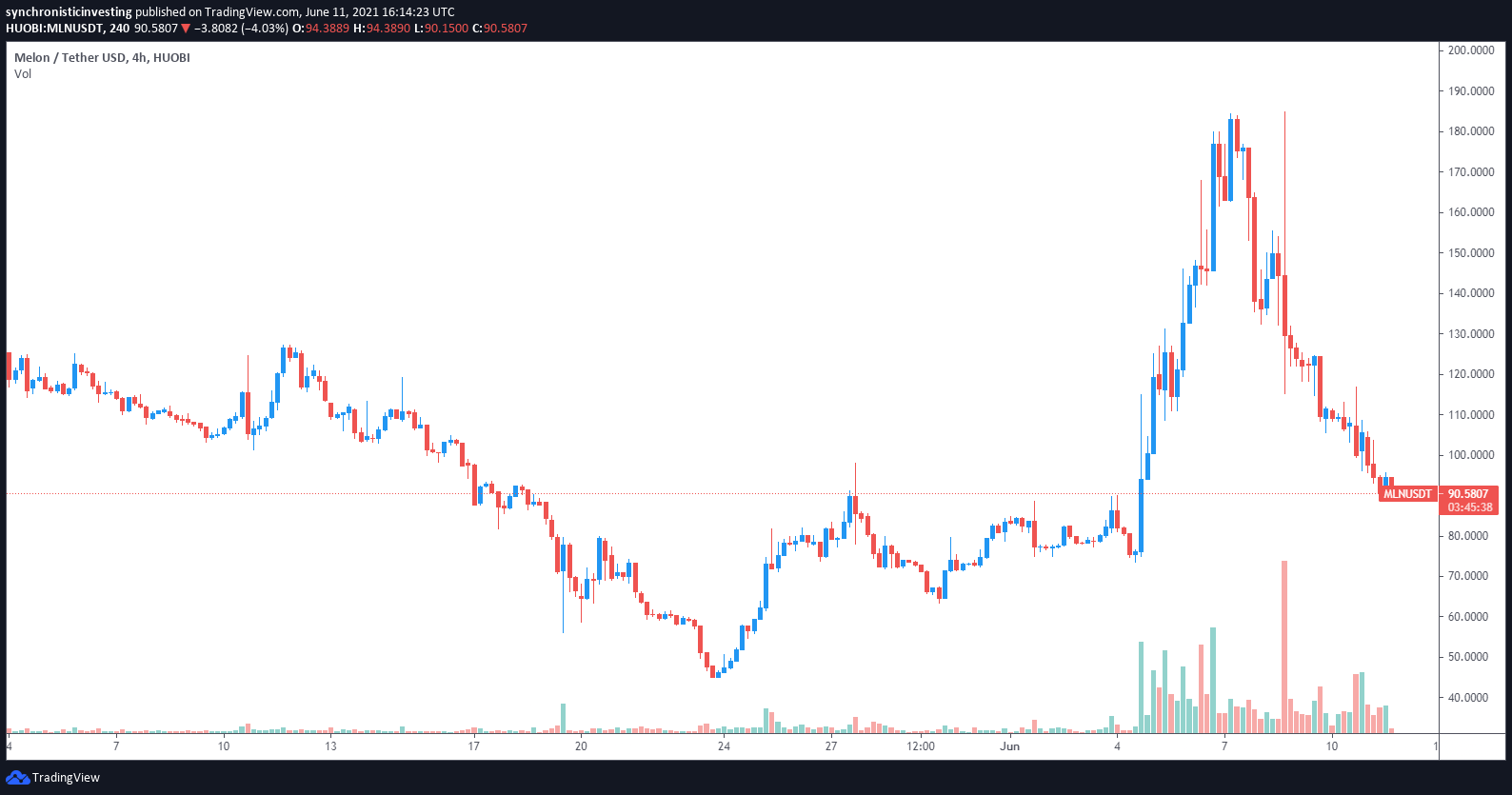
Two projects that have been more resilient than crypto majors and are down less than 20% from their highs established prior to the May 18 market sell-off are Solana (SOL) and Enzyme (MLN).
Enzyme benefits from the Coinbase bump
Out of the top 200 coins, Enzyme has outperformed the field in terms of bouncing back following the sell-off as the MLN token surged 150% from a low of $75.50 on June 4 to a high at $185 on June 7, propelled by a record $45 million in 24-hour trade volume.
Enzyme is a decentralized finance (DeFi) protocol designed for on-chain asset management and meant to empower investors to build, scale and monetize investment strategies that can be utilized by other members of the Enzyme community.
After a relatively quiet start to June, Enzyme began receiving more notice on Twitter beginning on June 6 with Messari analyst Jack Purdy pointing out that “even with prices down 40% from a few weeks ago Enzyme AUM are still close to all-time highs.”
While there was no major developments for the protocol as the price started to rise significantly beginning June 4, the June 8 revelation that MLN would be added to Coinbase Pro appears to be the driving force behind the tokens recent surging price demonstrating that the Coinbase bump still has the potential to move prices.
Starting today, inbound transfers for GTC, MLN & AMP are now available in the regions where trading is supported. Traders cannot place orders and no orders will be filled. Trading will begin on or after 9AM PT on Thurs 6/10 if liquidity conditions are met. https://t.co/wWYrUIXeRT
— Coinbase Pro (@CoinbasePro) June 8, 2021
Solana rebounds from its May 19 low
The second token that quickly rebounded from the May crash is Solana (SOL), a layer-one proof-of-stake protocol capable of processing 65,500 transactions per second (TPS).
Related: Solana Labs raises $314M via private token sale as ecosystem support expands
Momentum for the project began picking up on June 2 following the announced launch of the Metaplex NFT platform which offers “a radically new approach to NFTs and NFT storefronts” on the Solana blockchain.
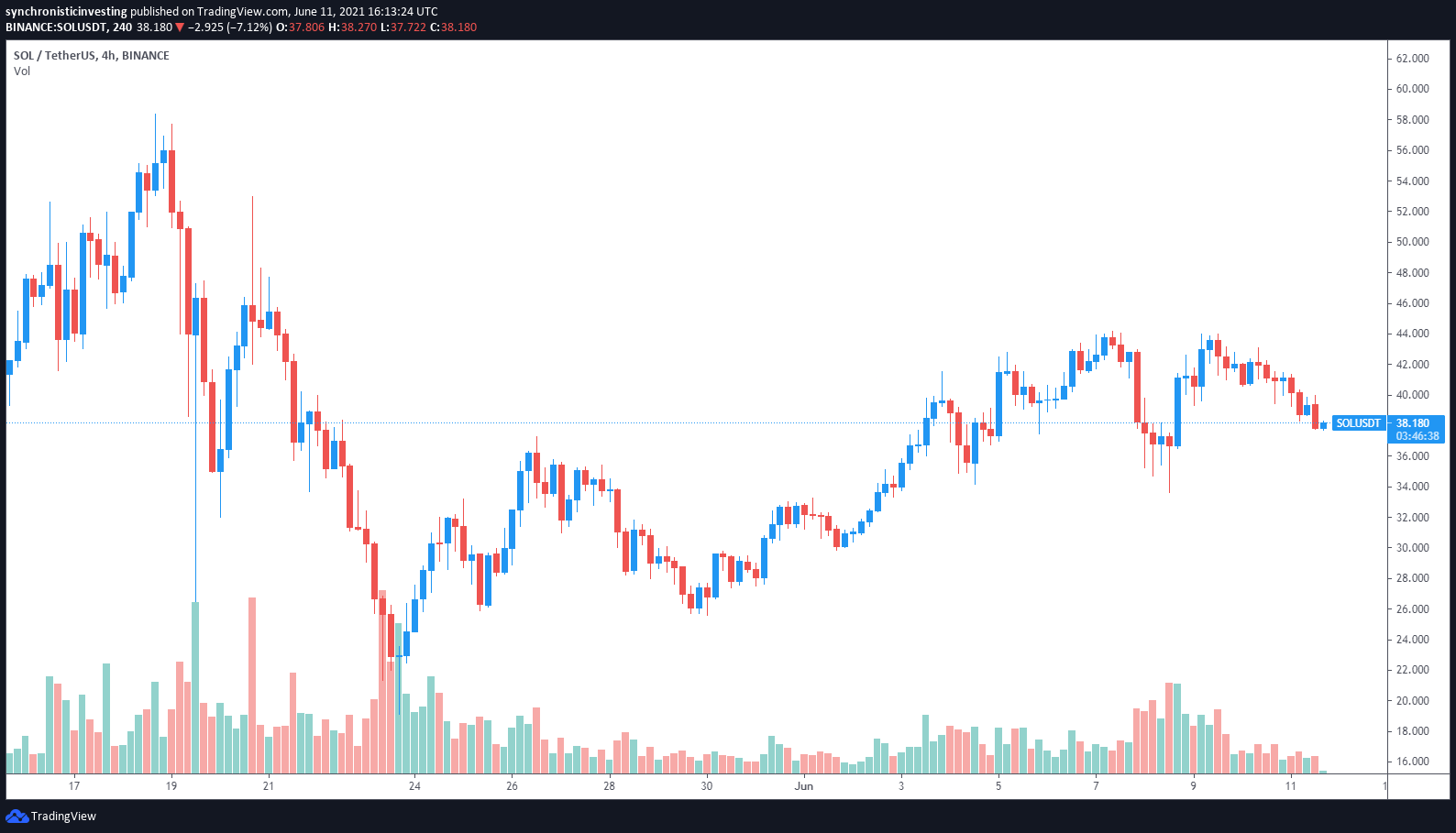
This announcement was followed up by a series of other project launches on Solana including the algorithmic decentralized lending and borrowing platform Solend and the decentralized, capital-efficient derivatives exchange Moët Finance.
According to data from Cointelegraph Markets Pro, market conditions for Solana have been favorable for some time.
The VORTECS™ Score, exclusive to Cointelegraph, is an algorithmic comparison of historic and current market conditions derived from a combination of data points including market sentiment, trading volume, recent price movements and Twitter activity.
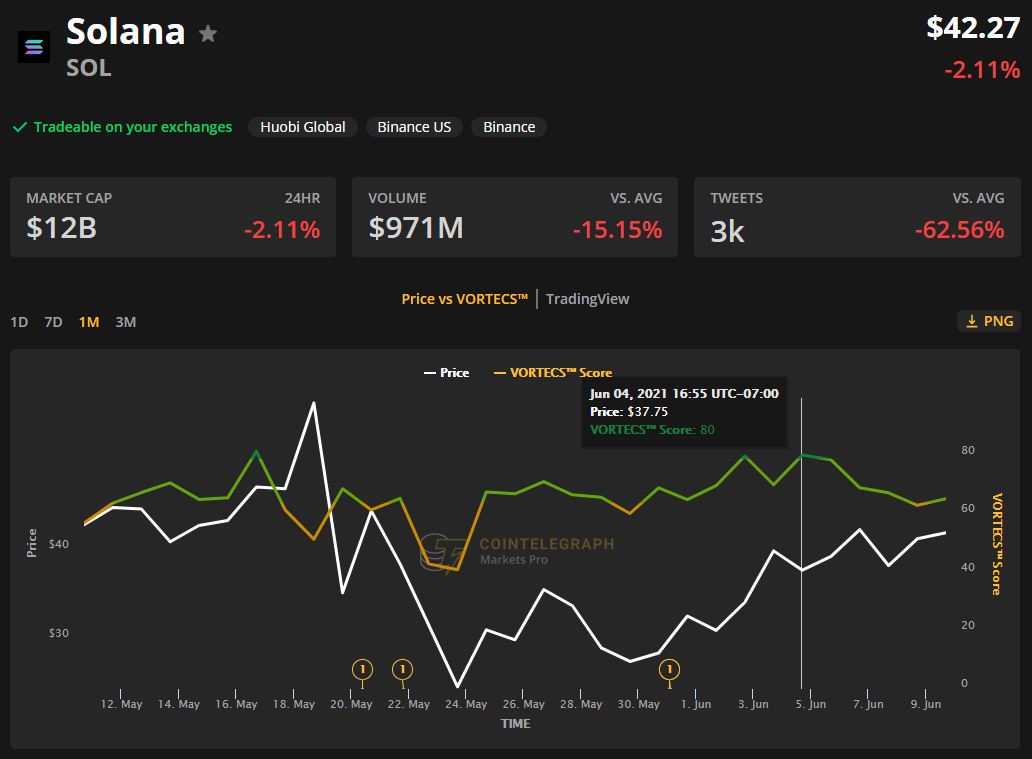
As seen on the chart above, the VORTECS™ Score for SOL has been green for the most of May, with its score quickly recovering above 67 on May 24 to reach a high at 80 on June 4 as its price began to rally 30% over the next three days.
The views and opinions expressed here are solely those of the author and do not necessarily reflect the views of Cointelegraph.com. Every investment and trading move involves risk, you should conduct your own research when making a decision.
Source link
While countries like El Salvador have welcomed Bitcoin (BTC) with open arms, other regions are pushing to legally ban the digital currency. Although this may be, some industry experts believe that Bitcoin is here to stay — for good.
For example, during an exclusive interview at Bitcoin 2021 Miami, Yoni Assia, chief executive officer of eToro, told Cointelegraph that he considers Bitcoin to be the “king of crypto,” noting that the most popular digital currency is here to stay:
“I’ll be surprised if we don’t see a significant rise in the price of Bitcoin over the next three to five years, as there are still 5 billion people in the world that basically don’t have good local currency.”
Yet in order for this dream to become a reality, Guy Hirsch, managing director of eToro U.S., told Cointelegraph that people need to believe in the morality of decentralizing money:
“I think that the moral case for Bitcoin and teaching people that it is the right thing to do is to basically separate state and money. It will ultimately create that vision that we all aspire for.”
Regulations: bridging the old world with the new world
In order to prepare for a decentralized future, Assia mentioned that eToro is building a bridge between traditional finance and the crypto industry. As such, Assia explained that the combination of crypto assets and equities is important. “The majority of our clients trade both cryptocurrencies as well as stocks in the platform. I think that’s definitely a trend that we’ll see continuing in the future,” he said.
Assia further mentioned that it’s good to see more institutions entering the crypto space, especially when it comes to innovating within decentralized finance, or DeFi:
“DeFi a bit of a wild west right now. No regulation, no real financial institutions, but a lot of amazing innovation. I think we’re going to see a lot of that innovation going into traditional or regulated financial institutions, centralized companies to be able to offer that innovation directly to consumers.”
Moreover, Assia mentioned that he thinks there will be a transfer of over $100 trillion dollars over the next 10 years into native digital assets. He noted this will be spurred by the notion that nearly all financial assets will eventually be incorporated onto blockchain networks moving forward.
Source link

Support for the Algorand ecosystem appears to be growing, with digital asset manager Arrington Capital earmarking $100 million for projects building on the smart-contract platform.
The massive Arrington Algorand Growth Fund, or AAGF, has been designed to accelerate additional development across all facets of the smart contract platform, the company announced Thursday. This includes applications spanning the DeFi, traditional finance, public sector and NFT marketplaces.
AAGF will invest in an array of Algorand-focused projects, including native cryptocurrencies that drive new financial applications on the network.
Arrington Capital was founded by TechCrunch and Crunchbase founder Michael Arrington. The company oversees more than $1 billion in assets under management and its portfolio includes key investments in Unbound Finance, BlockFi, Polkadot, Kava and many others.
Michael Arrington said his firm is “inspired by the traction that Algorand has in the market right now,” adding:
“With unmatched tech, robust developer resources and a vision for long term sustainability, Algorand is empowering its community to more easily create the future of finance.”
Related: Pantera Capital and Arrington XRP Capital lead $5.8M Unbound Finance raise.
Algorand was viewed as a serious smart-contract competitor to Ethereum during the run up to the 2017 bull market. The proof-of-stake blockchain has received more than $500 million in strategic investments, according to Arrington Capital. This includes a $25 million fund from Borderless Capital to support digital payment solutions on the Algorand network.
At the time of writing, Algorand was the 35th most valuable blockchain network, with a total market capitalization of nearly $3.1 billion.
Source link
El Salvador’s Bitcoin adoption an ‘interesting experiment,’ says BIS exec
Successful Investing in Stocks, Bitcoin, and Crypto Currency - Education and Insights (Part 3 of 3)
OAuth 2.0: An Overview

Here Are the 10 Altcoins To Watch in April As Risk Tolerance Swells in Crypto, Says Trader Luke Martin

How To Invest In Crypto Full Beginners Guide in 2021

CRYPTO EDUCATION: A beginners guide for accountants and IFAs
-
 Altcoins2 months ago
Here Are the 10 Altcoins To Watch in April As Risk Tolerance Swells in Crypto, Says Trader Luke Martin
-
 Education2 months ago
How To Invest In Crypto Full Beginners Guide in 2021
-
 Education2 months ago
CRYPTO EDUCATION: A beginners guide for accountants and IFAs
-
 Education2 months ago
Bitcoin: How Cryptocurrencies Work
-

 Usecase4 days ago
BTT (BITTORENT) SIAP NAIK !?? SETELAH EVENT 10 JUNI?? PREDIKSI DAN ANALISA BTT (BITTORENT) 2021 !!
-
 liquidity2 months ago
Unistake - The Big Reveal | The Importance of Liquidity for Cryptocurrency
-

 Usecase2 months ago
Robert Kiyosaki: WE ARE SCREWED - The Future Of Money Lies In Crypto, Bitcoin And Blockchain
-
 Technology2 months ago
Blockchain technology ante enti ? What is Blockchain ? Telugu Version