Altcoin News
Iron Finance’s Algorithmic Stablecoins Warning Hits Mark Cuban Too


DeFi protocol Iron Finance suffered a massive impact to their TITAN token in what they described as a “bank run,” and what many in the Cryptoverse called a rug pull - but inadvertently providing an important warning for algorithmic stablecoins, with Dallas Mavericks owner Mark Cuban finding himself among the victims too.
IRON Titanium Token (TITAN) has suffered an almost 100% loss in a single day - going from its all-time high of USD 64.19 on June 16 to almost USD 0 on June 17. “Almost” means that the price reached USD 0.000000049491.
“Dear community, please withdraw liquidity from all pools,” said Iron Finance earlier today, promising to share a post-mortem “as soon as we have a better understanding of this bank run.” Per this initial post, USD Coin (USDC) collateral was available for redemption.
According to the comments that followed, the request wasn’t in regards to TITAN, but IRON, “a multi-chain partial-collaterized stablecoin” available on Polygon (MATIC) and the Binance Smart Chain (BSC), per the website. This collateral consists of two tokens: TITAN and Polygon-based USDC, as well as STEEL and binance USD (BUSD) on BSC.
In the second post, the team explained that since the price of TITAN dropped to 0, the contract does not allow redemptions. Twelve hours of timelock will need to pass before USDC redemptions are once again enabled.
At 7:50 UTC, IRON is trading at USD 0.68, after it dropped 32% in the past day. STEEL is also down 69% in a day, now changing hands at USD 0.56.
Cryptonews.com has reached out to Iron Finance for comment.
All this suggests that algorithmic stablecoins - those that “aim to maintain a stable price by automatically adapting the stablecoin supply to meet demand,” as Gyroscope Protocol‘s Ariah Klages-Mundt wrote - come with risks of their own.
In regards to Iron Finance, Klages-Mundt, who is an applied math PhD student at Cornell University, argued that “the bank run is self-reinforcing with the price collapse of the Titan token that implicitly backs the algorithmic portion.”
Iron, an under-collateralized-by-design stablecoin, is experiencing a bank run on its algorithmic/Titan portion, si… https://t.co/ojKrb3bPyf
Per Anderson Kill Partner Preston Byrne, this incident “has to do with the fact that all algo stablecoins are, economically speaking, total bullshit. […] Algo stablecoins have been tried for years and years and they always blow up.”
And what does Mark Cuban have to do with it, you ask?
“I got hit like everyone else,” Cuban confirmed. “Crazy part is I got out, thought they were increasing their TVL [total value locked] enough. [Then] Bam.”
Earlier this week, he said that “crypto Businesses make more sense than you think and valuing tokens is easier and makes more sense than you think.”
In a related blog post, Cuban also revealed that he “placed some money” in certain blockchain and decentralized finance (DeFi) projects, including Polygon.
He then explained that he was “a small” liquidity provider for the decentralized exchange QuickSwap, providing two different tokens: DAI and, you guessed it, TITAN.
“But the cool thing is while I don’t get any extra rewards for this pair (you reading this Titan and Quickswap ???), I am currently the only [liquidity provider] in this pool, so I get 100pct of the fees. In every pool, the LPs, get a percentage of the fees based on the percentage of the liquidity they provide,” he wrote.
____
Reactions:
__
__
__
__
“Valuing tokens is easier and makes more sense than you think” - Mark Cuban, two days before suffering a 99.9% loss. https://t.co/O1Lf31arnj
__
Mark I’m telling you the way you are rolling up your sleeves, no bs and getting in the weeds is the way to go with anything in life.
Doing that in DeFi gets you battle scars, exponential knowledge and respect from the community.
These are stories we’ll laugh about soon
— Spadaboom (@spadaboom1) June 16, 2021
____
Learn more:
- DeFi Has Had a Strong 2021, Driven By New Trends & Paradigms
- The BTC-Colonial Pipeline FUD Gives A Lesson On Bitcoin Security
- Two More Binance Smart Chain Projects Report Incidents, Prices Plummet
Source link
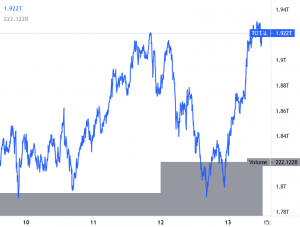
Bitcoin price found support near USD 43,800 and started a fresh increase. BTC surpassed the USD 45,500 and 46,000 resistance levels. It is currently (12:08 UTC) showing positive signs, but it must clear USD 46,700 for more gains.
Similarly, most major altcoins started a fresh increase after a short-term downside correction. ETH climbed back above the USD 3,150 and USD 3,200 resistance levels. XRP settled above USD 1.00 and it might test USD 1.08.
Total market capitalization
Bitcoin price
After a short-term downside correction, bitcoin price found support near USD 43,800. As a result, BTC started a fresh increase above the USD 45,000 resistance. It even broke the USD 46,000 resistance. The main resistance is still near the USD 46,500 and USD 46,700 levels, above which the price could rise further towards USD 48,000.
On the downside, an initial support is near USD 45,500. The first key support is now forming near the USD 45,000 level. Any more losses may possibly lead the price towards USD 43,800.
Ethereum price
Ethereum price remained well bid above the USD 3,000 support level. ETH started a fresh increase and it climbed above the USD 3,150 resistance. The bulls even pushed the price above USD 3,200. If the current trend remains intact, the price could rise towards the USD 3,350 level.
If there is a fresh decline, the bulls might remain active near the USD 3,150 level. The next major support is near USD 3,080, below which the price might revisit the USD 3,000 support.
ADA, LTC, DOGE, and XRP price
Cardano (ADA) outperformed bitcoin and ethereum, with a major move above the USD 2.00 resistance. It has also surpassed tether (USDT), becoming the third largest cryptoasset by market capitalization (USD 65bn). ADA gained almost 15% and it seems like it could test USD 2.10. The next major resistance is near USD 2.20, above which the price might test USD 2.40. On the downside, an initial support is near the USD 2.00 level, followed by USD 1.98.
Litecoin (LTC) is up almost 7% and it surpassed the USD 180 level. The current price action suggests the price could test the USD 192 resistance level. The main hurdle for the bulls on the upside is near the USD 200 level. If there is a downside correction, the USD 172 level may possibly act as a support.
Dogecoin (DOGE) was able to clear the USD 0.275 and USD 0.280 resistance levels. The price could even surpass the USD 0.288 resistance and accelerate higher towards the USD 0.300 level. Conversely, the price may possibly decline towards the USD 0.265 support level.
XRP price started a fresh increase after a short-term downside correction below USD 0.980. The price is back above USD 1.00 and it even tested the USD 1.05 resistance. The next major resistance is near USD 1.10, above which the price might rise towards the USD 1.20 level.
Other altcoins market today
Many altcoins are up over 5%, including QTUM, SNX, GRT, SUSHI, VGX, MKR, AVAX, WAVES, FTM, CHZ, XLM, DCR, SOL, and DGB. Out of these, QTUM rallied over 15% and it broke the USD 12.00 resistance.
To sum up, bitcoin price is back in a positive zone above USD 45,500 and USD 46,000. If BTC settles above USD 46,700, it could continue to rise in the coming sessions.
_____
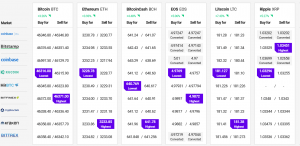
Find the best price to buy/sell cryptocurrency:
Source link

Japan’s sports club token craze has spilled over from the world of football and has made its debut on the basketball court – with a Yokohama-based team releasing Japanese professional basketball’s first-ever cryptoasset.
The franchise in question is the Yokohama B-Corsairs, and the move, once again, is being masterminded by the Financie platform. The latter has launched club tokens for an increasingly vast range of Japanese football clubs, including established professional teams in top flights and newer grassroots teams playing at amateur and semi-pro levels in the lower leagues.
The Corsairs’ token began retailing this week and will be made available in an initial sale event that lasts until September 23.
Crypto and blockchain technology are playing an increasingly large role in the world of Japanese sport, with club owners hopeful that industry 4.0-powered crowdfunding will help them raise funds while building a closer bond with their fans.
For token buyers, though, the crypto connection offers what issuers promise will be a new paradigm in fan support – finally handing some degree of control to supporters.
In a press release, the Corsairs and Financie claimed that the franchise would use the money raised “mainly for strengthening” the team and paying its “operating expenses.”
Fans, meanwhile, were promised voting rights in certain club-related matters. They will also be offered entry in special prize draws, access to special seating areas, and halftime events. The club will also offer token holders the chance to meet players and coaches.
In the world of football, Financie and a Yokohoma-based football club went a step further last month, offering token holders exclusive access to a specially organized friendly match with a league rival.
The club added that it was hopeful of using the funding boost to build up to new heights ahead of a major reform of the B.League (Japan’s three-tier basketball league) announced last month and slated for the 2026 season.
The next – and perhaps most significant – frontier for club tokens in Japan will undoubtedly be the world of professional baseball. The Japanese pro league, Nippon Professional Baseball, is the world’s biggest baseball league outside the United States, but is largely bankrolled by domestic conglomerates. And a club token launch here would unarguably prove to be a major coup for crypto advocates.
Financie this week announced that it had appointed its own founder and the head of of the major domestic blockchain player Gumi, Hironao Kunimitsu, as its new CEO.
____
Learn more:
- Messi Pockets Crypto in PSG Deal, Fan Token Payouts May ‘Incentivize’ Players
- China Hits out at Senators Who Asked for an Olympic Block on Digital Yuan
- Top Chess Players To Compete For USD 100K Worth Of Bitcoin
- Mexican Football Federation Shows League Club’s NFT Equity Sale Red Card
Source link

The market-leading South Korean crypto exchange Upbit has found itself involved in a series of legal struggles with the issuers of some of the tokens it delisted earlier this summer.
As previously reported, the nation’s biggest trading platforms went on a series of unexpected, late-night altcoin culls – with some analysts suggesting they have been trying to appease regulators with their zeal for removing questionable tokens.
But others suggest that they have been going overboard with their efforts – removing perfectly well-performing, above-board tokens along with projects exhibiting lower levels of activity. They claim that Upbit and its rivals have failed to sort the wheat from the chaff in their hurry to slim down their coin offerings.
The regulatory Financial Services Commission itself appeared to have been blindsided by the alacrity of the delistings.
Per KBS, Upbit has most recently found itself locking horns with the Pica Project, the operator of the pica token and a digital asset-powered art platform.
Pica was one of the tokens Upbit removed in a wider cull back in mid-June, giving investors just a week to remove their holdings from the trading platform.
The Pica Project immediately followed up the announcement by applying for an injunction against Dunamu, the Upbit operator. Pica had asked a branch of the Seoul District Court to order Upbit to suspend its decision to terminate support for its token.
But it appears that Upbit has won this battle, for the time being, ruling against the injunction request this week.
Dunamu was quoted as stating that the court had “recognized the need for policy to grant discretion to exchanges’ decisions to continue offering transaction support.”
The firm also noted that the court had ruled that it was “necessary to respect that” exchanges were free to use their own “judgment” in such matters unless “special circumstances” arose.
Dunamu has had to make regular visits to the Seoul District Court in recent weeks, with other token operators also attempting to lodge similar injunctions since June. The firm has also had to fight against an injunction request from the Go Money 2 token (GOM2) operator AnimalGo.
The rate of delistings has slowed somewhat since June, but investors have complained on web forums, stating that there is “no legal basis for delisting” and that many of the delistings were made in an “arbitrary” manner.
____
Learn more:
- Smaller South Korean Crypto Exchanges Begin to Shutdown, Suspend Services
- Crypto Exchange Korbit Charged for ‘Excessive Customer Data Collection’
- South Korean Customs Officers Close Net on ‘Kimchi Premium’ Offenders
Source link
Chilean Opposition Leader Owns Ethereum – But Is a Crypto-skeptic
Korean internet giant Kakao expands blockchain presence to Singapore
Elon Musk and Mark Cuban Say Dogecoin Is the ‘Strongest’ Crypto for Payments

Daily Farm Update | Token n Farm Launches | BSC & Polygon

How to Transfer Crypto From Binance to Trust Wallet (2021) | CryptoCurrency Tutorial

BTT (BITTORENT) SIAP NAIK !?? SETELAH EVENT 10 JUNI?? PREDIKSI DAN ANALISA BTT (BITTORENT) 2021 !!
-
 liquidity2 months ago
Daily Farm Update | Token n Farm Launches | BSC & Polygon
-
 Usecase2 months ago
How to Transfer Crypto From Binance to Trust Wallet (2021) | CryptoCurrency Tutorial
-
 Usecase2 months ago
BTT (BITTORENT) SIAP NAIK !?? SETELAH EVENT 10 JUNI?? PREDIKSI DAN ANALISA BTT (BITTORENT) 2021 !!
-

 Education2 months ago
Karan Dwivedi Zoom Meeting Crypto Bulls, ESPN Global, Master Nodes
-

 Blockchain4 weeks ago
SmartFi To Issue First Mineable Stablecoin & Payment System without Transaction Fees
-

 Usecase2 months ago
E-Oracle | Crypto Space Use Cases in Pipeline | Mr. Karn Dwivedi | Top Earners | Rahul_+917204321080
-
Bitcoin News4 weeks ago
A Warning From SEC Chair, Bitcoin Miners Go Public, Euro Tether + More News
-

 Usecase3 months ago
Next SAFEMOON | MARSMISSION Coin 100X ? Low Price Cryptocurrency 2021 | Best Profitable Crypto 2021