Altcoins
Flare Unveils Plan To Send 100,000,000,000 Spark Tokens to XRP Holders in Massive Airdrop

Flare Network’s much-anticipated airdrop to XRP holders appears to be set in stone, with a final plan for distribution confirmed.
Flare, which has planned for months to airdrop Spark (FLR) tokens to holders of XRP, is for the first time outlining how the distribution will happen.
Once the network goes live, Flare says that each eligible holder will immediately receive 15% of their claimable Spark tokens, and then claim an average of 3% per month, carrying on for a minimum of 25 months and a maximum of 34 months.
Flare says the slow rollout is designed to try and prevent excessive sell pressure or other negative effects on the Spark token.
“It has always been our stated position that the best people to provide capital to underpin the trustless issuance of FXRP on Flare are the people who own XRP. The only way to achieve this fairly is, in our opinion, the distribution of Spark that is taking place.
Rather than embracing Flare and Spark for the utility it creates, a certain percentage of people will wish to claim Spark only because they believe that it is ‘free money.’ To reduce the negative effects from this dynamic, the amount of liquidity that can be put into the market at any one time is therefore limited by the extended unlock process.”
Flare Networks and its native Spark token aim to essentially bring smart contract capabilities to various blockchain networks, starting with XRP and then Litecoin (LTC).
Flare previously said they would allow the community decide on how distribution should be done, but ultimately decided against it.
The previous decision to let the community decide on distribution was partially fueled by concerns over tax implications. Flare says anyone concerned about tax obligations can opt out of the 3% monthly distributions.
Don’t Miss a Beat – Subscribe to get crypto email alerts delivered directly to your inbox
Follow us on Twitter, Facebook and Telegram
Surf The Daily Hodl Mix

Disclaimer: Opinions expressed at The Daily Hodl are not investment advice. Investors should do their due diligence before making any high-risk investments in Bitcoin, cryptocurrency or digital assets. Please be advised that your transfers and trades are at your own risk, and any loses you may incur are your responsibility. The Daily Hodl does not recommend the buying or selling of any cryptocurrencies or digital assets, nor is The Daily Hodl an investment advisor. Please note that The Daily Hodl participates in affiliate marketing.
Featured Image: Shutterstock/Aron Alliston
Source link
The Ethereum network witnessed the deployment of its London upgrade on the Ropsten testnet on June 24. This upgrade consists of the highly anticipated Ethereum Improvement Proposal (EIP) 1559.
Following the launch on the Ropsten testnet, the London upgrade will be deployed on Ethereum’s Goerli, Rinkeby and Kovan testnets at weekly intervals. This is one of the important steps in the roadmap to implement a proof-of-stake (PoS) consensus on the Ethereum network, also known as Ethereum 2.0.
The London upgrade brings five EIPs that are going to be deployed on the testnets — EIP-1559, EIP-3198, EIP-3529, EIP-3541 and EIP-3554. The hotly debated EIP-1559 proposal is a transaction pricing mechanism that consists of a fixed per-block network fee that is burned and allows the dynamic expansion and contraction of block sizes to address the congestion issue.
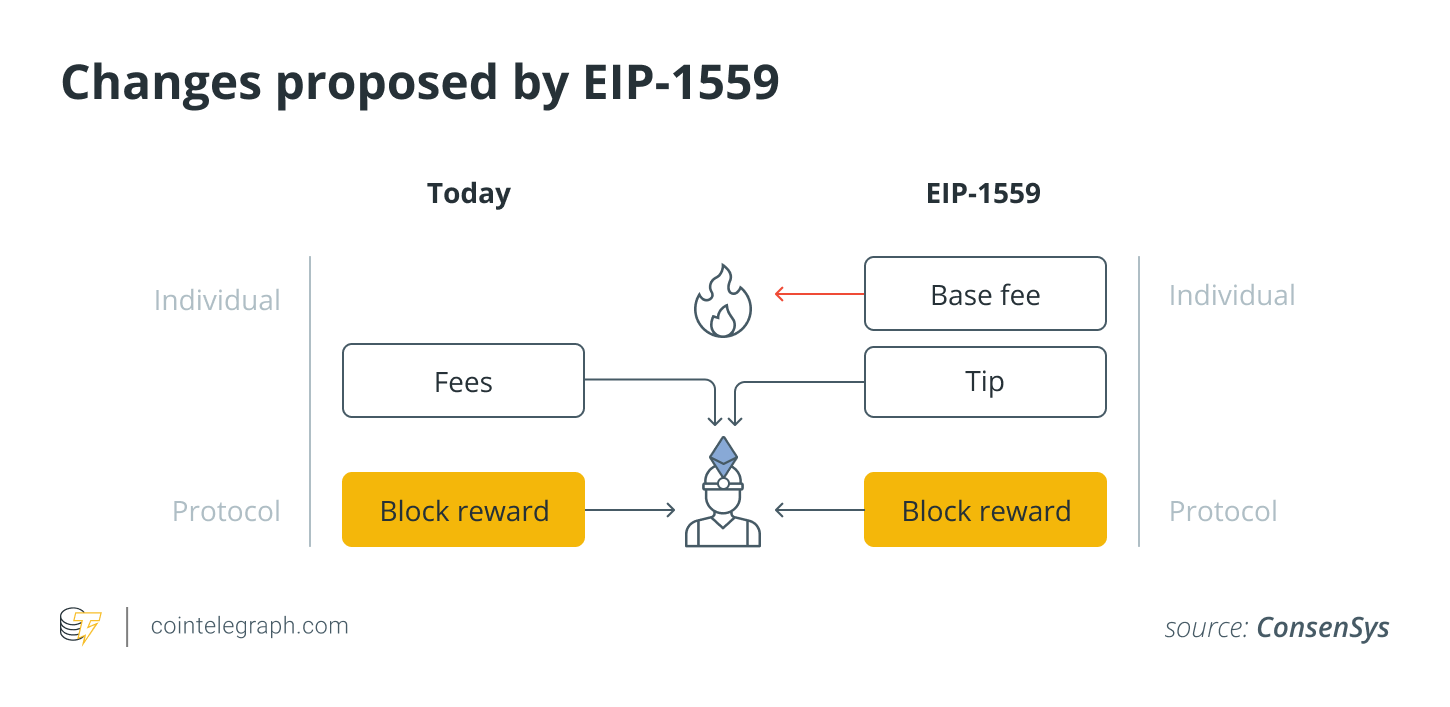
Through this mechanism, there will be a discrete base fee for transactions that will be included in the next block. For applications and users who want to prioritize their transactions on the network, a tip called “priority fee” can be added to incentivize the miner for faster inclusion. While the miner pockets this tip, the base fee for the transaction is burned. This entails that until the transition to a PoS model is complete, in addition to the 2 Ether (ETH) per block that miners receive, they would also be receiving the tip for prioritizing transactions.
James Beck, director of communications and content at ConsenSys — a blockchain technology company backing Ethereum’s infrastructure — discussed with Cointelegraph the impact of burning the base fees on the network:
“Burning the base fee should put a deflationary pressure on the issuance of ETH, though modeling exactly how deflationary is difficult since you have to project variables like expected transactions, and, even harder to predict, expected network congestion. In theory, the more transactions that occur, the more deflationary pressure that the burning of the base fee will have on the overall Ethereum supply.”
However, Marie Tatibouet, chief marketing officer of cryptocurrency exchange Gate.io, spoke to Cointelegraph about the possibility of this change to the transaction fees having an adverse effect on the network.
She noted that one can still tip miners and that the larger the tip, the faster the transaction will be processed, adding, “Now, as the network gets bigger and with Ethereum continuing to be the primary smart contract platform, will that not trigger another ‘fees war’ among the users who are willing to pay extra to speed up their transactions?”
Difficulty bomb delayed
Another crucial part of this upgrade that impacts day-to-day users is the EIP-3554. This EIP delays the “difficulty bomb” to come into effect from the first week of December 2021. In essence, the difficulty bomb going off would mean that mining a new block would become extremely unfeasible and hard for a miner, thus enforcing the transition to the PoS Beacon Chain.
Kosala Hemachandra, founder and CEO of MyEtherWallet — an Ethereum-based wallet platform — told Cointelegraph the EIP has been there since the inception of Ethereum in order to ensure that the network moves to a PoS and Eth2 on time. He further added:
“This value is responsible for making the block difficulty exponentially hard after a certain block number, thus making it impossible for miners to mine new blocks, and they have to move to Eth2 network. However, because of development delays, this time bomb kept getting delayed, and in the London fork, it’ll be postponed one last time.”
The official document for this EIP states that the network is “targeting for the Shanghai upgrade and/or the Merge to occur before December 2021.” However, it also goes on to add that the bomb can be readjusted at that time or be removed altogether, indicating that the first week of December is not a hard deadline for this bomb or the merge to finally occur and that it could be delayed even further from this point on.
Tatibouet also mentioned that until Ethereum 1.0 merges with the PoS Beacon Chain — a mechanism to coordinate shards and stakers on the network — transaction speed solutions built on top of the existing network, or layer-two solutions, seem to be the most viable option.
She went on to add, “Layer-one and layer-two solutions need not be exclusive from each other. This is the reason why Ethereum 2.0 is using a combination of layer-one (sharding, PoS) and layer-two (rollups) to achieve true scalability.”
Related: A London tour guide: What the EIP-1559 hard fork promises for Ethereum
Coincidentally, according to data from CryptoQuant, on the same day as the deployment of the upgrade on the Ropsten testnet, over 100,000 ETH was staked into the Eth2 deposit contract, which amounts to $210 million in notional value at the current ETH value of around $2,000. Such a high level of interest could be highly indicative of the anticipation that the Ethereum community has for this upgrade, especially due to the implications of the much-discussed EIP-1559.
Hemachandra also mentioned how this proposal supported layer-two solutions. He added, “EIP-1559 introduced dynamic block gas limit. In essence, now the number of transactions that can be included in a block can dynamically adjust based on the congestion.” He added further, “Therefore, it can reduce the congestion — this is another great solution on top of L2.”
Staking and aftermath of the “merge”
It’s important to note that after the additional 100,000 ETH was staked on the day of the deployment of the London upgrade on the testnet, the total proportion of ETH staked on the Beacon Chain surpassed 5% for the first time. The number of ETH staked currently stands at just over 6 million tokens with a value of $12.76 billion.
When compared to other PoS networks and coins, 5% of ETH staked isn’t a high proportion. For example, Cardano currently has nearly 72% of ADA staked on the network. However, there are a variety of reasons why this is the case. Hemachandra explained the core reason and why this is a positive indication for the network:
“Unlike most other PoS coins, the whole purpose of ETH is not just staking and earning interest. This is a good sign for ETH being used as a utility. For example, if 80% of ETH is staked, then there is only 20% of ETH left to do anything in Ethereum, and I don’t think this is an ideal scenario.”
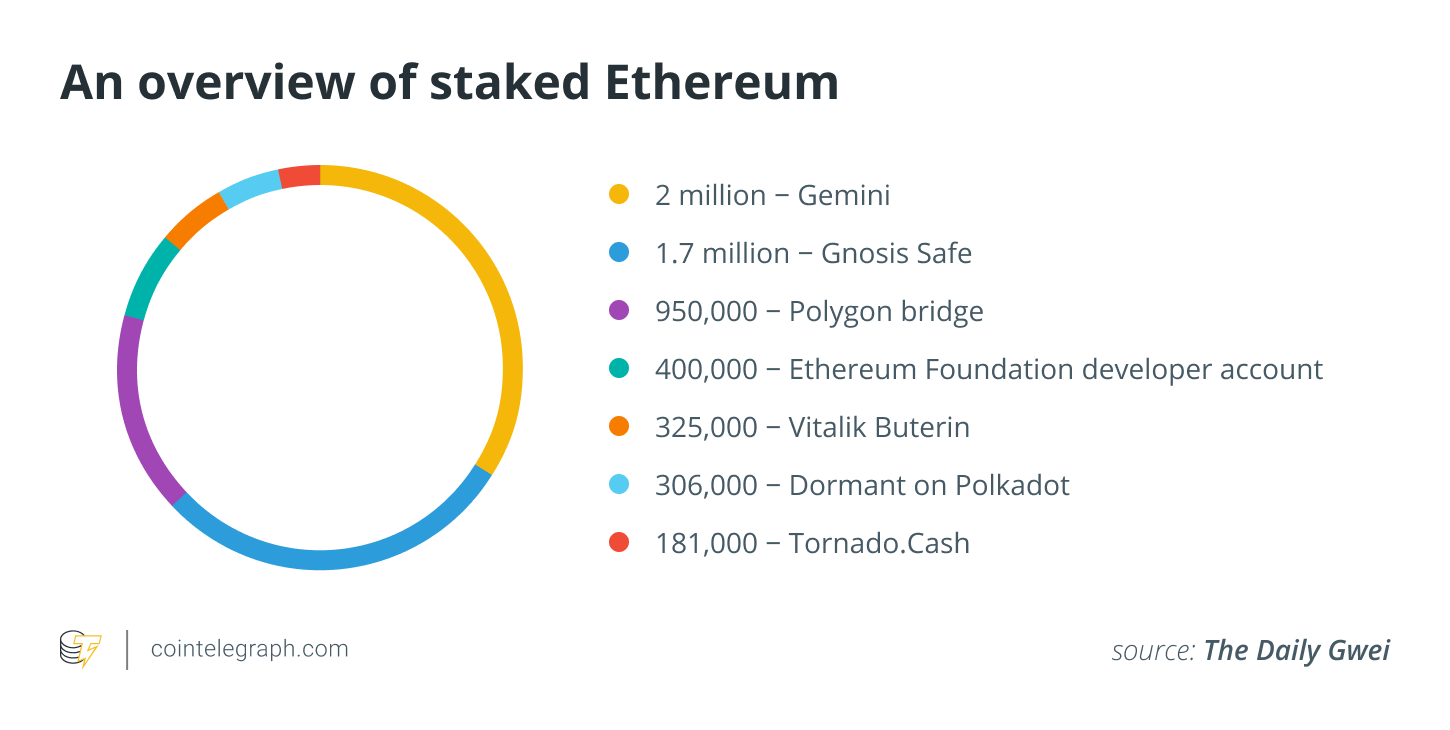
According to data from Anthony Sassano, co-founder of EthHub.io, 23% of all ETH mined is deposited in smart contracts. This proportion amounts to over 23.45 million ETH tokens valued almost at $50 billion. Out of the 23.45 million, over 6 million ETH is staked in the Eth2 deposit contract and 9 million ETH in various decentralized finance (DeFi) protocols, as the network is the one most widely used for DeFi.
The remaining ETH in smart contracts is split among various stakeholders such as Gemini, Gnosis Safe multi-sig wallet, Polygon Bridge and Vitalik Buterin’s cold wallet among others.
In the aftermath of “the merge,” which will combine both Ethereum 1.0 and Ethereum 2.0, marking the end of Ethereum’s proof-of-work consensus mechanism, ETH miners will be faced with a tough choice.
As their mining hardware becomes obsolete, they must either sell their rigs and move to staking ETH or — at least for miners using GPUs — move to other altcoins.
An analysis by Justin Drake of the Ethereum Foundation estimates there will be 1,000 ETH issued every day, and 6,000 ETH will be burned to make ETH a more deflationary asset.
His analysis further found that assuming the increase of validators and a staking annual percentage rate of 6.7%, the annual supply change would amount to a negative 1.6 million ETH, thus decreasing the annual supply rate by 1.4%.
This transition would make ETH a deflationary asset, with the supply rate shrinking as time passes on, putting upward pressure on the supply-demand dynamic that would dictate its price in the market.
Source link
Altcoins
Top Trader Says This Group of Altcoins Poised To ‘Massively Thrive’ in Next Bitcoin and Crypto Bull Run
A popular crypto analyst believes a specific set of altcoins could steal the show in a renewed crypto bull run.
The pseudonymous trader, known in the industry as Altcoin Psycho, tells his 278,000 Twitter followers that crypto projects connected to the interoperable blockchain network Cosmos (ATOM) are poised to outperform the market.
“Prediction: Cosmos ecosystem will massively thrive in the next alt run. Tendermint making aggressive moves in this shit market is big.
In my opinion, most alts go lower first, but I think an eventual THORChain (RUNE) run will violently drag up Cosmos projects like Persistence (XPRT), Akash (AKT) and DVPN (Sentinel).”
Other projects in the Cosmos network include the decentralized derivatives platform Injective Protocol (INJ), decentralized finance (DeFi) liquidity project Kira Network (KIRA) and omni-chain decentralized exchange (DEX) Sifchain (EROWAN).
As for the economy at large, the trader is making made another bold prediction, suggesting many asset bubbles will burst by next year.
“In my opinion, in the next 6-12 months, we’ll see people who claim fiat is worthless get burned hard.
Every sub-asset class is in a mini bubble. Look at lumber, real estate, used cars, startup valuations… all bubbles. Having sidelined cash may give a generational opportunity soon.”
Don’t Miss a Beat – Subscribe to get crypto email alerts delivered directly to your inbox
Follow us on Twitter, Facebook and Telegram
Surf The Daily Hodl Mix
Disclaimer: Opinions expressed at The Daily Hodl are not investment advice. Investors should do their due diligence before making any high-risk investments in Bitcoin, cryptocurrency or digital assets. Please be advised that your transfers and trades are at your own risk, and any loses you may incur are your responsibility. The Daily Hodl does not recommend the buying or selling of any cryptocurrencies or digital assets, nor is The Daily Hodl an investment advisor. Please note that The Daily Hodl participates in affiliate marketing.
Featured Image: Shutterstock/Zita/REDPIXEL.PL
Source link
Altcoins
Analyst Says Crypto Traders Are Sleeping on One Altcoin As ‘Final Leg’ of Bull Run Approaches
Popular trader Credible Crypto thinks one large-cap altcoin that some are counting out could see new all-time highs in the coming months.
The pseudonymous analyst tells his 222,000 Twitter followers that Litecoin (LTC) could capitalize on the final “legendary” leg of the current bull run.
“Seeing a lot of people saying LTC had its ‘bull run’ and it’s headed to the grave.
I don’t trade fractals, but I do think we will see something similar to what we saw in 2017 on the left. Not just for LTC but for much of the ‘old guard.’ Still think new ATH is on the cards.”
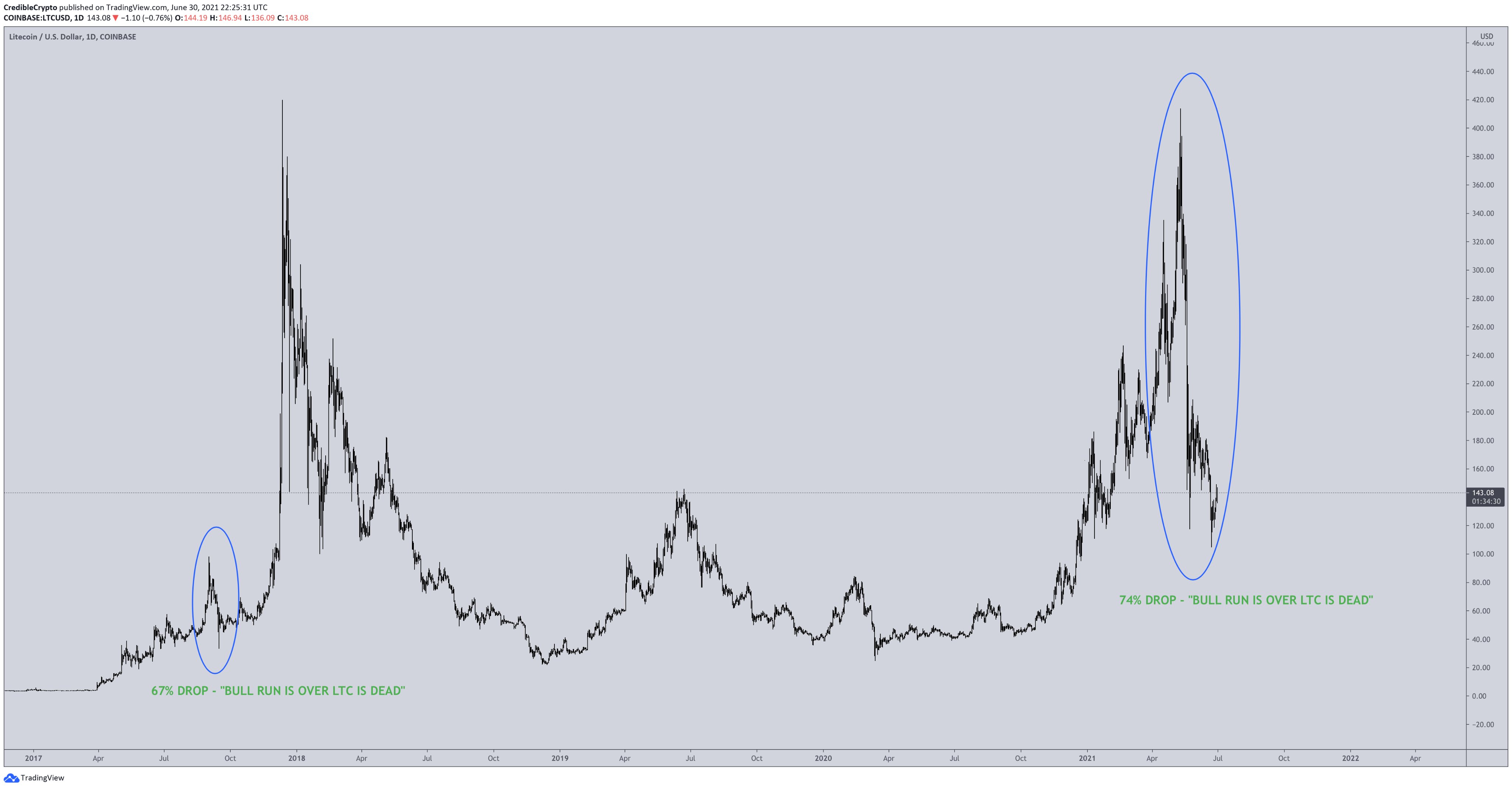
As for the timing of his prediction, he thinks the final rally will begin “after some months” of consolidation have passed.
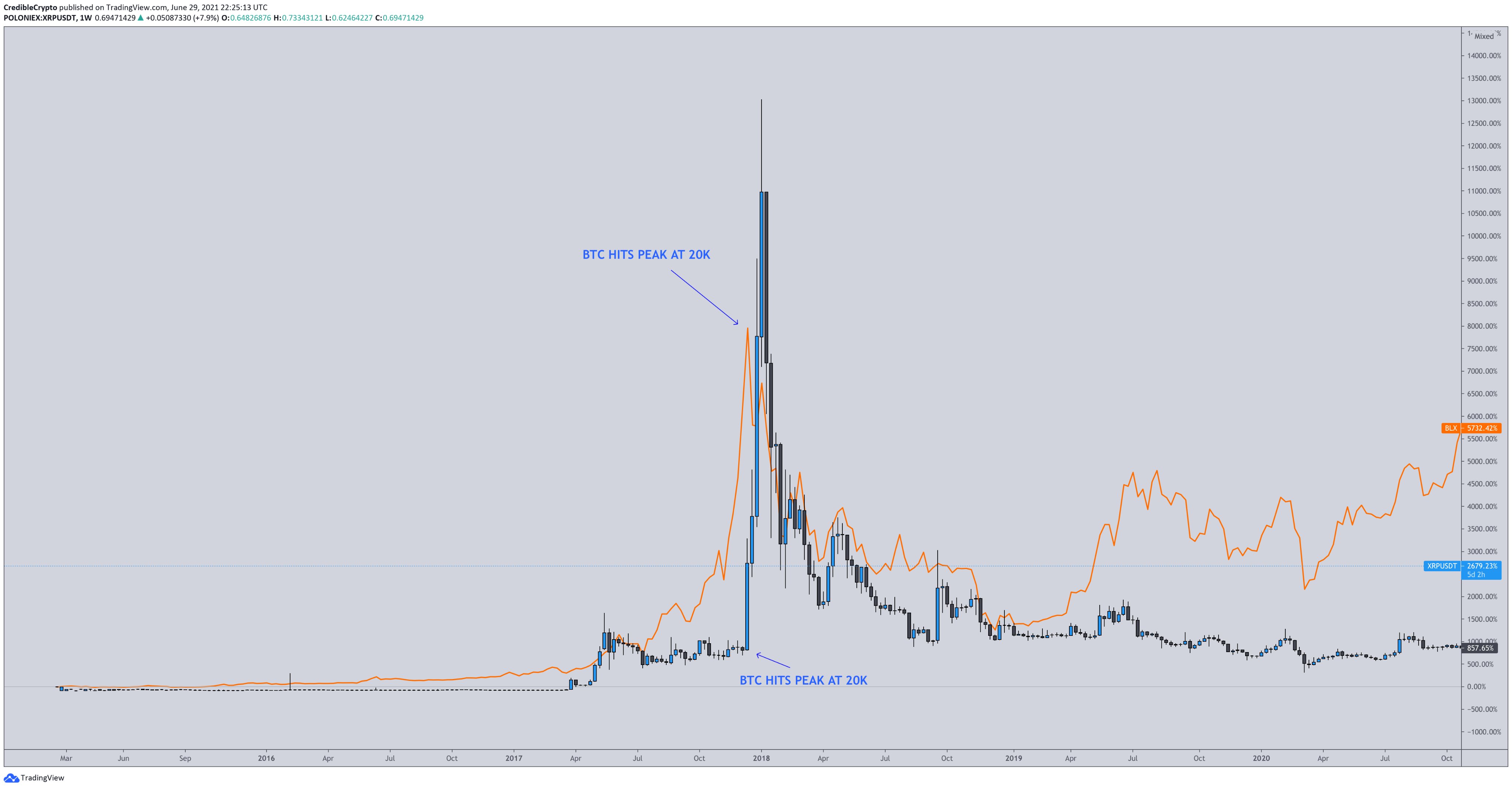
Credible Crypto also thinks Bitcoin Cash (BCH) could see all-time highs. And he warns traders not to count out XRP.
“XRP was also one of the worst-performing majors in 2017, until it wasn’t. In the 30 days following BTC’s peak, XRP rallied over 10x bringing total gains for its cycle to 62,947% or 629x. Don’t count it out simply because it has had a slow start.”
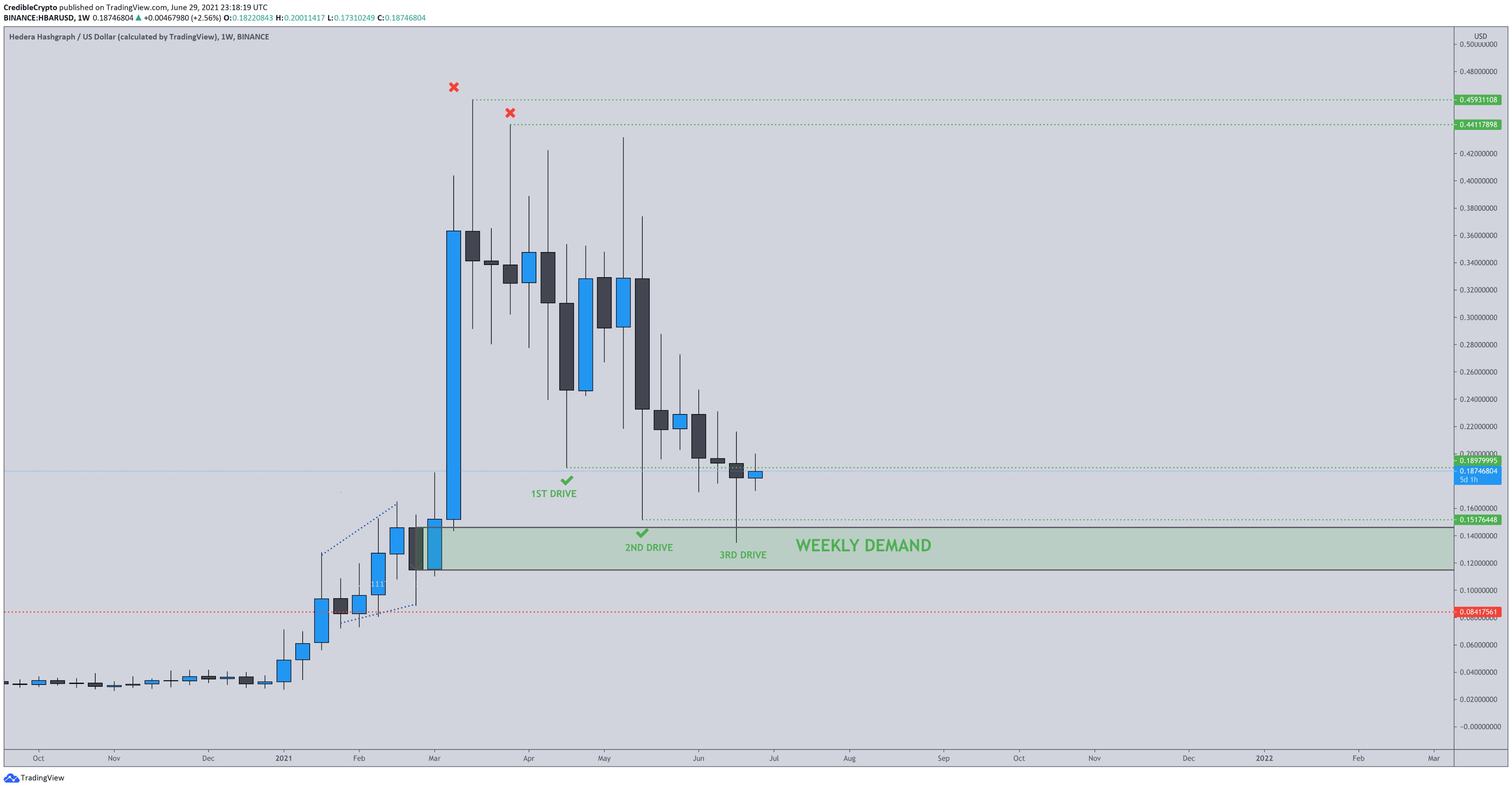
Additionally, the analyst says the market is pushing into a key area of demand for the decentralized public network Hedera Hashgraph (HBAR).
“Did not think we were going to get a 3rd chance to buy at these levels but the market felt kind.
Note that each successive drive down is aggressively bought up indicating seller absorption as we push into a key HTF area of demand. Buyers are stepping in here, repeatedly.”
Credible Crypto predicts that Bitcoin (BTC) will move towards $45-55,000 if it can break $35-38,000. If it goes higher, he plans to short it.
“If we can get to 55k I’ll look to hedge short. I know if we manage to get there many will be euphoric- calling for new ATH when in reality that region is the most likely place to see a mid-term rejection. Have a plan.”
Don’t Miss a Beat – Subscribe to get crypto email alerts delivered directly to your inbox
Follow us on Twitter, Facebook and Telegram
Surf The Daily Hodl Mix
Disclaimer: Opinions expressed at The Daily Hodl are not investment advice. Investors should do their due diligence before making any high-risk investments in Bitcoin, cryptocurrency or digital assets. Please be advised that your transfers and trades are at your own risk, and any loses you may incur are your responsibility. The Daily Hodl does not recommend the buying or selling of any cryptocurrencies or digital assets, nor is The Daily Hodl an investment advisor. Please note that The Daily Hodl participates in affiliate marketing.
Featured Image: Shutterstock/Wlad74
Source link
Bitcoin Greener Than Any Country or Industry Says Survey – Trustnodes
Types of orders in crypto trading. Bitcoin,XRP,ADA,DOGE,Ethereum,BNB
Bitcoin to $100k in 100 Days! BTC & Crypto [w/ Voyager CEO] [Episode 20]

Here Are the 10 Altcoins To Watch in April As Risk Tolerance Swells in Crypto, Says Trader Luke Martin

How To Invest In Crypto Full Beginners Guide in 2021

BTT (BITTORENT) SIAP NAIK !?? SETELAH EVENT 10 JUNI?? PREDIKSI DAN ANALISA BTT (BITTORENT) 2021 !!
-
 Altcoins3 months ago
Here Are the 10 Altcoins To Watch in April As Risk Tolerance Swells in Crypto, Says Trader Luke Martin
-
 Education3 months ago
How To Invest In Crypto Full Beginners Guide in 2021
-
 Usecase4 weeks ago
BTT (BITTORENT) SIAP NAIK !?? SETELAH EVENT 10 JUNI?? PREDIKSI DAN ANALISA BTT (BITTORENT) 2021 !!
-

 Education3 months ago
CRYPTO EDUCATION: A beginners guide for accountants and IFAs
-
 Education3 months ago
Bitcoin: How Cryptocurrencies Work
-
 liquidity3 months ago
Unistake - The Big Reveal | The Importance of Liquidity for Cryptocurrency
-

 Usecase4 weeks ago
How to Transfer Crypto From Binance to Trust Wallet (2021) | CryptoCurrency Tutorial
-
 Technology3 months ago
Blockchain technology ante enti ? What is Blockchain ? Telugu Version