
Bitcoin
Bitcoin Layer 2 Foundations Should Buy Bitcoin For Their Treasuries



I’ve been thinking about this a lot lately: Bitcoin Layer 2 foundations need to start holding bitcoin in their treasuries. It makes too much sense for them not to.
And apparently I’m not the only one.
As someone who’s watched this space evolve, let me explain why Bitcoin Layer 2 foundations should listen to Molly and I.
For years, bitcoin was known as “digital rock”—a solid store of value but not much else. But now with the explosion of Bitcoin Layer 2s, bitcoin is becoming a “programmable rock.” These layers are adding functionalities like smart contracts and scaling solutions, making bitcoin more versatile than ever.
But here’s the thing: these projects raise millions of dollars from VCs and investors, and most of that money ends up sitting in fiat currencies like USD. That’s a huge mistake.
Why? Because fiat is a melting ice cube. Every year, it loses 5-10% of its value due to inflation. The longer you hold it, the less it’s worth. On the other hand, bitcoin has a Compound Annual Growth Rate (CAGR) of around 70%. If these foundations held their treasury in bitcoin instead of fiat, their runway wouldn’t just stay the same—it would grow.
Imagine having 70% more resources each year to fund developers, grants, and projects. That’s the kind of edge that could make or break a Layer 2 ecosystem.
Okay, okay, I get it — Bitcoin is volatile, and these foundations need some stability. Because of this, keeping 3 to 4 years of runway in fiat makes sense. It would help to cover short-term needs. But the rest? It should be in bitcoin. Over the long run, this strategy could double or even triple the runway of these foundations, giving them the time and resources they need to succeed.
There’s a precedent for this too. Remember EOS? They raised $4.2 billion in 2018 and reportedly bought 164,000 bitcoin with it. Today, that bitcoin is worth around $16 billion—even though EOS itself fell off the map. Now, imagine if Bitcoin Layer 2 foundations did the same but actually used their bitcoin to grow and sustain their ecosystem. The potential is massive.
At the end of the day, these foundations are building on Bitcoin. They believe in its future, so why not hold it in their treasuries? Bitcoin is the best store of value out there. If you’re running a Bitcoin Layer 2 foundation, stop holding depreciating fiat, and start holding bitcoin. It’s not just a smart move—it’s the move.
This article is a Take. Opinions expressed are entirely the author’s and do not necessarily reflect those of BTC Inc or Bitcoin Magazine.
Source link








Bitcoin (BTC) has recently reached a new weekly high above the $112,000 mark, signaling a potential new uptrend for the leading cryptocurrency. This movement may represent the final phase of the current cycle for Bitcoin and the broader cryptocurrency market.
Market analyst CryptoBirb has indicated that this uptrend could last for approximately 50 more days, emphasizing that Bitcoin is now 95% through its cycle, which has spanned 1,017 days since the lows of November 2022.
50 Days Until Possible Bitcoin Peak
Historically, Bitcoin’s bull markets have peaked between 1,060 and 1,100 days after significant lows, suggesting a target timeframe for this cycle’s peak could fall between late October and mid-November 2025.
The analysis highlights the typical relationship between Bitcoin’s Halving events and subsequent price peaks. Since the last Halving in April 2024, 503 days have passed, with past data showing that price peaks usually occur 518 to 580 days following such events.
Related Reading
As seen in the chart below, Bitcoin is currently 77% to 86% of the way through this timeline, entering what the analyst refers to as the “hot zone”—a period of heightened volatility and potential price movements.
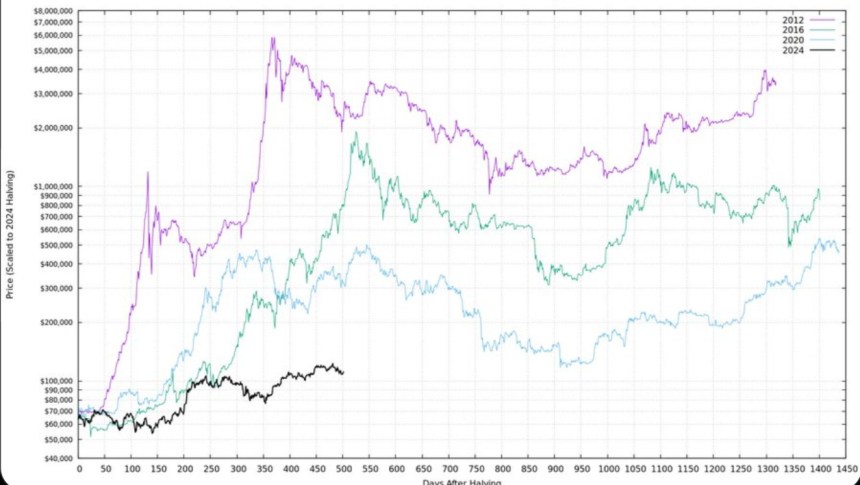
However, CryptoBirb cautions that historical trends indicate that after reaching a peak, Bitcoin typically experiences a significant decline, often dropping by 70% to 80% over a 370 to 410-day timeframe.
This bearish phase is projected for approximately the first and second quarter of 2026, with a historical probability of a bear market in that year reaching 100%. Before this potential downturn, the analyst expects a final surge, with about 50 days remaining before the market may peak.
September, often recognized as a weaker month for Bitcoin, has shown an average decline of 6.17%. Although third quarter statistics can be mixed, with a median increase of 0.80%, the overall average tends to reflect a decline due to larger losses.
The typical seasonal pattern suggests that a poor September could be followed by stronger performance in October and November, with September 17 identified as a crucial date to watch by the analyst.
Critical Support And Resistance Levels
On the technical front, Key support levels are identified at the 50-week simple moving average (SMA) of $95,900 and the 200-week SMA at $52,300.
The daily chart reveals further technical insights, including a 200-day breakout point at $111,000 and a 200-day SMA at $101,000. CryptoBirb has identified local support between $107,700 and $108,700, while resistance sits at $113,000 to $114,100.
Related Reading
Looking ahead, both short-term and long-term trading trailers are currently in a bearish mode. CryptoBirb asserts that if Bitcoin falls below the critical levels of $107,000 to $108,000, bearish sentiment could intensify, potentially leading to secondary corrections in the range of 20% to 30%.
Fortunately, cryptocurrency miners appear to be faring well, with the mining cost established at $95,400, suggesting a healthy market environment with minimal capitulation risk.
Lastly, the analyst cautions against the potential for a market peak leading into the altcoin season in October and November. CryptoBirb suggests to mark calendars for October 22, as it could be a pivotal date in Bitcoin’s cycle.
As of this writing, Bitcoin trades at $112,886, down nearly 11% from all-time high levels.
Featured image from DALL-E, chart from TradingView.com
Source link


MARA Holdings (MARA) reported that its bitcoin holdings climbed to 52,477 BTC as of Aug. 31, after the crypto mining company produced 705 BTC during the month.
The company mined 208 blocks, maintaining a 4.9% share of network rewards. Energized hashrate rose 1% month-over-month to 59.4 exahashes per second (EH/s). MARA opted not to sell any BTC in August, with management noting that the price decline provided an opportunity to grow reserves.
The largest cryptocurrency fell more than 6% in August, the worst performance since February.
“Given the decline in bitcoin price during the month, we took the opportunity to strategically add to our treasury and currently hold over 52,000 BTC,” said CEO Fred Thiel.
MARA remains on track to complete its Texas wind farm buildout by the fourth quarter, with all miners on-site and connected. Internationally, the company signed an agreement to buy a 64% stake in Exaion, a subsidiary of EDF, with the option to increase to 75% by 2027. The deal aims to integrate MARA’s infrastructure with AI and edge solutions.
MARA also opened its European headquarters in Paris, reinforcing its focus on sustainability, grid partnerships and the repurposing of unused energy.
MARA shares fell 5% on Thursday and are down 14% year to date.
Source link

Trump-Tied Thumzup Raises $50M, Merges Dogecoin Mining With XRP Plans

Tokenizing Car Reservations Can Open Up A Trillion-Dollar Market

Public Keys: Big ETH Stakes, AI Boost for Bitcoin Miners and 24/7 Trading

Chart of the week: M, IP, PUMP, SKY, POL altcoins could extend double-digit rallies

If They Can Do it to Sun, Who’s Next?’ Say Insiders as WLFI Claims Freeze Was to ‘Protect Users’

Analyst Eyes $127 as BlackRock Joins Ripple

Cycle Peak Indicates 95% Completion

Senate Crypto Bill Clarifies Tokenized Stocks Remain Securities

Solana Treasury Company SOL Strategies to Begin Trading on Nasdaq

SEC announces cross-border task force to combat fraud

Cardano’s Bearish Retail Crowd Hands Whales a Buying Window

Michael Saylor’s Strategy Fails To Make S&P 500 Listing

Africa Becomes Ripple’s Next Battleground For RLUSD Stablecoin

Bitcoin Unlikely To Reach Price Peak In Q4 2025: Analyst
Robinhood Set to Join S&P 500 as Bitcoin Giant Strategy Misses Out

Pi Network coin to $10? 4 catalysts that may make it possible

Arthur Hayes, Murad’s Prediction For Meme Coins, AI & DeFi Coins For 2025

3 Voting Polls Show Why Ripple’s XRP Price Could Hit $10 Soon

Expert Sees Bitcoin Dipping To $50K While Bullish Signs Persist

Aptos Leverages Chainlink To Enhance Scalability and Data Access

Bitcoin Could Rally to $80,000 on the Eve of US Elections

The Future of Bitcoin: Scaling, Institutional Adoption, and Strategic Reserves with Rich Rines

Institutional Investors Go All In on Crypto as 57% Plan to Boost Allocations as Bull Run Heats Up, Sygnum Survey Reveals

Sonic Now ‘Golden Standard’ of Layer-2s After Scaling Transactions to 16,000+ per Second, Says Andre Cronje

Crypto’s Big Trump Gamble Is Risky

Has The Bitcoin Price Already Peaked?

Ripple-SEC Case Ends, But These 3 Rivals Could Jump 500x

A16z-backed Espresso announces mainnet launch of core product

I’m Grateful for Trump’s Embrace of Bitcoin

Is A Bitcoin Supercycle Imminent?
 Markets6 months ago
Pi Network coin to $10? 4 catalysts that may make it possible
 24/7 Cryptocurrency News10 months ago
Arthur Hayes, Murad’s Prediction For Meme Coins, AI & DeFi Coins For 2025
 Ripple Price6 months ago
3 Voting Polls Show Why Ripple’s XRP Price Could Hit $10 Soon
 Bitcoin8 months ago
Expert Sees Bitcoin Dipping To $50K While Bullish Signs Persist
 24/7 Cryptocurrency News8 months ago
Aptos Leverages Chainlink To Enhance Scalability and Data Access
 Bitcoin10 months ago
Bitcoin Could Rally to $80,000 on the Eve of US Elections
 Bitcoin7 months ago
The Future of Bitcoin: Scaling, Institutional Adoption, and Strategic Reserves with Rich Rines
 Bitcoin10 months ago
Institutional Investors Go All In on Crypto as 57% Plan to Boost Allocations as Bull Run Heats Up, Sygnum Survey Reveals