
Bitcoin
Fed Minutes Confirm QT Is Ending

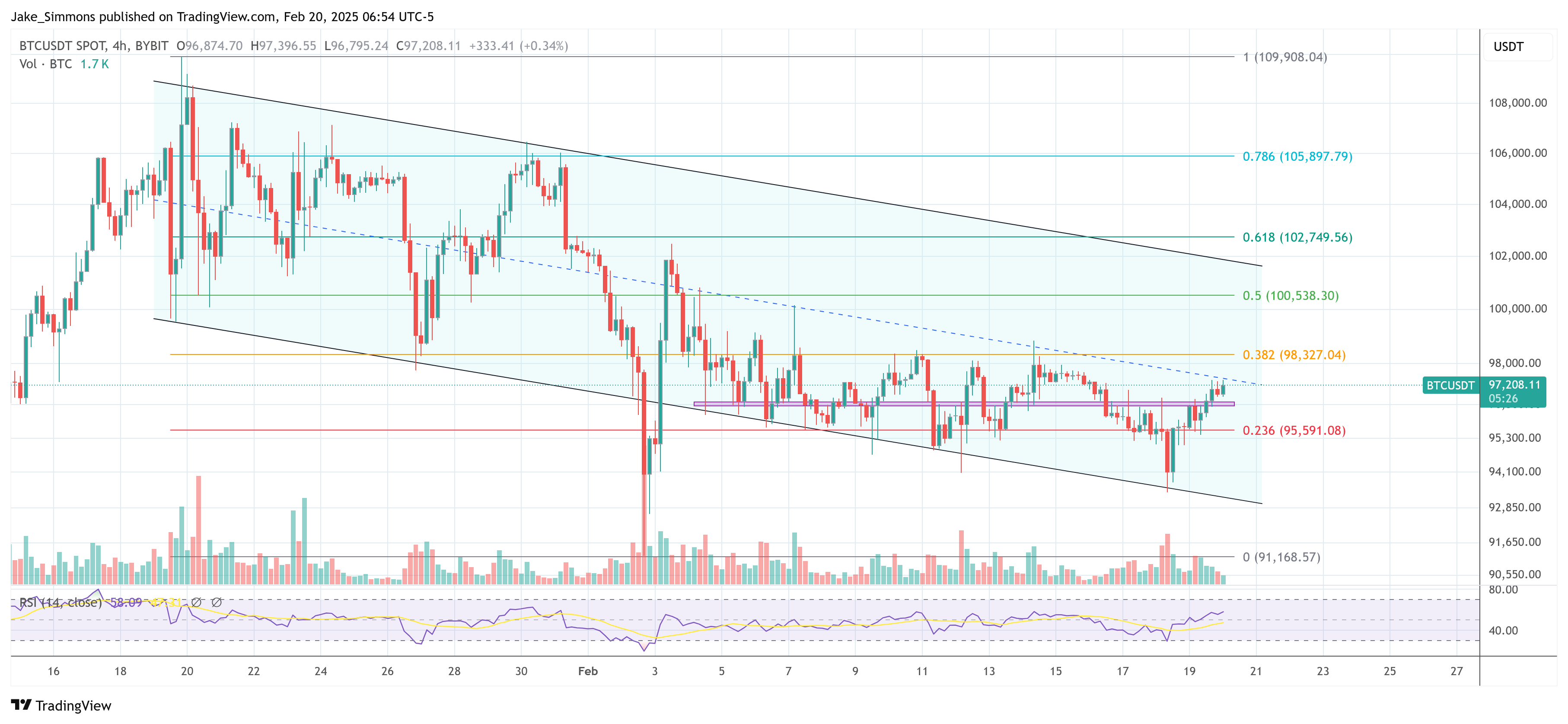
On Tuesday, February 19, the Federal Reserve released their meeting minutes, revealing that central bankers are considering an end—or at least a significant slowdown—to quantitative tightening (QT). The document states: “Several participants suggest halting or slowing balance sheet reduction pending debt ceiling resolution.”
These remarks have fueled optimism among Bitcoin experts who view the potential end of QT as a bullish signal. Many see it as a precursor to greater liquidity entering financial markets, a condition that has historically benefited risk assets like cryptocurrencies.
The newly published minutes confirm that certain Fed officials are worried about the interaction between ongoing balance sheet reduction and the looming debt ceiling debate. The possibility of large-scale US Treasury issuance once the debt ceiling is resolved appears to be a key driver behind calls to pause or halt QT.
Related Reading
No explicit shift to quantitative easing (QE) was announced, but the acknowledgment that balance sheet reduction might be curtailed has been enough to stoke speculation in digital asset circles. The minutes must be unanimously approved by the Federal Open Market Committee (FOMC), further suggesting an intentional message from policymakers.
Implications For Bitcoin
Renowned market commentator and host of the On the Margin podcast, Felix Jauvin, took to X to emphasize the significance of the Fed’s signaling, writing: “There it is, QT coming to an end this spring. Reminder that every FOMC member has to unanimously approve these minutes, this is intentional.”
While Jauvin underscores the unanimity behind these minutes, he stops short of predicting an immediate shift toward QE. Instead, he points to a specific chain of events that the Fed seems to be navigating.
The Fed has already reduced the pace of balance sheet runoff by half compared to its initial rate. Jauvin also notes that as the reverse repo facility (RRP) nears zero and the Fed reaches its target reserve level of roughly 3% of GDP, an end to QT becomes more likely.
Related Reading
Moreover, concerns loom over the Treasury General Account (TGA) potentially being rebuilt once the debt ceiling is resolved, leading to sizable bill issuance which could lead to interim disruptions in funding markets.
Therefore, rather than pivot to QE, Jauvin believes the Fed could pursue a temporary Supplementary Leverage Ratio (SLR) exemption, allowing commercial banks to absorb additional government debt. “They are very very very very far from any sort of formal QE. Instead, it’s more likely they pursue an SLR exemption allowing commercial banks to be the marginal buyer of debt,” Jauvin predicts.
A formal return to QE, Jauvin concludes, would only materialize if financial and economic conditions deteriorate significantly, including a major collapse in risk assets and a drop in rates to near zero. In response to an X user asking if ending QT is bullish without necessarily indicating an immediate move to QE, Jauvin offered a succinct explanation:
“Therefore think for the current liquidity backdrop it is marginally improving in that we will have the possible sequence of TGA drawdown into QT ending into potentially SLR exemption, and that’ll be it for now. QE shouldn’t even be in the current vocabulary of discourse as it stands.”
Renowned crypto analyst Pentoshi agrees, highlighting a previously published forecast: “QT coming to an end… My guess, QT ends by start of Q3. With all that’s taking place currently Trump will likely end up forcing it. Was correct on QT guess in Nov 21. Let’s see.”
He cited how the conclusion of quantitative easing in late 2021 coincided with the end of the crypto bull run. Now, market watchers are keenly observing whether the inverse—a potential termination of QT—could spark renewed momentum for Bitcoin and other digital assets.
At press time, BTC traded at $97,208.
Featured image created with DALL.E, chart from TradingView.com
Source link






Bitcoin
Bitcoin Primed To Crash Lower Before a ‘Violent and Glorious Bounce,’ Says Crypto Analyst – Here Are His Targets

A widely followed cryptocurrency analyst and trader is leaning bullish on Bitcoin (BTC).
The analyst pseudonymously known as Kaleo tells his 687,400 followers on the social media platform X that Bitcoin is on the cusp of a bull season but could first go lower from the current level.
Based on the analyst’s chart, it appears he’s suggesting that Bitcoin could fall to under $82,000 before rallying to above $120,000.
“Sweep into the $80,000s is going to feel like the bottom rings of hell for altcoins after what they’ve already been through, but the bounce back across the board should be violent and glorious when it’s all over.”
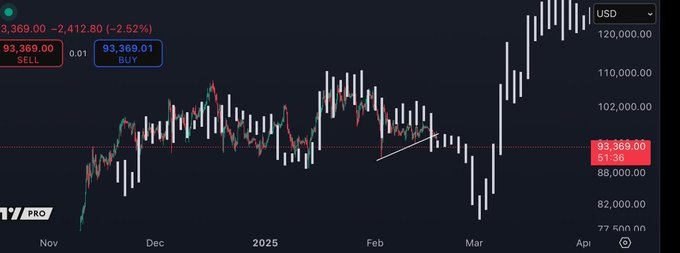
Bitcoin is trading at $96,310 at time of writing.
The pseudonymous analyst also offers his outlook on the Polkadot/Bitcoin pair. According to Kaleo, Polkadot (DOT) is poised to go “up only from here” after a strong bounce at a major support level.
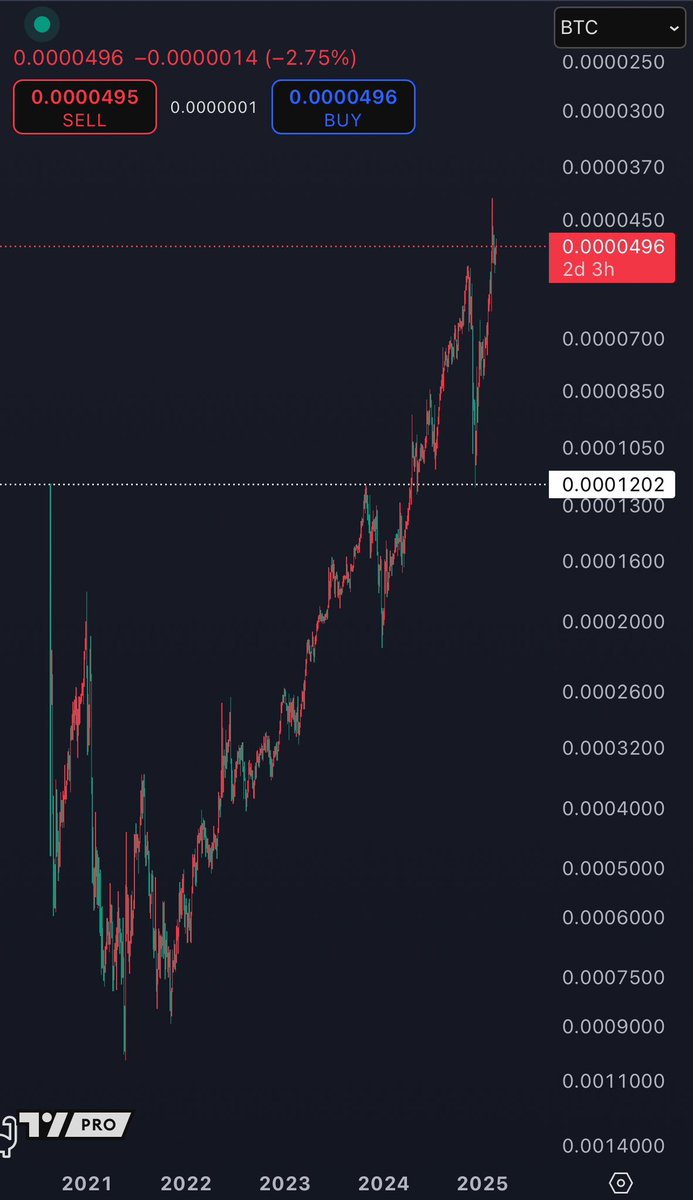
Polkadot is trading at 0.00005 BTC ($4.81) at time of writing.
On altcoins, the widely followed analyst says he believes the “heart of the bull market” is yet to be experienced.
“Entering into the most frictionless regulatory period the crypto market has seen in years, combined with the MOST support it has seen from the highest levels of the government, I have a very hard time believing that we don’t see significant growth in the altcoin sector outside of just memecoins.
The next leg up of the cycle will definitely have some madness in memecoins and non-fungible tokens (NFTs), but I really believe we’ll see a return to the roots of real tech and real products advancing adoption in this space.”
Don’t Miss a Beat – Subscribe to get email alerts delivered directly to your inbox
Check Price Action
Follow us on X, Facebook and Telegram
Surf The Daily Hodl Mix

Disclaimer: Opinions expressed at The Daily Hodl are not investment advice. Investors should do their due diligence before making any high-risk investments in Bitcoin, cryptocurrency or digital assets. Please be advised that your transfers and trades are at your own risk, and any losses you may incur are your responsibility. The Daily Hodl does not recommend the buying or selling of any cryptocurrencies or digital assets, nor is The Daily Hodl an investment advisor. Please note that The Daily Hodl participates in affiliate marketing.
Generated Image: Midjourney
Source link

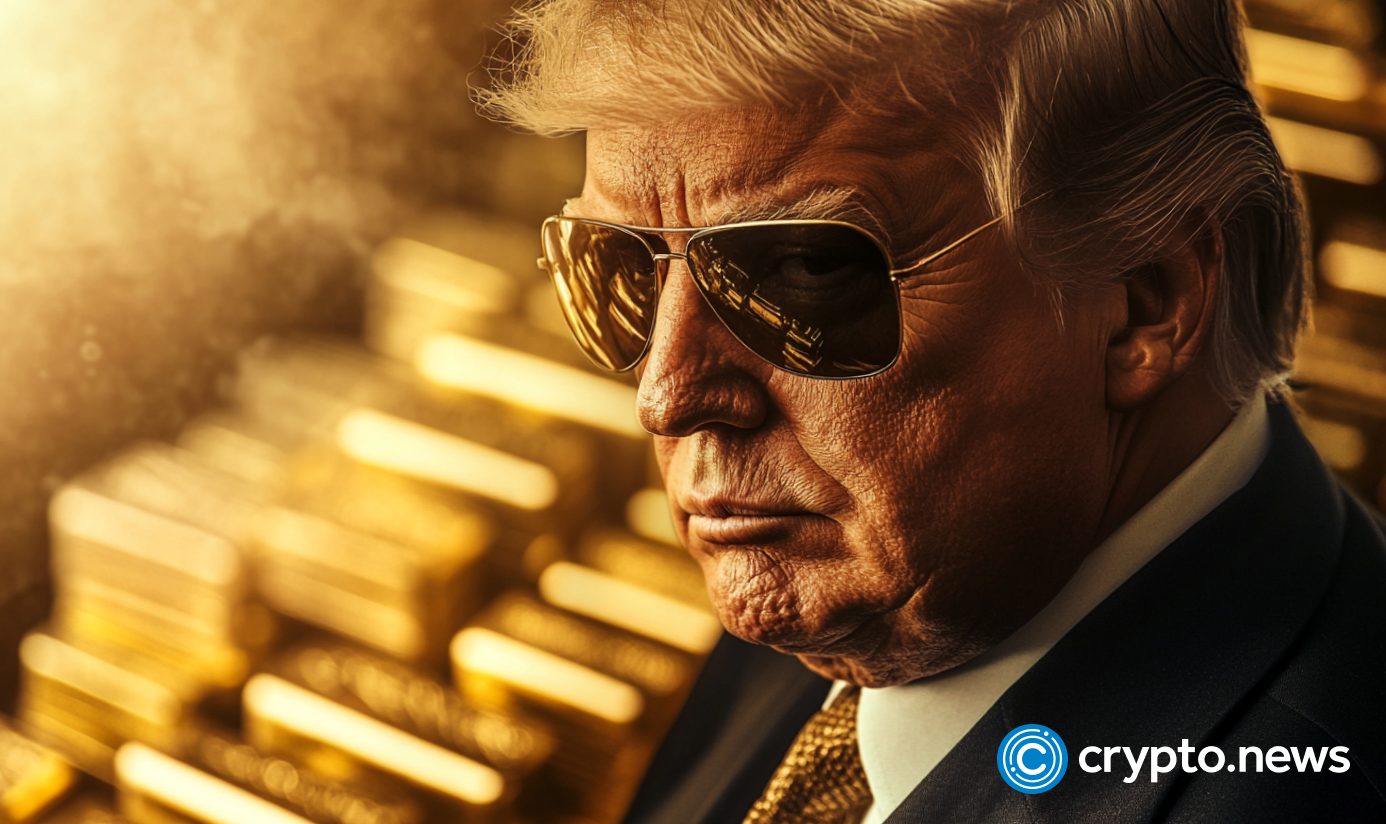
Elon Musk raised concerns about whether Fort Knox is still holding $425 billion worth of gold. The posts reignited an old conspiracy theory about gone gold and sparked discussion about the advantages of Bitcoin. Donald Trump said he will audit “the fabled Fort Knox.”
As a head of the Department of Government Efficiency Musk has been busy scrutinizing the government institutions lately. Fort Knox was another target for his daring eyes as Musk published an X post saying that “it would be cool to do a live video walkthrough of Fort Knox.”
Sen. Mike Lee fueled the discussion when he replied to Musk that despite being a senator, he was denied access to Fort Knox on multiple occasions without a proper cause. Musk replied that the American public was the true owner of gold stored in Fort Knox and asked if someone could confirm the gold was there.
The discussion continued with many expressing support for the idea of a public audit of the biggest gold reserve in the U.S. The Fort Knox reserve holds 147 troy ounces of gold, more than any other storage in the country.
Missing Fort Knox gold is an old conspiracy theory, infused by the extremely low level of the reserve’s transparency. It is hard to enter this storage even by the military base standards.
The inability to make sure gold is present in the depository raises questions about accountability and transparency standards revision.
Does Fort Knox undergo regular audits?
Regular audits take place. The U.S. government issues monthly reports that specify the amount of gold stored in every storage. The proponents of the missing gold theory don’t buy these reports and want to get evidence. However, the restrictive policies that don’t allow visitors to Fort Knox only make people more suspicious.
Probably, you saw a striking statement that Fort Knox hasn’t been audited for 50 years. That’s not far from the truth.
Indeed, the last public audit of Fort Knox took place on Sept. 24, 1974, when several congressmen and journalists were allowed in the depository. They entered the storage, inspected the gold, and took photos. The previous tone when Fort Knox had such an audit took place in 1943.
The press release dedicated to the 1974 visitation proclaimed that the event marked a change in the long-standing no-visitors policy. According to it, the Congressional inspection adhered to President Ford’s new policy of open doors. However, as we know today, the Fort Knox doors were closed shortly after the visit for the next 40+ years.
During the previous Donald Trump presidency, in 2017, then-Treasury Secretary Steven Mnuchin managed to obtain permission to visit the bullion depository accompanied by Kentucky elected officials. Unlike the 1974 inspection, this event was pretty private, with no media present.
Mnuchin received backlash for the inappropriate use of military aircraft to travel to Fort Knox, spending an additional $9k of the taxpayers’ money.
The fact that the visitation took place on the very day of the total solar eclipse, which Mnuchin observed from the roof of Fort Knox, which is situated close to the Path of Totality, one of the best points to look at the eclipse, raised additional criticism. The photos of him and his peers in front of golden bricks were published in 2018. This tour to Fort Knox hardly adheres to the criteria for audit.
The is no evidence that any portion of the Fort Knox gold is missing. However, the lack of transparency and clear accountability set a good climate for speculations and alternative solutions.
Bitcoin enters the discussion
Gold is often compared to Bitcoin, especially now, when national gold reserves are not such a hot topic as Bitcoin reserves. No wonder the inability to verify the consistency of the gold reserves draws discussions in the crypto community.
Whether Fort Knox gold is safe or not, Bitcoin is an asset that would not have raised any of these concerns, Bitcoin proponents say.
More and more experts claim Bitcoin is better than gold. In light of the Fort Knox case, Bitcoin showcases higher transparency and ease of user and transportation. It’s much easier to cross the border with $5 million worth of Bitcoin than gold or cash. More than that, the ownership of Bitcoin is verifiable by any person with a device connected to the Internet. The Fort Knox situation reminds us that we don’t have such a possibility with gold.
More than that, more traditional assets like Bitcoin ETFs or ETPs are as transparent as Bitcoin. Bradley Duke of Bitwise took to X to remind everyone why Bitcoin is much more trustworthy than gold. He said why trust when you can verify?
Bernstein analytics say the U.S. will need gold to buy Bitcoin
One of the reasons why Bitcoin maxis may be concerned by the possible lack of gold in the bullion depository is that at some point, the American government will start selling gold to acquire more Bitcoin.
According to Gautam Chhugani, an analyst from Bernstein, if a Strategic Bitcoin reserve is established, the Federal Reserve will have to search for funds to purchase Bitcoin. It may issue debt (which is opposite to the proclaimed goal of setting the Strategic Bitcoin reserve) or sell some of the gold reserves.
Musk’s concerns didn’t go unnoticed by the POTUS. On Feb. 20, Musk posted a clip with Trump saying they are going to inspect “the fabled Fort Knox to make sure the gold is there.” “If the gold isn’t there, we’re gonna be very upset,” Trump added, smiling.
Source link


LayerZero, the bridging protocol that allows different crypto networks to communicate with each other, plans to connect to Bitcoin sidechain Rootstock in what would be its first integration with the world’s original blockchain.
Rootstock aims to end Bitcoin’s “isolation” from other blockchains due to its lack of native smart contracts, a barrier that LayerZero is able to address, according an emailed announcement shared with CoinDesk on TK.
The Bitcoin blockchain lacks the functionality to offer smart contracts that other blockchains have and which are fundamental building decentralized finance (DeFi) services.
This lack of provision for DeFi on Bitcoin, which holds more value that every other blockchain combined, is an impediment to even greater adoption. That’s prompting developers to seeking ways of tapping into the massive liquidity that is held in bitcoin (BTC) and allowing it to be bridged to rest of the crypto world.
With the connection between Rootstock and LayerZero, developers would be able to build applications on the Bitcoin sidechain that can communicate with the over 100 other blockchains, including Ethereum and Solana, Rootstock said in the announcement.
Source link

Fed Minutes Confirm QT Is Ending

Bitcoin Primed To Crash Lower Before a ‘Violent and Glorious Bounce,’ Says Crypto Analyst – Here Are His Targets

If gold isn’t there, we’re gonna be very upset

Metaplanet Now Holds 0.01% of Bitcoin’s Total Supply

Binance To Delist These Token Pairs Soon, Prices At Risk?

Blockchain Bridging Protocol LayerZero to Connect With Bitcoin Sidechain Rootstock

BNB Price Approaches a Key Level—Can It Clear the Hurdle?

The Next Decade, Part 3: The Road Blocks(And Roads Around?)

Hyperliquid (HYPE) Among Top Three Best Plays in Crypto Market Right Now, According to Analyst

21Shares Ethereum ETF Staking proposal acknowledged by SEC

First-Ever Spot XRP ETF Gets Green Light in Brazil

3 Critical Risks That Could Crash Pi Network’s Price Post Mainnet Launch

Memecoin Craze Is ‘Unquestionably Over’ as Crypto Heads Towards Maturation, Nic Carter Says

How Close Is Bitcoin To A Bear Market? This Historical Level May Contain Hints

I Still Don’t Like Tether (USDT) On Bitcoin And Lightning

Arthur Hayes, Murad’s Prediction For Meme Coins, AI & DeFi Coins For 2025

Expert Sees Bitcoin Dipping To $50K While Bullish Signs Persist

Aptos Leverages Chainlink To Enhance Scalability and Data Access

Bitcoin Could Rally to $80,000 on the Eve of US Elections

Institutional Investors Go All In on Crypto as 57% Plan to Boost Allocations as Bull Run Heats Up, Sygnum Survey Reveals

Crypto’s Big Trump Gamble Is Risky

Ripple-SEC Case Ends, But These 3 Rivals Could Jump 500x

A16z-backed Espresso announces mainnet launch of core product

Sonic Now ‘Golden Standard’ of Layer-2s After Scaling Transactions to 16,000+ per Second, Says Andre Cronje

Xmas Altcoin Rally Insights by BNM Agent I

Blockchain groups challenge new broker reporting rule

Trump’s Coin Is About As Revolutionary As OneCoin

Ripple Vs. SEC, Shiba Inu, US Elections Steal Spotlight
SAFE rallies 20% on Bithumb listing

Will Ethereum Price Fail $3,000 Breakout as Whale Selling Prolongs?
 24/7 Cryptocurrency News3 months ago
Arthur Hayes, Murad’s Prediction For Meme Coins, AI & DeFi Coins For 2025
 Bitcoin1 month ago
Expert Sees Bitcoin Dipping To $50K While Bullish Signs Persist
 24/7 Cryptocurrency News1 month ago
Aptos Leverages Chainlink To Enhance Scalability and Data Access
 Bitcoin4 months ago
Bitcoin Could Rally to $80,000 on the Eve of US Elections
 Bitcoin3 months ago
Institutional Investors Go All In on Crypto as 57% Plan to Boost Allocations as Bull Run Heats Up, Sygnum Survey Reveals
 Opinion4 months ago
Crypto’s Big Trump Gamble Is Risky
- Price analysis4 months ago
Ripple-SEC Case Ends, But These 3 Rivals Could Jump 500x
 Blockchain3 months ago
A16z-backed Espresso announces mainnet launch of core product