
Bitcoin
Head of Swiss Central Bank Opposes Holding Bitcoin Reserves, Citing Volatility, Liquidity and Security Weaknesses: Report


The head of the Central Bank of Switzerland is reportedly skeptical about holding Bitcoin (BTC) as a reserve asset.
According to a new report from SwissInfo, Swiss National Bank (SNB) President Martin Schlegel is against using BTC as a reserve asset, namely because of volatility, liquidity and security.
Schlegel says that digital assets don’t meet the requirements that solid currencies should have. He believes that crypto assets are too volatile to be favorable for long-term investments and too illiquid to be in the bank’s reserves.
He also questions the security of the blockchains underpinning crypto assets, saying that they could run into bugs or have “weak points.”
The proposal for Switzerland to hold Bitcoin as a reserve asset was first introduced last December. The initiative, titled “For a financially strong, sovereign and responsible Switzerland (Bitcoin Initiative)” called for the SNB to build currency reserves from its earnings with BTC and gold.
Schlegel goes on to say that the SNB believes the digital asset industry is still an under-the-radar phenomenon in the grand scheme of things, pointing toward its relatively small $3.08 trillion market cap.
The executive goes on to note that the Swiss franc – which the SNB is tasked with protecting – is doing well relative to other currencies and thus, the bank is “not afraid of competition from cryptocurrencies.”
Don’t Miss a Beat – Subscribe to get email alerts delivered directly to your inbox
Check Price Action
Follow us on X, Facebook and Telegram
Surf The Daily Hodl Mix

Disclaimer: Opinions expressed at The Daily Hodl are not investment advice. Investors should do their due diligence before making any high-risk investments in Bitcoin, cryptocurrency or digital assets. Please be advised that your transfers and trades are at your own risk, and any losses you may incur are your responsibility. The Daily Hodl does not recommend the buying or selling of any cryptocurrencies or digital assets, nor is The Daily Hodl an investment advisor. Please note that The Daily Hodl participates in affiliate marketing.
Generated Image: Midjourney
Source link







Bitcoin
BTC’s Strength Amid Nasdaq Drop is Impressive, But Potential Basis Trade Blowup That Catalyzed the COVID Crash Poses Risk

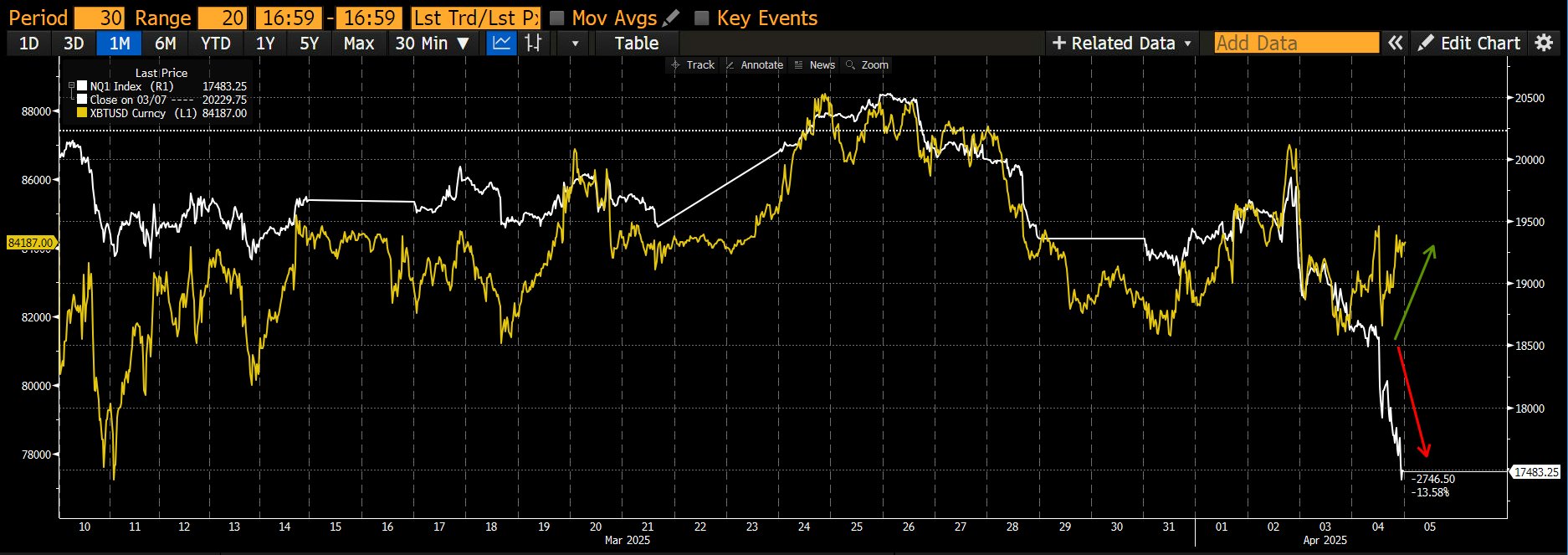
Bitcoin’s (BTC) recent stability amid Nasdaq turmoil driven by tariffs has generated excitement among market participants regarding the cryptocurrency’s potential as a haven asset.
Still, the bulls might want to keep an eye on the bond market, where dynamics that characterized the COVID crash of March 2020 may be emerging.
Nasdaq, Wall Street’s tech-heavy index known to be positively correlated to bitcoin, has dropped 11% since President Donald Trump on Wednesday announced reciprocal tariffs on 180 nations, escalating trade tensions and drawing retaliatory levies from China.
Other U.S. indices and global markets have also taken a beating alongside sharp losses in the risk currencies like the Australian dollar and a pullback in gold.
BTC has largely remained stable, continuing to trade above $80,000, and its resilience is being viewed as a sign of its evolution into a macro hedge.
“The S&P 500 is down roughly 5% this week as investors brace for trade-driven earnings headwinds. Bitcoin, meanwhile, has shown impressive resilience,” David Hernandez, crypto investment specialist at 21Shares, told CoinDesk in an email. “After briefly dipping below $82,000, it rebounded quickly, reinforcing its status as a macro hedge in times of macroeconomic stress. Its relative strength could continue to attract institutional inflows if broad market volatility persists.”
The perception of stability could quickly transform into a self-fulfilling prophecy, solidifying BTC’s position as a haven asset for years to come, as MacroScope noted on X.
Treasury basis trade risks
However, sharp downside volatility in the short term cannot be ruled out, especially as the “Treasury market basis trade” faces risks due to heightened turbulence in bond prices.
The basis trade involves highly leveraged hedge funds, reportedly operating at leverage ratios of 50-to-1, exploiting minor price discrepancies between Treasury futures and securities. This trade blew up in mid-March 2020 as coronavirus threatened to derail the global economy, leading to a “dash for cash” that saw investors sell almost every asset for dollar liquidity. On March 12, 2020, BTC fell by nearly 40%.
“When market volatility spikes - as it is now - it unearths highly leveraged carry trades vulnerable to big market moves. The blowup in the US Treasury market in March 2020, which disrupted basis carry trades, is a recent example. Risk of leveraged carry trade blowups is high…,” Robin Brooks, managing director and chief economist at the International Institute of Finance,” wrote to CoinDesk in an email.
The risk is real because, the size of the basis trade as of March end was $1 trillion, double the tally in March 2020. The positioning is such that a one basis point move in Treasury yields (which move opposite to prices) would lead to a $600 million shift in the value of their bets, according to ZeroHedge.
So, increased volatility in the Treasury yields could cause a COVID-like blowup, leading to a widespread selling of all assets, including bitcoin, to obtain cash.
On Friday, the MOVE index, which represents the options-based implied or expected 30-day volatility in the U.S. Treasury market, jumped 12% to 125.70, the highest since Nov. 4, according to data source TradingView.
The gravity of the situation is underscored by a recent Brookings Institution paper, which advises the Federal Reserve to consider targeted interventions in the U.S. Treasury market, specifically supporting hedge funds engaged in basis trading during times of severe market stress.
Let’s see how things unfold in the week ahead.
Source link
Arthur Hayes
Era of US Treasuries and Stocks As Global Reserve Assets Now Over As Gold and Bitcoin Take Over: Arthur Hayes

BitMEX founder and crypto investor Arthur Hayes says gold and Bitcoin (BTC) are effectively replacing US Treasuries and equities as the predominant global reserve assets.
In a post on the social media platform X, Hayes says that President Trump was partially elected by Americans who feel that they didn’t share in the alleged “prosperity” stemming from going off the gold standard in 1971.
Hayes says that if the White House follows through on reducing its debt and current account deficit, then other countries will be forced to finance their economies by selling their US stocks and bonds, creating a permanent change in the global financial order since finance ministers around the world won’t take a chance that Trump will change his mind.
“THE END: Of US Treasuries and, to a lesser extent, US stocks as the global reserve asset. If the US current account deficit is eliminated, then foreigners do not have dollars to buy bonds and stocks. If foreigners have to juice up their own nations’ economies, they will sell what they own, US bonds and stocks, to fund their nation-first policies.”
The crypto investor also notes that he believes gold and Bitcoin will emerge as the winners of a shifting global financial order.
“THE RETURN:
Of gold as the neutral reserve asset. The dollar will still be the reserve currency, but nations will hold reserves in gold to settle global trade. Trump hinted at this because gold is tariff-exempt! Gold must flow freely and cheaply in the new world monetary order.
A lot of those who had it good are in the denial stage, and share a delusion that somehow things will return to ‘normal’…
For those who want to adapt to a return to pre-1971 trade relationships, buy gold, gold miners and BTC.”
Hayes also suggests that the Trump-induced economic shockwaves may have finally broken the correlation between BTC and the Nasdaq.
“BTC hodlers need to learn to love tariffs, maybe we finally broke the correlation with Nasdaq, and can move onto the purest form of a fiat liquidity smoke alarm.”
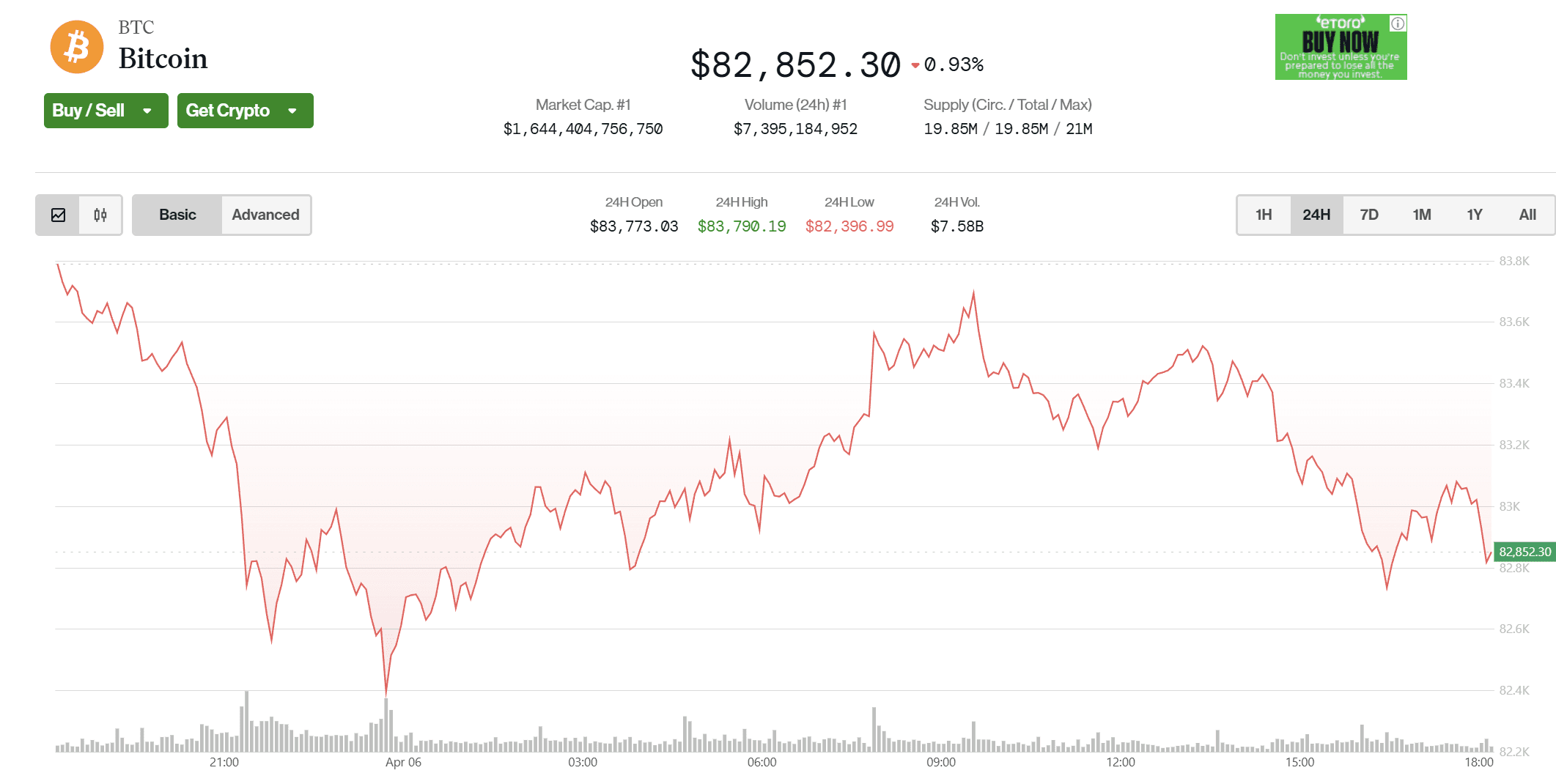
At time of writing, BTC is trading at $83,322.
Follow us on X, Facebook and Telegram
Don’t Miss a Beat – Subscribe to get email alerts delivered directly to your inbox
Check Price Action
Surf The Daily Hodl Mix
Disclaimer: Opinions expressed at The Daily Hodl are not investment advice. Investors should do their due diligence before making any high-risk investments in Bitcoin, cryptocurrency or digital assets. Please be advised that your transfers and trades are at your own risk, and any losses you may incur are your responsibility. The Daily Hodl does not recommend the buying or selling of any cryptocurrencies or digital assets, nor is The Daily Hodl an investment advisor. Please note that The Daily Hodl participates in affiliate marketing.
Generated Image: Midjourney
Source link


Bitcoin could be headed for its most sweeping cryptographic overhaul yet if a new proposal gains traction.
A draft Bitcoin Improvement Proposal (BIP) titled Quantum-Resistant Address Migration Protocol (QRAMP) has been introduced by developer Agustin Cruz. It outlines a plan to enforce a network-wide migration of BTC from legacy wallets to ones secured by post-quantum cryptography.
Quantum computing involves moving away from a process reliant on binary code, ones and zeros, and exponentially increasing computing power by employing Quantum bits (qubits) that exist in multiple states simultaneously. Such a jump in power is expected to threaten modern computing encryption built by classic machines.
The proposal suggests that after a predetermined block height, nodes running the updated software would reject any transaction trying to spend coins from an address using ECDSA cryptography, which could theoretically make it vulnerable to quantum attacks.
A hard fork debate
Bitcoin currently relies on algorithms, including SHA-256 for mining and the Elliptic Curve Digital Signature Algorithm (ECDSA) for signatures. Per Cruz, legacy addresses that haven’t yet transacted are protected by additional layers, while those that have exposed their public keys—necessary to conduct transactions—may now be vulnerable “if sufficiently powerful quantum computers emerge.”
The move would require a hard fork, which is likely going to be a tall ask from the community. A hard fork refers to a change to a blockchain that renders an older version incompatible.
“I admire the effort but this will still leave everyone who doesn’t migrate’s coins vunerable, including Satoshi’s coins,” said one Reddit user about the new proposal.
“Bitcoin could implement a post quantum security for all coins but that would need a hard fork, which due to bitcoin’s history and the mantra repeated by maxis that would create a new coin and would not be bitcoin anymore.”
Read more: The Blocksize Wars Revisited: How Bitcoin’s Civil War Still Resonates Today
Preventive measure
The proposed solution sets a migration deadline to lock those funds unless they’re moved to a more secure wallet. This proposal isn’t a response to any imminent breakthrough in quantum computing. Instead, it’s a preventive measure, yet it comes a little over a month after Microsoft unveiled Majorana 1, a quantum processing unit designed to scale to a million qubits per chip.
During a migration window, users would still be able to move funds freely. The BIP calls for wallet developers, block explorers and “other infrastructure” to build tools and warnings to help users comply.
After the deadline, non-upgraded nodes could fork from the network if they continue accepting legacy transactions.
This is not the first time someone has suggested a mechanism to defend Bitcoin from quantum computing threats. Most recently, BTQ, a startup working to build blockchain technology that can withstand attacks from quantum computers, has proposed an alternative to the Proof of Work (PoW) algorithm involving quantum technology.
In its research paper, BTQ proposed a method called Coarse-Grained Boson Sampling (CGBS). This process uses light particles (bosons) to generate unique patterns—samples—that reflect the blockchain’s current state instead of hash-based mathematical puzzles.
However, this proposal would also require a hard fork involving miners and nodes replacing their existing ASIC-based hardware with quantum-ready infrastructure.
Read more: Quantum Startup BTQ Proposes More Energy Efficient Alternative to Crypto’s Proof of Work
Source link

Chainlink (LINK) Targets Rebound To $19 — But Only If This Key Support Holds

NFT industry in trouble as activity slows, market collapses

US Tech Sector About To Witness ‘Economic Armageddon’ Amid Trump’s Tariffs, According to Wealth Management Exec

XRP’s Open Interest Surges Above $3 Billion, Will Price Follow?

This Week in Bitcoin: BTC Holds Steady as Trump’s Trade War Wrecks Stocks

Decentralized exchanges gain ground despite $6M Hyperliquid exploit

BTC’s Strength Amid Nasdaq Drop is Impressive, But Potential Basis Trade Blowup That Catalyzed the COVID Crash Poses Risk

Ethereum instant finality? Buterin aims to silence critics

XRP High Stakes Setup: Analyst Warns Of Sharp Move To $17 Or $0.65

Bitcoin Holds $83K Despite Macro Heat, What’s Happening?

Era of US Treasuries and Stocks As Global Reserve Assets Now Over As Gold and Bitcoin Take Over: Arthur Hayes

Billionaire investor would ‘not be surprised’ if Trump postpones tariffs

The Biggest Games Coming to Nintendo Switch 2

Dragonfly Capital backs Codex, $16m round

Bitcoin Developer Proposes Big Changes to Future-Proof BTC From Quantum Threats

Arthur Hayes, Murad’s Prediction For Meme Coins, AI & DeFi Coins For 2025

Expert Sees Bitcoin Dipping To $50K While Bullish Signs Persist

Aptos Leverages Chainlink To Enhance Scalability and Data Access

Bitcoin Could Rally to $80,000 on the Eve of US Elections

Sonic Now ‘Golden Standard’ of Layer-2s After Scaling Transactions to 16,000+ per Second, Says Andre Cronje

Institutional Investors Go All In on Crypto as 57% Plan to Boost Allocations as Bull Run Heats Up, Sygnum Survey Reveals

Crypto’s Big Trump Gamble Is Risky

Ripple-SEC Case Ends, But These 3 Rivals Could Jump 500x

Has The Bitcoin Price Already Peaked?

A16z-backed Espresso announces mainnet launch of core product

Xmas Altcoin Rally Insights by BNM Agent I

Blockchain groups challenge new broker reporting rule

The Future of Bitcoin: Scaling, Institutional Adoption, and Strategic Reserves with Rich Rines

Trump’s Coin Is About As Revolutionary As OneCoin
I’m Grateful for Trump’s Embrace of Bitcoin
 24/7 Cryptocurrency News5 months ago
Arthur Hayes, Murad’s Prediction For Meme Coins, AI & DeFi Coins For 2025
 Bitcoin3 months ago
Expert Sees Bitcoin Dipping To $50K While Bullish Signs Persist
 24/7 Cryptocurrency News3 months ago
Aptos Leverages Chainlink To Enhance Scalability and Data Access
 Bitcoin5 months ago
Bitcoin Could Rally to $80,000 on the Eve of US Elections
 Altcoins2 months ago
Sonic Now ‘Golden Standard’ of Layer-2s After Scaling Transactions to 16,000+ per Second, Says Andre Cronje
 Bitcoin5 months ago
Institutional Investors Go All In on Crypto as 57% Plan to Boost Allocations as Bull Run Heats Up, Sygnum Survey Reveals
 Opinion5 months ago
Crypto’s Big Trump Gamble Is Risky
- Price analysis5 months ago
Ripple-SEC Case Ends, But These 3 Rivals Could Jump 500x