
EIP-1559
Highlights of Ethereum Project Roadmap for Q3 After Major Upgrade












The long-awaited London upgrade for the Ethereum network is edging closer as the code was deployed to the final testnet this week.
Ethereum’s London hard fork, which will usher in the EIP-1559 upgrade, has now been scheduled for August 4 following the launch on the Rinkeby testnet on Thursday.
Ethereum developer Tim Beiko posted the testnet update confirming that the code has now been successfully deployed to all three testnets.
And we are live https://t.co/a5blKgbZym
All three testnets have now successfully upgraded to London
Note: because of OpenEthereum being deprecated after London, a block hasn’t been set for Kovan yet, and it will likely upgrade after mainnet. https://t.co/rCnLDMjxZj
— Tim Beiko | timbeiko.eth (@TimBeiko) July 8, 2021
The mainnet launch will occur at block 12965000 which puts the estimated date at August 4. The first block was produced on the Ropsten testnet on June 24, and the Goerli testnet deployed the hard fork on June 30. Rinkeby is the final testing phase before the mainnet goes live.
The London upgrade has been named after the second-annual Ethereum developer’s conference in 2015. It may take the network into a deflationary state through the adjustment of the current auction mechanism for network fees. The EIP will introduce a “base fee” instead of the existing first-price auction fee. According to Ethereum software solutions firm ConsenSys, in theory, the more transactions that occur, the more deflationary pressure that the burning of the base fee will have on the overall Ethereum supply.
It will not necessarily reduce gas fees through the EIP-1559 update, however, as many had hoped. ConsenSys confirmed this in a guide to the upgrade posed last month, though they did suggest fees may ease slightly:
“As a side effect of a more predictable base fee, EIP-1559 may lead to some reduction in gas prices if we assume that fee predictability means users will overpay for gas less frequently.”
Related: A London tour guide: What the EIP-1559 hard fork promises for Ethereum
The upgrade will see some of the transaction fees burned, which will have an effect on the supply of Ethereum over time. A website has been set up to see this mechanism in action on the various testnets. At the time of writing more than 89,000 ETH had been burnt on the testnets, nominally valued at approximately $185 million at current prices.
The deflationary properties of the system may be amplified when the network switches from mining to proof-of-stake consensus in the latter half of 2022.
Source link

- JPMorgan analysts said the demand for staking mechanisms will explode upon complete transition to Ethereum 2.0.
- JPMorgan: Attractive crypto staking yields could put the direct competition to traditional debt investment vehicles.
Once an ardent critic of Bitcoin and the crypto world in general, Wall Street giant JPMorgan is now changing tunes! Two JPMorgan analysts are betting big on the Ethereum 2.0 Proof-of-Stake (PoS) developments.
In the bank’s latest report, the analysts wrote that Ethereum 2.0 can kickstart a $40 billion staking industry in the next four years i.e. by 2025. Besides, the two senior analysts noted that the blockchain platforms with energy-efficient networks will continue to gain more popularity.
Just like Bitcoin, the existing Etereum blockchain follows a proof-of-work (PoW) consensus model. However, ETH developers are now actively working on the next iteration – Ethereum 2.0 – which will introduce the staking mechanism through its PoS model.
As per JPMorgan analysts, the PoS blockchain networks are generating $9 billion in annual revenue via its staking holdings. As Ethereum is likely to complete its transition from the existing PoW model to the Ethereum 2.0 PoS model, the analysts noted that it can massively spur the adoption of the PoS mechanism.
Thus, JPMorgan expects the staking rewards to double to $20 billion. The analysts further noted that by 2025, the staking returns will double again to $40 billion.
Competing Against the Traditional Debt Investments
In the report, JPMorgan analysts added that blockchains with the staking mechanism will eat into the market share of traditional debt offerings. They compared the financial rewards of crypto staking to cash and other fixed-income instruments like the U.S. Treasury bonds. The report notes:
Yield earned through staking can mitigate the opportunity cost of owning cryptocurrencies versus other investments in other asset classes such as U.S. Dollars, U.S. Treasuries, or money market funds in which investments generate some positive nominal yield. In fact, in the current zero rate environment, we see the yields as an incentive to invest.
Currently, the combined market cap of PoS tokens is $150 billion. The analysts predict that the rising market of staking yield will make cryptocurrencies a lot more attractive. As per data from StakingRewards, the top ten staking cryptocurrencies by market cap offer anywhere between 3-13 percent annual returns.
Ethereum competitor Cardano has the highest staked value of over $30 billion. This is three times more than Ethereum 2.0 which has a staked value of over $11 billion and comes second. Interestingly, 75 percent of Cardano (ADA) tokens are staked while it’s only 4.96 percent of ETH.
Thus, the complete implementation of Ethereum 2.0 could possibly raise ETH staking. The report mentions the positive yields of the PoS network along with the price appreciation of the PoS tokens. It notes:
Not only does staking lower the opportunity cost of holding cryptocurrencies versus other asset classes, but in many cases cryptocurrencies pay a significant nominal and real yield.
However, investors should be aware that a consistent positive yield through crypto staking largely depends on market volatility. Thus, if the price of staking tokens goes down, the returns could sink simultaneously. But with increased market participation, the volatility will subside. Thus, staking will become rewarding in the long term.
The Ethereum 2.0 London Hardfork
This month ahead in July, the Ethereum 2.0 mainnet will witness a major upgrade through the London hard fork. All eyes are currently on the EIP-1559 implementation which will change the “base fee” structure of the Ethereum network.
Reportedly, it aims to make the Ethereum network deflationary making transaction costs cheaper. A week back, developers successfully implemented the Ropsten testnet while burning over 88K ETH coins. Ethereum miners have opposed the EIP-1669 implementation as it could reduce the mining revenues.
Read More: It’s finally here: Ethereum’s London upgrade launches, $174M already burned in a day
Source link

Ether (ETH) eclipsed $4,000 for the first time on May 10, passing the psychologically significant barrier on multiple exchanges including Coinbase. The new milestone comes just a week after breaking $3,000.
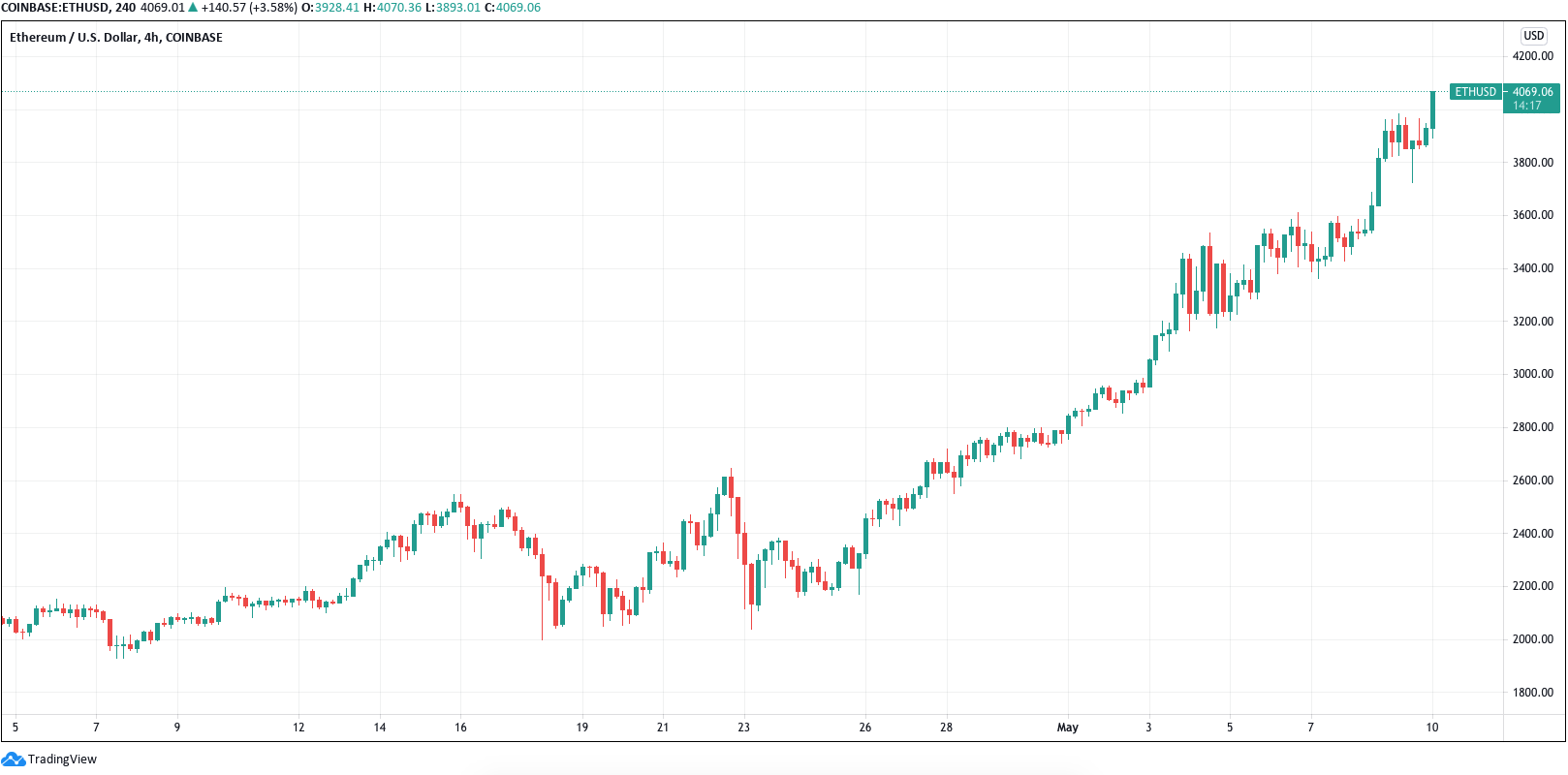
Last week, ETH overtook Bank of America as the 28th largest asset in the world. But at $454.49 billion as of today, ETH has now eclipsed the market cap of consumer staples giants Wal-Mart and Johnson and Johnson, and is knocking at the door of JPMorgan Chase — the largest American bank by assets under management.
Part of the rise may be linked to increasing institutional interest in the asset. This week, a Coinshares report said that institutions bought over $30 million in ETH at the end of April. Money managers are thought to now own $13.9 billion in ETH or ETH vehicles.
Likewise, there have been significant strides in adoption. Last week the European Investment Bank announced that they would be issuing a $120 million bond on the world’s largest layer-1 in collaboration with major banking entities such as Goldman Sachs. Additionally, the growth of decentralized finance — one of Ethereum’s key communities and use cases — continues at a remarkable clip.
However, the most bullish catalysts on the horizon are a pair of major infrastructure upgrades to the network: EIP-1559 and ETH 2.0. EIP-1559, now scheduled to be included in the “London” hard fork, will include an overhaul of the ETH fee structure and is expected to decrease gas costs significantly while also potentially making ETH a more deflationary asset.
ETH 2.0, in turn, will transition the network to a proof-of-stake consensus model, which is expected to decrease sell pressure and encourage holding the asset.
The remarkable run has even prompted renewed speculation that there could be a “flippening” on the horizon — a long-anticipated event among the Ethereum community where ETH overtakes BTC in market capitalization.
Source link

BES171/Money#3: Bitcoin Simplified, Blockchain technology how useful in Banking transactions?

Blockchain Tutorial For Beginners - 1 | Blockchain Technology | Blockchain Tutorial | Simplilearn

Crypto News Recap - Happy Birthday, Satoshi! 🎁🎂🎁 - April 2- April 9, 2021

Daily Farm Update | Token n Farm Launches | BSC & Polygon

BTT (BITTORENT) SIAP NAIK !?? SETELAH EVENT 10 JUNI?? PREDIKSI DAN ANALISA BTT (BITTORENT) 2021 !!

How to Transfer Crypto From Binance to Trust Wallet (2021) | CryptoCurrency Tutorial
-
 liquidity4 weeks ago
Daily Farm Update | Token n Farm Launches | BSC & Polygon
-
 Usecase2 months ago
BTT (BITTORENT) SIAP NAIK !?? SETELAH EVENT 10 JUNI?? PREDIKSI DAN ANALISA BTT (BITTORENT) 2021 !!
-
 Usecase2 months ago
How to Transfer Crypto From Binance to Trust Wallet (2021) | CryptoCurrency Tutorial
-

 Usecase2 months ago
Next SAFEMOON | MARSMISSION Coin 100X ? Low Price Cryptocurrency 2021 | Best Profitable Crypto 2021
-

 Education2 months ago
Karan Dwivedi Zoom Meeting Crypto Bulls, ESPN Global, Master Nodes
-

 Education2 months ago
Best Crypto Coin To Invest in 2021 | Best Cryptocurrency To Invest 2021 | Wazirx | Safemoon Binance
-

 liquidity2 months ago
How to Use Bunny Swap to Maximize Your Yield Farming on Binance Smart Chain
-

 liquidity3 months ago
Liquidity In Cryptocurrency | knowledge about Crypto