
Bitcoin
Institutional Inflows of Ethereum Near $1,000,000,000 This Year, According to CoinShares

Digital asset manager CoinShares says that institutional demand for Ethereum continues to soar this year as inflows near the $1 billion mark.
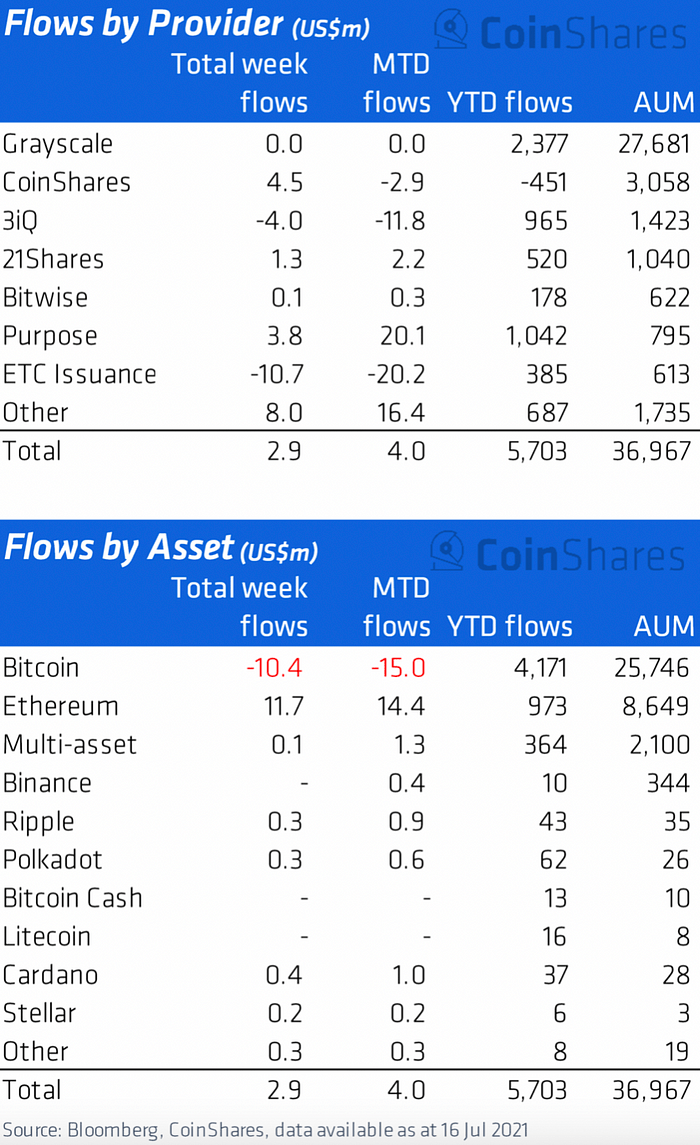
According to their new weekly report, financial institutions have scooped up approximately $973 million worth of ETH since the beginning of 2021.
CoinShares also notes that Ethereum has seen net inflows for the third week in a row, this time totaling over $11 million.
“Ethereum saw its 3rd consecutive week of inflows, with last week’s inflows totaling $11.70 million. This brings year-to-date inflows close to the $1 billion mark.”
As for Bitcoin, the world’s biggest crypto by market cap finished a second consecutive week of outflows from institutions, according to CoinShares.
“After a few weeks of inflows into Bitcoin, we have seen outflows for the last two weeks, with outflows last week totaling $10.40 million. These outflows are minimal relative to the significant outflows witnessed in May and June this year. Furthermore, we believe the timing of some investment product launches, where investors gained market access for the first time, has led to recent profit-taking rounds. This is evident in the mixed nature of inflows and outflows across different providers.”
The firm highlights that BTC’s institutional trading volume is also falling. Coinshares adds the dip in volume does not necessarily come with bearish implications.
“Volumes in Bitcoin fell to just 38% of the year-to-date average, totaling $3.90 billion per day last week. We do not believe this represents something ominous in the market as we saw similar seasonal dips in volumes during the summer months in recent years.
Looking at other crypto assets, Coinshares says that altcoins had a very quiet week.
“Ripple, Polkadot, Multi-asset, Cardano and Stellar all had inflows but were less than $0.50 million each.”
Don’t Miss a Beat – Subscribe to get crypto email alerts delivered directly to your inbox
Follow us on Twitter, Facebook and Telegram
Surf The Daily Hodl Mix

Disclaimer: Opinions expressed at The Daily Hodl are not investment advice. Investors should do their due diligence before making any high-risk investments in Bitcoin, cryptocurrency or digital assets. Please be advised that your transfers and trades are at your own risk, and any loses you may incur are your responsibility. The Daily Hodl does not recommend the buying or selling of any cryptocurrencies or digital assets, nor is The Daily Hodl an investment advisor. Please note that The Daily Hodl participates in affiliate marketing.
Featured Image: Shutterstock/IM_VISUALS
Source link










Bloomberg Intelligence commodity strategist Mike McGlone is weighing in on Bitcoin’s (BTC) outlook and whether or not the top crypto is more likely to revisit $60,000 than to drop to support at $20,000.
Eric Balchunas, Bloomberg’s exchange-traded fund (ETF) senior analyst, shares a section of McGlone’s report in which the commodity strategist explains how BTC’s current consolidation above $30,000 is reminiscent of its price pattern in 2019 when the leading cryptocurrency launched a 250% rally in a span of three months.
“Bitcoin is more likely to revert toward $60,000 resistance vs. $20,000 support, if its history of recovering from similar too-cold conditions are any guide. Our graphic depicts the benchmark crypto akin to the 2018-2019 consolidation period of around $4,000, just before launching to the 2019 peak at about $14,000. The more tactical-trading-oriented bears seem to proliferate when Bitcoin sustains at about 30% threshold below its 20-week moving average, allowing the buy-and-hold types time accumulate.”
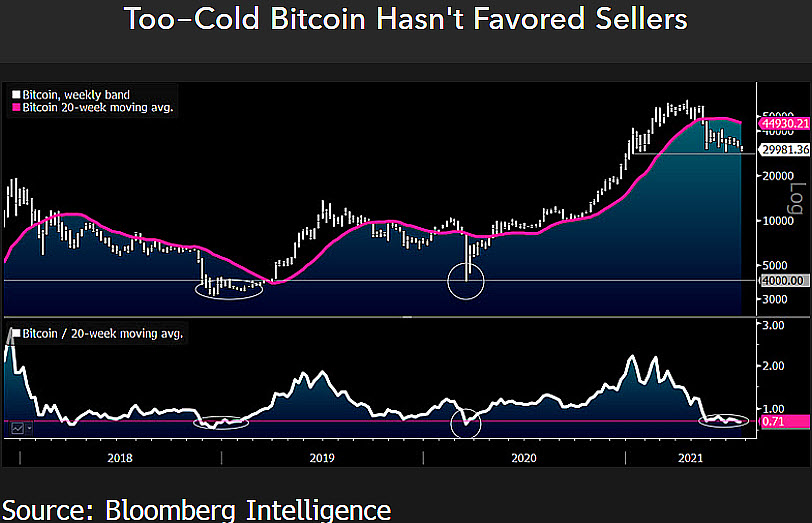
McGlone says that Bitcoin’s consolidation above $30,000 suggests that BTC is setting the stage for a sustained uptrend as opposed to triggering another round of sell-off.
“Shorter-Term Bitcoin Pain Typical for Potential Longer-Term Gain:
Probing $30,000 is more a matter of supportive maturation within a longer-term pricing uptrend than a signal that Bitcoin is destined for dark days. China’s crackdown [confirms] Bitcoin’s revolutionary value.”
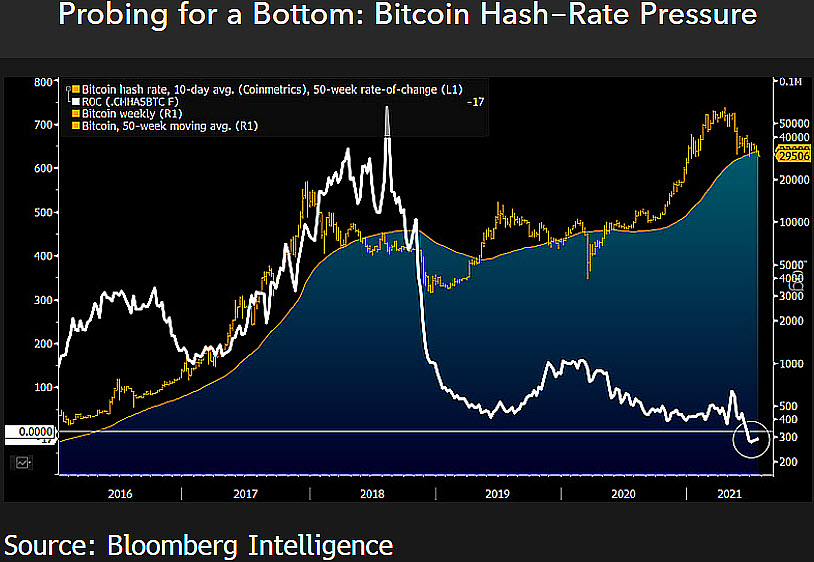
Looking at China’s harsh stance on Bitcoin trading and mining, McGlone says its crackdown on BTC and other crypto assets could be a signal that the country has hit a ceiling in its economic rise.
“China’s rejection of open-source software crypto-assets may mark a plateau in the country’s economic ascent, we believe, while extolling the value of the U.S. dollar and Bitcoin.”
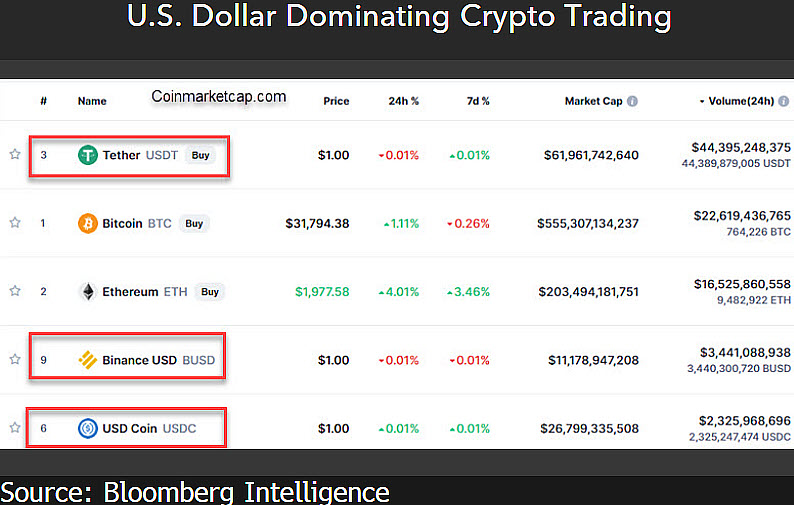
McGlone suggests that when it comes to the digitalization of money, the US Dollar is ahead of the curve, as he highlights that top stablecoins such as Tether (USDT), Binance USD (BUSD) and USD Coin (USDC) have reserves denominated in dollars.
Don’t Miss a Beat – Subscribe to get crypto email alerts delivered directly to your inbox
Follow us on Twitter, Facebook and Telegram
Surf The Daily Hodl Mix
Disclaimer: Opinions expressed at The Daily Hodl are not investment advice. Investors should do their due diligence before making any high-risk investments in Bitcoin, cryptocurrency or digital assets. Please be advised that your transfers and trades are at your own risk, and any loses you may incur are your responsibility. The Daily Hodl does not recommend the buying or selling of any cryptocurrencies or digital assets, nor is The Daily Hodl an investment advisor. Please note that The Daily Hodl participates in affiliate marketing.
Featured Image: Shutterstock/Olga Salt
Source link


Lending has been around in some form for thousands of years — dating back to ancient civilizations where farmers would borrow seeds and use crops as repayment.
The arrival of fiat currencies transformed the way economies were run back then. Indeed, you could argue that we’re seeing such a seismic shift now as cryptocurrencies become a larger and more influential part of the world’s financial ecosystem.
When done right, crypto lending has the potential to level the playing field — giving consumers a type of flexibility that they may otherwise have been unaccustomed to. For several years now, the rates offered by banks have been tepid to say the least. In some countries, even the most generous savings accounts will only pay less than 1% interest — even if funds are locked up for several years.
Given how inflation has been rising sharply recently, in part because of the money printing performed in response to the coronavirus pandemic, signing up for one of these accounts means a saver’s money would actually command less spending power down the line.
Crypto lending offers three powerful advantages compared with the status quo. First, it is possible to find more competitive deals that ensure capital actually grows — with interest sometimes paid on a weekly or a monthly basis. Second, many platforms offer a much-needed degree of flexibility to lenders, meaning that they won’t be forced to lock up their money for long periods of time and can withdraw their funds at will. And third, it can act as a powerful incentive when markets are behaving rather erratically.
That’s before we’ve even discussed the fact that crypto as collateral can be far more practical from a lender’s point of view than real estate — an asset that is rather illiquid and can be rather time consuming to sell.
It isn’t just lenders who benefit
Of course, all of this sounds like a good deal for lenders — the people who have capital to spare. But it can also be beneficial for borrowers, too. In the current financial ecosystem, where a single blemish on an otherwise impeccable credit history can deny a responsible consumer access to the best interest rates, crypto platforms can offer an invaluable lifeline.
Banks often have an opaque list of requirements when it comes to finding the people they are willing to extend credit to. And, in a world where ever-increasing numbers of consumers are self-employed, otherwise creditworthy applicants can end up being excluded from the market simply because they don’t have a traditional nine-to-five job — irrespective of whether they actually earn more money in their current arrangement.
The crypto world can help to foster inclusivity here, but there are challenges. A number of lenders in this space are offshore and unregulated — something that can make them less appealing to everyday consumers. This also restricts the number of partnerships that crypto platforms can enter into with fintech firms.
A new approach?
One platform that is aiming to shake up the world of lending is Baanx, a crypto-as-a-service fintech intending to bridge the worlds of crypto and fiat. The company allows brands to offer interest-free forms of secured lending to their customers and communities, alongside high savings rates for those who stake their digital assets. This is all achieved via APIs that can be rapidly integrated into any DeFi, exchange, or wallet’s app or website.
This form of interest free and low cost secured lending is provided to those who stake BXX, the utility coin that’s associated with Baanx. Loans can subsequently be moved into crypto wallets or physical and virtual cards. For those who use Bitcoin and Ether as collateral, loan-to-value ratios of up to 50% are available, and approval can be achieved in one click.
Baanx is on the list of temporarily registered cryptoasset businesses with the FCA and also utilizes a lending license. The project’s whitepaper states that it will “lend against any digital asset including cryptos, stocks, bonds and the emerging NFT asset class.”
The volumes of money that can be offered through lending will depend on the volumes of tokens that are staked within its system.
Figures provided by Baanx suggest that the platform now has sold more than 600,000 white-label cards and accounts around the world — almost exclusively through branded corporate clients, including Tezos Crypto Life app, DeFi protocols, exchanges, and wallet providers. It is also planning to launch with a major wallet provider in the U.S. in the fourth quarter of 2021.
Disclaimer. Cointelegraph does not endorse any content or product on this page. While we aim at providing you all important information that we could obtain, readers should do their own research before taking any actions related to the company and carry full responsibility for their decisions, nor this article can be considered as an investment advice.
Source link

Blockchain Tutorial For Beginners - 1 | Blockchain Technology | Blockchain Tutorial | Simplilearn

Crypto News Recap - Happy Birthday, Satoshi! 🎁🎂🎁 - April 2- April 9, 2021

#BlockChain Technology

Daily Farm Update | Token n Farm Launches | BSC & Polygon

BTT (BITTORENT) SIAP NAIK !?? SETELAH EVENT 10 JUNI?? PREDIKSI DAN ANALISA BTT (BITTORENT) 2021 !!

How to Transfer Crypto From Binance to Trust Wallet (2021) | CryptoCurrency Tutorial
-
 liquidity4 weeks ago
Daily Farm Update | Token n Farm Launches | BSC & Polygon
-
 Usecase2 months ago
BTT (BITTORENT) SIAP NAIK !?? SETELAH EVENT 10 JUNI?? PREDIKSI DAN ANALISA BTT (BITTORENT) 2021 !!
-
 Usecase2 months ago
How to Transfer Crypto From Binance to Trust Wallet (2021) | CryptoCurrency Tutorial
-

 Usecase2 months ago
Next SAFEMOON | MARSMISSION Coin 100X ? Low Price Cryptocurrency 2021 | Best Profitable Crypto 2021
-

 Education2 months ago
Karan Dwivedi Zoom Meeting Crypto Bulls, ESPN Global, Master Nodes
-

 Education2 months ago
Best Crypto Coin To Invest in 2021 | Best Cryptocurrency To Invest 2021 | Wazirx | Safemoon Binance
-

 liquidity2 months ago
How to Use Bunny Swap to Maximize Your Yield Farming on Binance Smart Chain
-

 liquidity3 months ago
Liquidity In Cryptocurrency | knowledge about Crypto