Cardano
Next two months are going to be fun for Cardano, Hoskinson tells critics

- The Cardano project was recently criticized by a user claiming it will clone another working POS chain and call it an update of ADA.
- However, Cardano founder Charles Hoskinson responded that these critics as being delusional.
Cardano is currently in the third stage of its development roadmap, Goguen. Recently, the first testnet for the Alonzo smart contract was launched with many reports expecting the project to go live on the mainnet in a couple of weeks, a move that will allow for the full integration of smart contracts on the network.
The hype surrounding the project has been reflected in its price with an incredible run this year. However, many critics suspect that Cardano may not be able to live up to the hype. A user identified as S.Z Tanyel tweeted:
@IOHK_Charles will most likely completely clone another working POS chain and call it an update of $ADA and decorate it with fact-bending theses to make it look like it evolved from the current GitHub.
I’ve found free money on Polymarket
There is no chance $ADA will have a functioning smart contract on mainnet in 2021. Charles Hoskinson especially mentioned this bet and made fun of it. Surely he will ignore it when this bet resolves and ”No” betters get their rewards. pic.twitter.com/nOfCZU1yWl
— S. Z. Tanyel (@tanybro) July 24, 2021
In response, Charles Hoskinson, the founder of Cardano, tweeted that the next two months “will be fun.”
It’s amazing how delusional some people are. This is honestly the level Cardano critics are at now. The next two months are going to be fun. Expect a lot of meltdowns and temper tantrums from the paint chip brigade.
Cardano smart contract could be fully implemented in September
Cardano is referred to as the “Ghost of Blockchain,” and in 2020, critics slammed the project for lack of assets or DApps operating on the blockchain.
A user identified as Evan Van Ness tweeted:
Do people realize that Cardano barely does 20k transactions per day? Yet $ADA has a valuation of $63b despite zero traction a full 5 years after its ICO. That’s $1.93m in valuation per daily transaction.
Despite the criticisms, several experts rate the project as one of the few cryptos that may lead a massive revolution in the crypto industry. Just recently, Portfolio Strategist at MorningStar, Amy Arnott mentioned that Cardano will join Bitcoin and Ethereum to form the “big three cryptos” to go mainstream.
Read More: Cardano (ADA) to become a mainstream crypto like BTC & ETH – Portfolio strategist
There have been several ongoing projects including the recent successful implementation of the Alonzo “White” on the mainnet after the forking of the Alonzo testnet. These are all part of its plans to get closer to the launch of smart contracts. However, there was a delay in the scheduled roadmap about the 1.2.8 node that integrated “validation fixes as discovered by a series of tests”.
Related: Cardano developer portal goes live, 10 NFTAs minted to celebrate milestone
It is expected that the Cardano smart contract would be fully implemented around September after the completion of the Alonzo “Purple” phase.
Source link







In the past two decades, index and exchange-traded funds (ETF) have become some of the most popular forms of investing because they offer investors a passive way to gain exposure to a basket of stocks as opposed to investing in individual stocks which increases risk of loss.
Since 2018, this trend has extended to the crypto sector and products like the Bitwise 10 Large Cap Crypto Index (BITX) tracks the total return of Bitcoin (BTC), Ether (ETH), Cardano (ADA), Bitcoin Cash (BCH), Litecoin (LTC), Solana (SOL), Chainlink (LINK), Polygon (MATIC), Stellar (XLM) and Uniswap (UNI).
The ability to access multiple top projects through one weighted average market cap index sounds like a great way to spread out risk and gain exposure to a wider range of assets, but do these products offer investors a better return in terms of profit and protection against volatility when compared to the top-ranking cryptocurrencies?
Hodling versus crypto baskets
Delphi Digital took a closer look at the performance of the Bitwise 10 and compared it to the performance of Bitcoin following the December 2018 market bottom. The results show that investing in BTC was a more profitable strategy even though BITX was slightly less volatile.
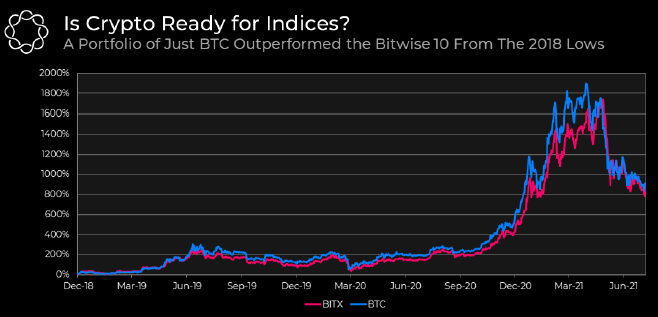
According to the report, “indices aren’t meant to outperform individual assets, they’re meant to be lower-risk portfolios compared to holding an individual asset,” so it’s not surprising to see BTC outperform BITX on a purely cost basis.
The index did offer less downside risk to investors as the market sold-off in May but the difference was “trivial” as “BTC’s max drawdown was 53% and Bitwise’s was 50%.”
Overall, the benefits of investing in an index versus Bitcoin are not that great because the volatile nature of the crypto market and frequent large drawdowns often have a larger effect on altcoins.
Delphi Digital said:
“Crypto indices continue to be a work-in-progress. Choosing assets, allocations, and re-balancing thresholds is a difficult task for an emerging asset class like crypto. But as the industry matures, we expect more efficient indices to pop up and gain traction.”
Ethereum also outperforms DeFi baskets
Decentralized finance (DeFi) has been one of the hottest crypto sectors in 2021 led by decentralized exchanges like Uniswap (UNI) and SushiSwap (SUSHI) and lending platforms like AAVE and Compound (COMP).
The DeFi Pulse Index (DPI) aims to tap into this rapid growth and the DPI token has allocations to 14 of the top DeFi tokens, including UNI, SUSHI, AAVE, COMP, Maker (MKR), Synthetic (SNX) and Yearn.finance (YFI).
When comparing the performance of DPI to Ether since the inception of the index, Ether significantly outperformed in terms of profitability and volatility, as evidenced by a 57% drawdown on Ether versus 65% for DPI.
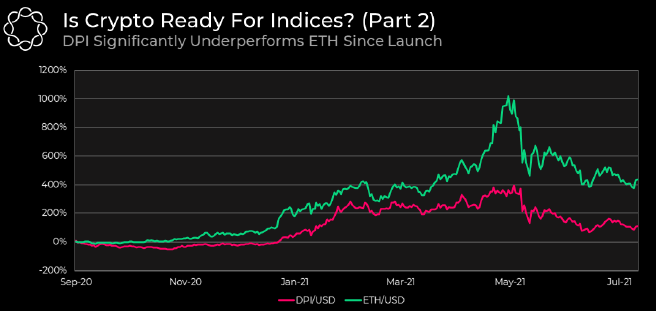
While this is an “imperfect comparison” according to Delphi Digital due to the fact that “the risk and volatility of DeFi tokens are higher than Ether’s,” it still highlights the point that the traditional benefits seen from indices are not mirrored by crypto-based baskets.
Delphi Digital said:
“You could’ve just HODL-ed ETH for a superior risk-return profile.”
For the time being, Bitcoin and Ether have proven to be two of the lower-risk cryptocurrency plays available when compared to crypto index funds that offer exposure to a larger number of assets.
The views and opinions expressed here are solely those of the author and do not necessarily reflect the views of Cointelegraph.com. Every investment and trading move involves risk, you should conduct your own research when making a decision.
Source link
Cardano creator Charles Hoskinson says that his development company Input Output Global (IOG) has created its own stablecoin crypto.
IOG describes the new coin, called Djed, as a “crypto-backed pegged algorithmic stablecoin.”
“Djed [is] an algorithmic stablecoin protocol that behaves like an autonomous bank that buys and sells stablecoins for a price in a range that is pegged to a target price. It is crypto-backed in a sense that the bank keeps a volatile cryptocurrency in its reserve.”
Hoskinson tells his 547,000 Twitter followers that he had “been busy” and also reveals details on Djed in a live AMA (ask me anything) video.
Been Busy. pic.twitter.com/mmYGoBAsPO
— Charles Hoskinson (@IOHK_Charles) July 15, 2021
Although the full whitepaper has not been released, Hoskinson says the researchers have spent significant time verifying the new project using Isabelle code, a tool that computer scientists use to prove theorems and make them easily convertible into code.
“What makes this paper very unique is the Isabelle code associated with paper. So the Isabelle higher-order logical formalization, there’s actual prose here. You can see all the Isabelle code, pages and pages and pages and pages of it. So a lot verification was done here, and that is just a truly remarkable thing, and it’s very unique for papers of this nature.”
Hoskinson says the new stablecoin will eventually be implemented into Plutus, Cardano’s smart contract platform.
“One of the things we’re doing with this stablecoin paper – after we clean it up a little bit more, because it’s so involved and there are so many moving pieces to it that have to be carefully thought about – is actually implementing it into Plutus as a Plutus native application. So we have a vendor in mind that we think would be perfect for this work, and we’re going to work closely with them.”
Don’t Miss a Beat – Subscribe to get crypto email alerts delivered directly to your inbox
Follow us on Twitter, Facebook and Telegram
Surf The Daily Hodl Mix

Disclaimer: Opinions expressed at The Daily Hodl are not investment advice. Investors should do their due diligence before making any high-risk investments in Bitcoin, cryptocurrency or digital assets. Please be advised that your transfers and trades are at your own risk, and any loses you may incur are your responsibility. The Daily Hodl does not recommend the buying or selling of any cryptocurrencies or digital assets, nor is The Daily Hodl an investment advisor. Please note that The Daily Hodl participates in affiliate marketing.
Source link

Pursue 6 J (Live): Approach to small G I biopsies & Polyps : Session 1

How Bitcoin transaction is executed. Bitcoin transaction. Block chain technology. #shorts #bitcoin

Prof. Jens Ducree (FPC@DCU) - DLT4RTD Distributed Ledger Technology for Research … - #BFSCON

Daily Farm Update | Token n Farm Launches | BSC & Polygon

BTT (BITTORENT) SIAP NAIK !?? SETELAH EVENT 10 JUNI?? PREDIKSI DAN ANALISA BTT (BITTORENT) 2021 !!

How to Transfer Crypto From Binance to Trust Wallet (2021) | CryptoCurrency Tutorial
-
 liquidity4 weeks ago
Daily Farm Update | Token n Farm Launches | BSC & Polygon
-
 Usecase2 months ago
BTT (BITTORENT) SIAP NAIK !?? SETELAH EVENT 10 JUNI?? PREDIKSI DAN ANALISA BTT (BITTORENT) 2021 !!
-
 Usecase2 months ago
How to Transfer Crypto From Binance to Trust Wallet (2021) | CryptoCurrency Tutorial
-

 Usecase2 months ago
Next SAFEMOON | MARSMISSION Coin 100X ? Low Price Cryptocurrency 2021 | Best Profitable Crypto 2021
-

 Education2 months ago
Karan Dwivedi Zoom Meeting Crypto Bulls, ESPN Global, Master Nodes
-

 Education2 months ago
Best Crypto Coin To Invest in 2021 | Best Cryptocurrency To Invest 2021 | Wazirx | Safemoon Binance
-

 liquidity2 months ago
How to Use Bunny Swap to Maximize Your Yield Farming on Binance Smart Chain
-

 Usecase2 months ago
4 Altcoins To Buy in the Dip For HUGE GAINS (Crypto Flash Crash 2021)