Bitcoin
Coinbase-Backed DeSo Disrupts Telegram, WhatsApp, and Signal – Blockchain News, Opinion, TV and Jobs


DeSo, a new layer-1 blockchain built from the ground up to decentralize social media, just launched decentralized on-chain end-to-end encrypted group chats, a first-of-its-kind innovation. On-chain messages are resistant to censorship and can be used pseudonymously without supplying personal information, just like Bitcoin or Ethereum.
DeSo is the only blockchain that supports seamless end-to-end encrypted on-chain messaging today, and the extension to group chats is a first-of-its-kind breakthrough. The platform recently raised $200 million from Coinbase, Sequoia, and Andreessen Horowitz. $DESO, the native currency of the DeSo blockchain and is listed on Coinbase.
At the moment, Signal is the most popular private messaging app, and yet users can’t use it without entering a personally-identifying piece of information: their phone number. This makes it so that anyone with access to Signal’s database gets full information about who the user messaging and when. Additionally, because Signal is a centralized service, it has been blocked in major countries like China.
Imagine if creating a Bitcoin wallet required users to give up their phone numbers. Why can’t users have the same level of privacy and censorship resistance that they have with Bitcoin but applied to their communications?
Today, the DeSo blockchain brings Bitcoin’s pseudonymity and censorship resistance to messaging with the launch of decentralized end-to-end encrypted on-chain direct messages and group chats.
Thanks to a recent integration with MetaMask, users of DeSo apps like Diamond can sign up without entering any personal information. Additionally, because DeSo is a decentralized layer-1 blockchain, all messages are censorship resistant, meaning that nothing can stop the users recipient from getting their message, even if they’re in a country with limited free speech.
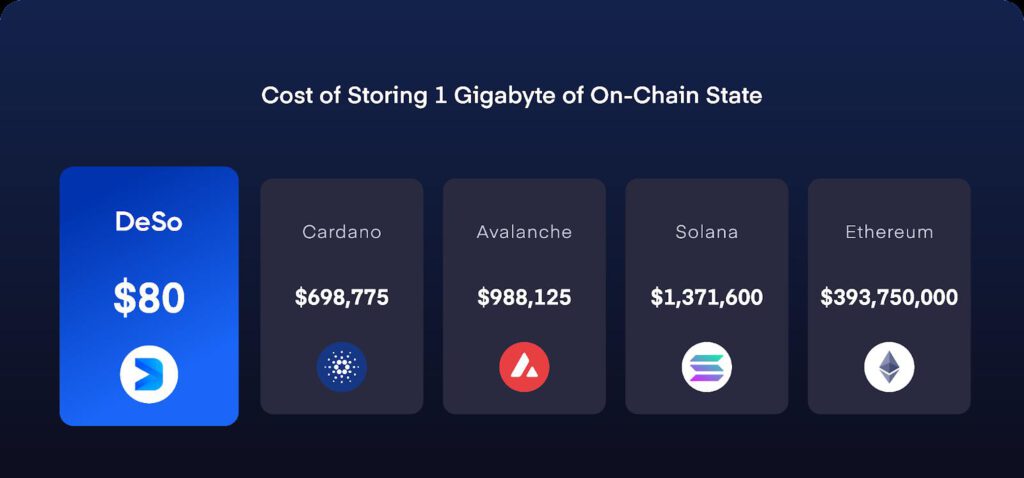
“DeSo is the only blockchain that could support something like this today,” says Nader Al-Naji, the creator of DeSo. “It costs about $75 to store a 200-character message on Ethereum, and about fifteen cents to store it on Solana, Avalanche, or Polygon. In contrast, DeSo is one ten-thousandth of a cent, making it the first blockchain capable of disrupting storage-heavy applications like iMessage, WhatsApp, and Signal,” Al-Naji adds.
This is the latest in a recent string of successes for DeSo. The platform listed on Coinbase earlier this year announced a groundbreaking MetaMask integration last week that caused a significant price surge. Many new social apps like Diamond, a web3 social network built on DeSo, have launched and are growing rapidly with a recent surge in user numbers. Recently, the platform announced a USDC integration that has attracted many new builders to the ecosystem.
With the launch of decentralized messaging, DeSo’s true disruptive power becomes apparent. It is a platform that can not only disrupt social media but a platform that can ensure open communication and free speech for all citizens of the world.
Source link







Bitcoin (BTC) may see more pain in the near future, but the bulk of the bear market is already “likely” behind it.
That is one of many conclusions from Philip Swift, the popular on-chain analyst whose data resource, LookIntoBitcoin, tracks many of the best-known Bitcoin market indicators.
Swift, who together with analyst Filbfilb is also a co-founder of trading suite Decentrader, believes that despite current price pressure, there is not long to go until Bitcoin exits its latest macro downtrend.
In a fresh interview with Cointelegraph, Swift revealed insights into what the data is telling analysts — and what traders should pay attention to as a result.
How long will the average hodler need to wait until the tide turns and Bitcoin comes storming back from two-year lows?
Cointelegraph (CT): You’ve pointed out that some on-chain metrics such as HODL Waves and RHODL Ratio are hinting at a BTC bottom. Could you expand on this? Are you confident that history will repeat this cycle?
Philip Swift (PS): I believe we are now at the point of maximum opportunity for Bitcoin. There are numerous key metrics on LookIntoBitcoin that indicate we are at major cycle lows.
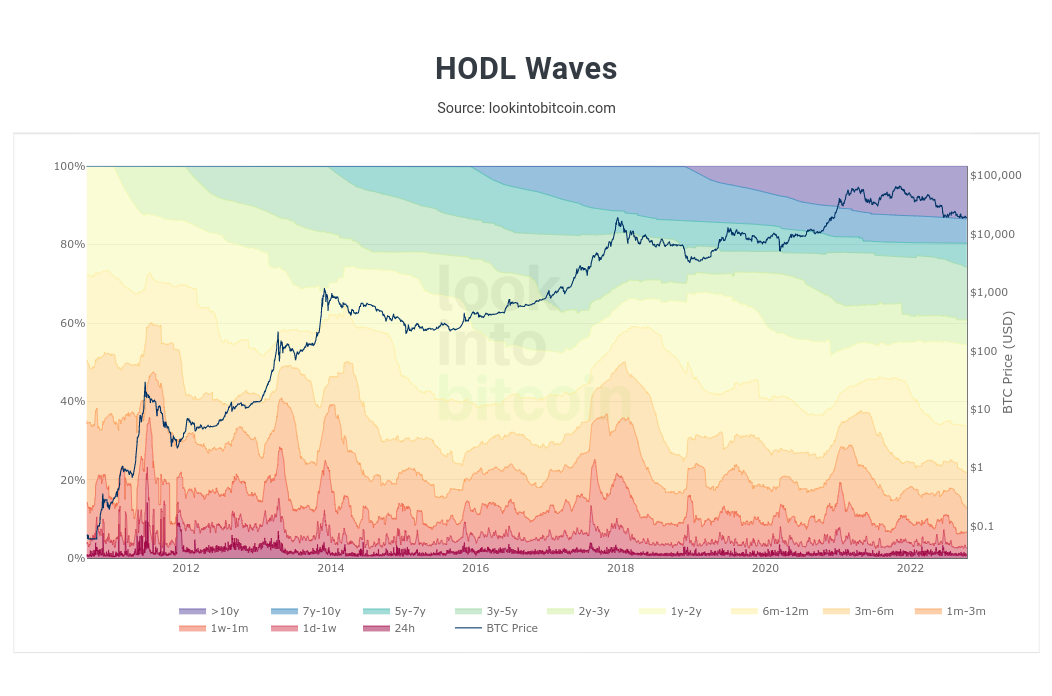
We are seeing the percentage of long-term holders peak (1yr HODL Wave), which typically happens in the depths of bear market as these long-term holders don’t want to take profit until price moves higher.
This has the effect of restricting available supply in the market, which can cause price to increase when demand does eventually kick back in.
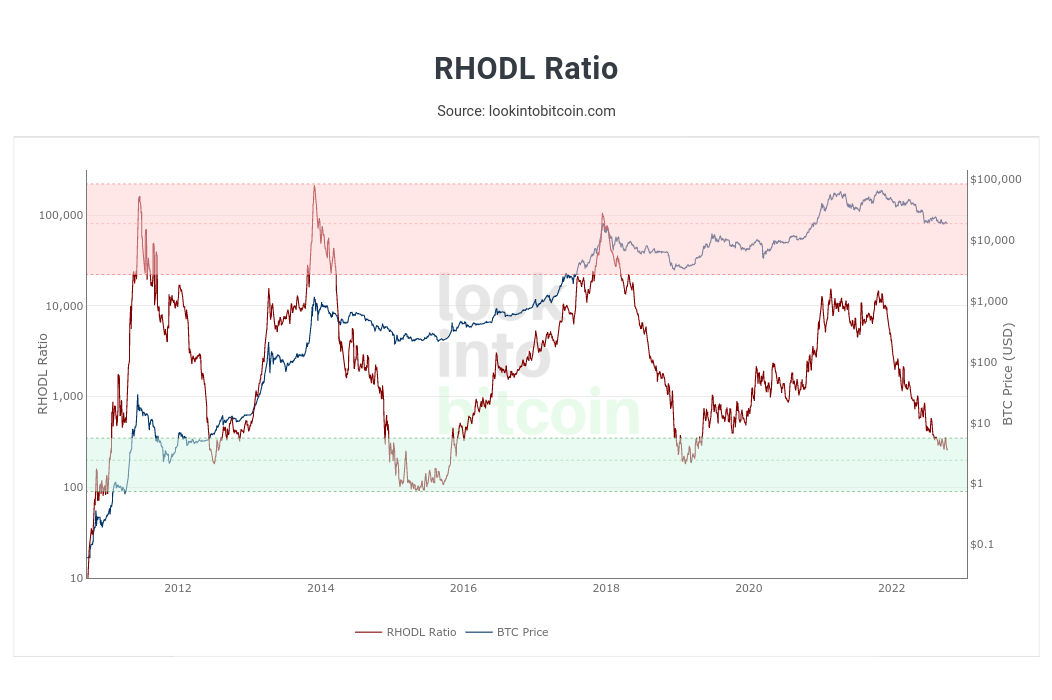
We are also seeing metrics like RHODL Ratio dip into their accumulation zones, which shows the extent to which euphoria has now been drained from the market. This removal of positive sentiment is necessary for a bottom range to form for BTC.
RHODL Ratio is highlighting that the cost basis of recent Bitcoin purchases is significantly lower than prices paid 1–2 years ago when the market was clearly euphoric and expecting +$100k for Bitcoin. So it is able to tell us when the market has reset in preparation for the next cycle to start.
CT: How is this bear market different from previous BTC cycles? Is there any silver lining?
PS: I was around for the 2018/19 bear market and it actually feels pretty similar. All the tourists have left and you just have the committed passionate crypto people remaining in the space. These people will benefit the most in the next bull run — as long as they don’t go crazy trading with leverage.
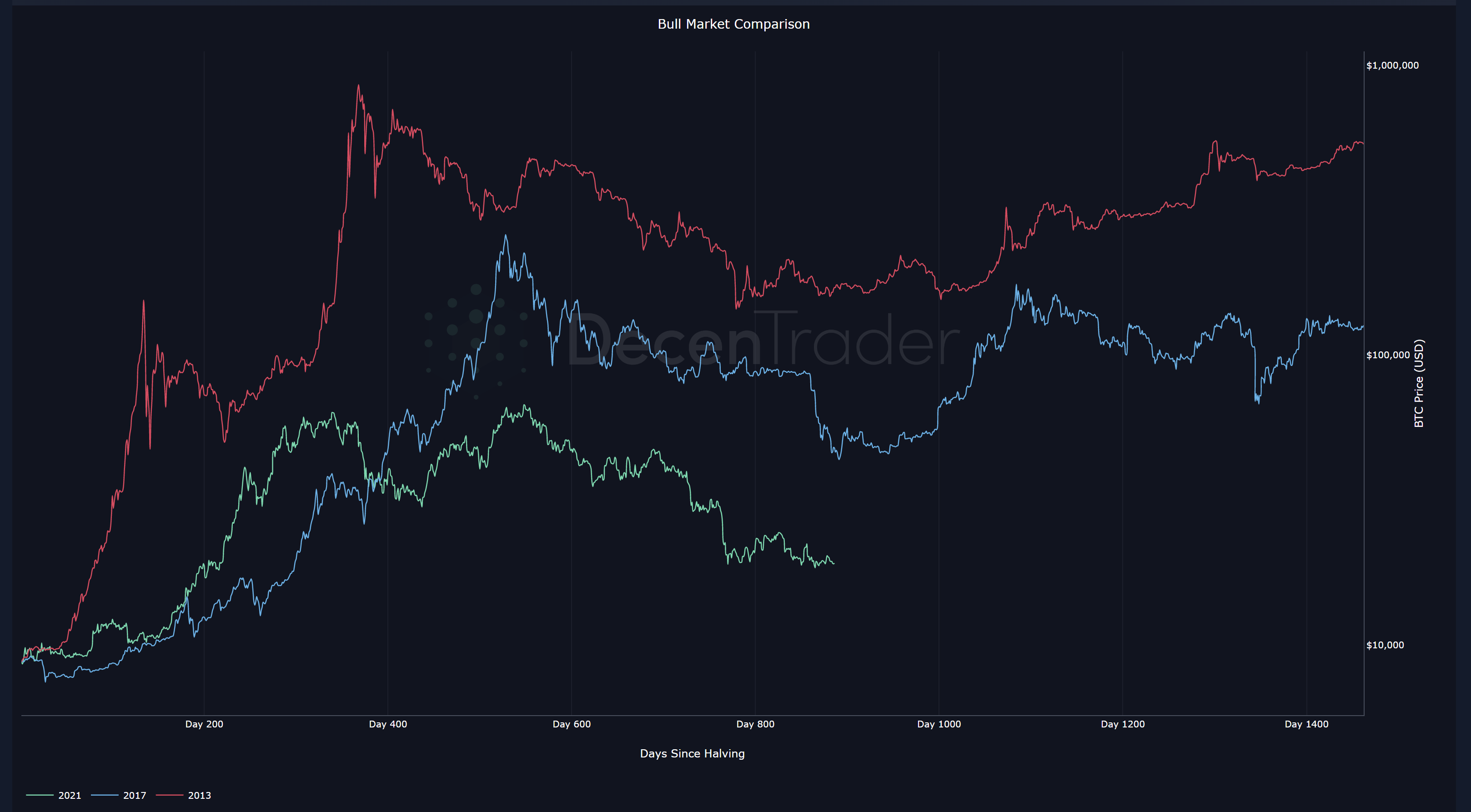
In terms of silver linings, I have a couple! First, we are actually a fair way through the market cycle, and likely through the majority of this bear market already. The chart below shows Bitcoin performance each cycle since the halvening, and we are already around the capitulation points of the previous two cycles.
Second, the macro context is very different now. While it has been painful for bulls to see Bitcoin and crypto so heavily correlated to struggling traditional markets, I believe we are soon going to see a bid on Bitcoin as confidence in (major) governments crosses downwards beyond a point of no return.
I believe this lack of confidence in governments and their currencies will create a rush towards private “hard” assets, with Bitcoin being a major beneficiary of that trend in 2023.
CT: What other key on-chain metrics would you also recommend to keep an eye on to spot the bottom?
PS: Be wary of Twitter personalities showing Bitcoin on-chain charts cut by exotic/ weird variables. Such data very rarely adds any genuine value to the story shown by the major key metrics and these personalities just do it as a way to grab attention rather than genuinely trying to help people.
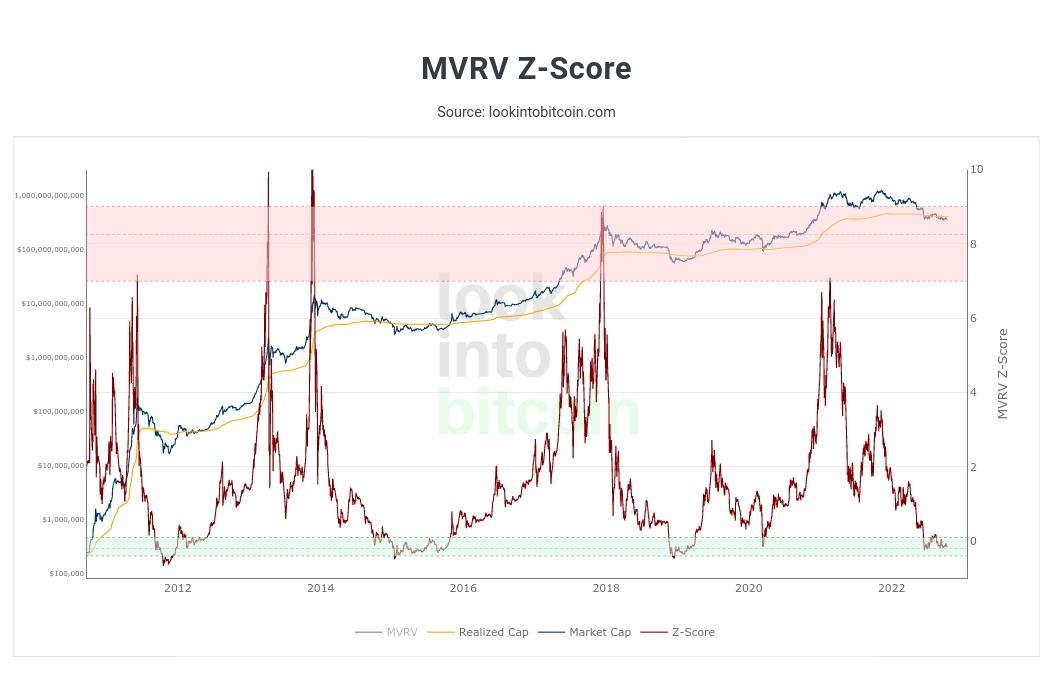
Two metrics that are particularly useful in the current market conditions:
When it does, the indicator on this chart dips into the green “accumulation” zone. We are currently in that zone, which suggests that these may be very good levels for the strategic long-term investor to accumulate more Bitcoin.
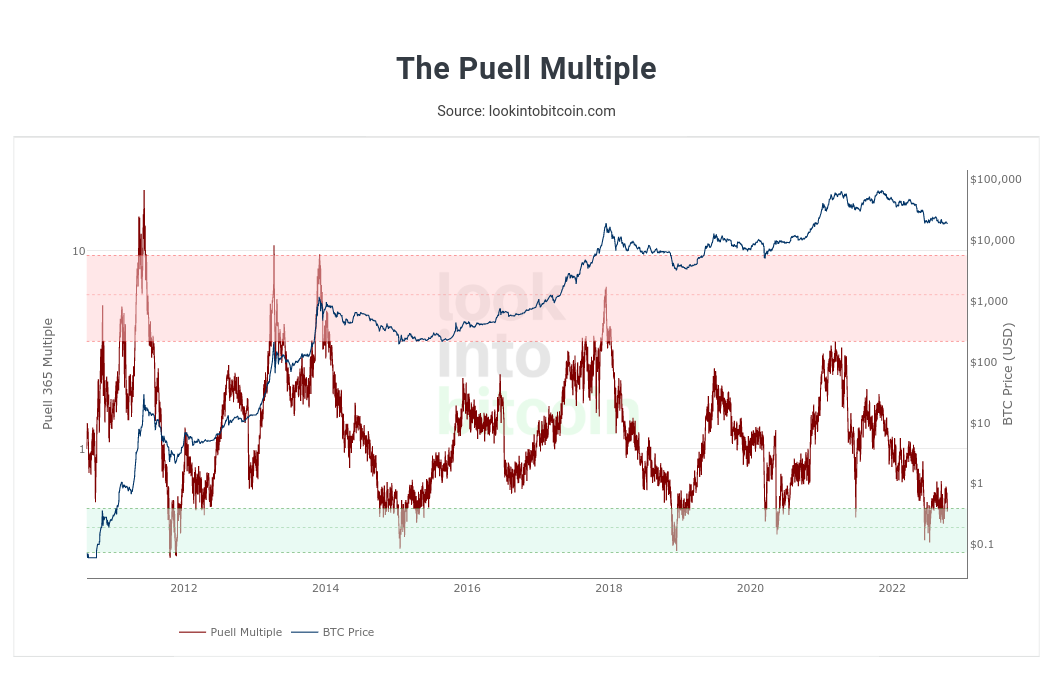
The Puell Multiple Looks at miner revenues versus their historical norms. When the indicator dips into the green accumulation band, like it is now, it shows many miners are under significant stress. This often occurs at major cycle lows for Bitcoin. This indicator suggests we are close to a major cycle low for Bitcoin if we have not already bottomed.
CT: Your fellow analyst Filbfilb expects BTC to reverse course in Q1 2023. Do you agree?
PS: Yes, I do. I think traditional markets probably have a bit more downturn going into early 2023. At worst, I see crypto having a tough time until then, so probably another 2–3 months max. But I think the majority of fear will soon switch toward governments and their currencies — rightly so. Therefore I do expect private assets like Bitcoin to outperform in 2023 and surprise many of the doomers who are saying Bitcoin has failed and is going to zero.
Related: Bitcoin analyst who called 2018 bottom warns ‘bad winter’ may see $10K BTC
CT: October is a historically bad month for stocks — not so much for Bitcoin. How long do you expect BTC to be in lockstep with risk-on assets and what will be the catalyst?
PS: Bitcoin has been a useful forward-looking risk indicator for the markets throughout much of 2022. What will change in 2023 is that market participants will appreciate [that] most of the risk in fact lies with governments, not with traditionally defined “risk” assets. As a result, I expect a narrative shift that will benefit Bitcoin next year.
The actions of the United Kingdom’s government around their mini-budget two weeks ago were a key turning point for that potential narrative shift. Markets showed they were prepared to show their disapproval of poor policy and incompetence. I expect that trend to accelerate not only for the U.K. but in other countries also.
CT: Are you surprised at Ethereum’s poor performance post-Merge? Are you bullish on ETH longer term with its supply-burning mechanisms?
PS: [Ether] (ETH) had a strong short-term narrative with the Merge, but it was within the context of a global bear market. So it is not surprising that its price performance has been lackluster. Ultimately, the overall market conditions dominated, which was to be expected.
Long term, though, Ethereum is set up to do exceptionally well. It is a critical component of Web3, which is growing exponentially. So I am very bullish on Ethereum over the next couple of years.
CT: What is the best jurisdiction for a Bitcoin/ crypto trader today?
PS: Somewhere that is low-tax and crypto-friendly. I personally think Singapore is great and there is a growing crypto scene here, which is good fun too. I have friends who are in Bali, which also sounds great and is more affordable.
CT: Anything you would like to add?
PS: Resist any temptation to quit crypto near the bottom of the bear market. Just be patient and use some good tools to help manage your emotions.
The views and opinions expressed here are solely those of the author and do not necessarily reflect the views of Cointelegraph.com. Every investment and trading move involves risk, you should conduct your own research when making a decision.
Source link

Bitcoin
Bitcoin, Explained. Did you know around 17% of the US adult… | by Blockchain.com | @blockchain | Oct, 2022

Did you know around 17% of the US adult population now owns bitcoin? There’s no denying that crypto has gone mainstream.
From mining to the mystery around who invented bitcoin, there’s still confusion around this new and powerful technology despite increased adoption.
This article covers everything you need to know about bitcoin basics, the risks you should be aware of, and how to get started.
What is Bitcoin
Bitcoin (abbreviated BTC) is digital money that can be used to make secure peer-to-peer transactions on the internet without the need for a third party intermediary (like a bank) to facilitate transactions.
It was created by an open-source community in part due to banks’ detrimental actions during the Great Financial Crisis of 2008, which involved governments printing money and bailing out the financial institutions responsible for the crash.

At its core, Bitcoin allows the user to “be their own bank” eliminating the need to get permission from a company to complete a transaction. On the bitcoin network there are no restrictions on who a user can send money to and how much money can be sent, and operations run around the clock not just during business hours.
Beyond enabling users to “be their own bank” bitcoin also “banks the unbanked”, as financial services cost money to set up and maintain.
From initial deposits, to withdrawal, and membership fees, there are currently over two billion unbanked individuals in the world.
Bitcoin itself can be used as a store of value or medium of exchange that only exists in the digital domain. You cannot hold or see bitcoin.
The Bitcoin network and the bitcoins that power the network were created to be used on the internet, it is not owned by anyone or company — it is a true open payment network that anyone with an internet connection can access.
What can you do with bitcoin?
- Use it like money. Accepted by many companies including Starbucks and Virgin Galactic, Bitcoin can be used to make purchases.
- Transfer funds more quickly and cheaply. Funds can be transferred more efficiently (peer to peer) without high processing fees by the removal of a third party intermediary like a bank or payment processor.
- Use it as a store of value. A store of value should be worth the same or more over time. Bitcoin is often referred to as ‘digital gold’ — it’s limited in supply with specific use-cases. Amidst its volatility — bitcoin has appreciated over 15k% since conception.
How do you “get” bitcoin?
- You can buy bitcoin using fiat currency (e.g. USD, GBP, EUR) through a Brokerage or Exchange like Blockchain.com.
- You can sell something and accept payment in bitcoin.
- You can “mine” bitcoin using specialized computer equipment. (more on this below).
Do I need to buy a “whole” bitcoin?
No. Bitcoin can be bought fractionally.
For example, if bitcoin’s price is $20,000, you can purchase 0.1 Bitcoin for $2,000.
In fact, there’s a special name for the smallest unit of bitcoin that can be traded: satoshi, or sats for short. There are 100 million satoshis in one unit of bitcoin.
With market supply and demand, the price of bitcoin is always changing.
You can check the live price of a whole Bitcoin here.
Who created Bitcoin?
The Bitcoin whitepaper “Bitcoin: A Peer-to-Peer Electronic Cash System”, was published in an email list called the Cryptography Correspondence Group under the pseudonym (fake name) Satoshi Nakamoto on October 31, 2008.
A white paper is an academic document which a project team or company writes to outline the full scope of the product, including the problem that it’s solving.
The problem Satoshi Nakamoto was trying to solve was related to the current financial system and crisis that occurred in 2008.
The Bitcoin white paper explains that:
“The root problem with conventional currencies is all the trust that’s required to make it work.
The central bank must be trusted not to debase the currency, but the history of fiat currencies is full of breaches of that trust.”
In 2009, the software was publicly released and the bitcoin network was launched.
Nakamoto was still active in the project with other developers for an additional year, but in 2010 they stopped contributing and their real identity still remains unknown.
As open source software, hundreds of developers, companies and organizations contribute to Bitcoin’s code.
Bitcoin, bitcoin, or BTC?
Capitalizing or abbreviating bitcoin can be confusing. Here’s what each of these means:
Bitcoin: Bitcoin with an uppercase B is referring to the Bitcoin network and protocol. This is the system that the bitcoin currency runs on.
bitcoin: The lowercase spelling of bitcoin refers only to the cryptocurrency, not the payment network or blockchain protocol.
BTC: BTC is the abbreviated version of bitcoin, and again refers to the cryptocurrency. The use of BTC is similar to a stock ticker symbol and is what you’ll usually see on price charts.
How does it work?
The Bitcoin blockchain can be accessed and managed by any computer, anywhere in the world. The computers that run on the bitcoin blockchain are embedded with a set of rules which makes the data (bitcoins) scarce and valuable.
As a rule, only 21 million bitcoins can be produced, and this scarcity limit ultimately gives bitcoin its value.
Here’s a simple breakdown of what happens when someone wants to send bitcoin using blockchain technology.
- When someone joins the bitcoin network they are given a public key, which you can think of like an email address and a private key which you can think of like a password.
- Every bitcoin transaction made, along with the sender’s public key, is recorded in a public list called the blockchain.
- The main mechanism by which bitcoin transactions are confirmed and validated is called “mining”
- The public full list is then distributed to every computer that is connected to the Bitcoin network.
- As this public list is in chronological order of transactions, it’s possible to trace the history of all bitcoin activity that’s ever occurred. The bitcoin ledger is resistant to both tampering and censorship.
This “open” nature prevents and discourages people or “bad actors” from spending coins that aren’t theirs, making copies of coins or even reversing transactions.
You can check all transactions on the Bitcoin network on the Blockchain.com Explorer.
What is bitcoin “mining”?
Bitcoin mining consists of two processes:
- The verification of new transactions on the blockchain
- The process by which new bitcoin enters into circulation
Recap: only 21 million bitcoins will ever be produced.
Different transactions that have occurred around the same time are bundled together into “blocks” in order to add to the blockchain.
A new block containing all of the transactions that have occurred since the last block is “mined” is added to the blockchain by one “miner” roughly every ten minutes. Once added, the transactions within the block are “confirmed”.
What’s in it for bitcoin miners?
Bitcoin miners are incentivised by bitcoin rewards which they can receive in the following ways:
- If they are the successful miner who adds the new block to the blockchain
- Through transaction fees from all the transactions included in the block
To be the miner who adds the next block to the blockchain, miners must compete to solve an extremely complex mathematical problem based on a cryptographic hash algorithm.
The “answer” to the problem is called the “proof of work” and is included in the new block.
The miner who solves the puzzle fastest adds the new block to the blockchain. Mining is performed by specialized computers with very high processing power.
Listen to our podcast on, What Exactly is Bitcoin Mining? With Jaime Leverton of mining farm Hut 8.
Recap: What is the difference between cryptocurrency, bitcoin and blockchain?
Bitcoin is a cryptocurrency.
In fact, bitcoin was the first ever cryptocurrency developed. Cryptocurrency (including bitcoin) is digital money that is run on a blockchain.
Since bitcoin was created, thousands of new cryptocurrencies have been developed. Bitcoin remains the most popular however in terms of market capitalization and trading volume.
Characteristics of Bitcoin
Bitcoin is a fairly new technology, but shares many of the same characteristics of money:
Limited supply, durability, divisibility, portability, fungibility and acceptability.

Is Bitcoin safe?
Bitcoin uses cryptographic technology, which secures the information by transforming it into a format that makes it hard for unintended recipients to understand.
That’s not to say bitcoin does not come without risks, here are some you should be aware of:
- Loss of crypto keys. As with all crypto self-custody, if you lose your keys, you can lose access to your crypto funds.
- A “51% attack”. In theory, this could occur when a single miner or mining group takes majority control of the bitcoin blockchain and essentially “hacks” the network.
- Actions are irreversible. The user is ultimately responsible for what they do. When you click send on a cryptocurrency transaction, it can’t be undone.
- Unclear regulation. Although crypto and bitcoin are regulated in parts of the world such as the US, crypto assets could be subject to stricter regulations in the future.
Is Bitcoin the future?
Economic value is generated when enough people agree that something is valuable. Through this principle, money has taken many forms through the ages: shells, rocks and even cows.
One of the world’s most wealthiest individuals, Elon Musk, famously said:
“Bitcoin’s structure is very ingenious. The paper money disappears, and crypto-currencies are a much better way to transfer values than a piece of paper, that’s for sure.”
From the 20th century onward, we’ve quickly advanced from a cash-based society to plastic cards, to plastic contactless cards.
Who’s to say that bitcoin isn’t just the next iteration of money?
If you’re excited about the benefits of bitcoin and the prospect of a new financial system for the internet, you can purchase bitcoin today on Blockchain.com using the Blockchain.com Wallet.
Source link

Bitcoin bear market will last ‘2-3 months max’ —Interview with BTC analyst Philip Swift

Uniswap Soars 14% In Last 24 Hours

Smart contract-enabled insurance holds promise, but can it be scaled?

Sushiswap Cracks 24% Gains As Market Rebounds; Is This A Fakeout?

Turn Cointelegraph articles into NFTs — Early access for 500 readers

Who Shines Brighter? Solana Beats Ethereum In This Key Area

Ukrainian art museum to preserve art and cultural heritage through NFT auction

Bitcoin, Explained. Did you know around 17% of the US adult… | by Blockchain.com | @blockchain | Oct, 2022

Dogecoin Can Recover If DOGE Extricates Itself From This Level

Industry exec explains why NFT fraud protection falls on brand and not marketplaces

Ethereum Price Pumps and Looks Ready For Another Leg Higher Over $1,400

MakerDAO revenue tumbles 86% on Ether and Wrapped BTC woes

Chiliz (CHZ) Social Mentions Hit Highest Mark In The Last 90 Days.

Japanese gaming giant’s hiring spree ahead of NFT marketplace

Bitcoin Price Jumps 5%, Why Recent Breakout Seems Significant
Fed policy and crumbling market sentiment could send the total crypto market cap back under $1T

What does the Coinbase Premium Gap Tell us about Investor Activity? – Blockchain News, Opinion, TV and Jobs
BNM DAO Token Airdrop

Bitcoin Dropped Below 2017 All-Time-High but Could Sellers be Getting Exhausted? – Blockchain News, Opinion, TV and Jobs

Enjoy frictionless crypto purchases with Apple Pay and Google Pay | by Jim | @blockchain | Jun, 2022
New Minting Services

Could Today’s CPI Data be Bullish? – Blockchain News, Opinion, TV and Jobs

Friends or Enemies? – Blockchain News, Opinion, TV and Jobs

Benvenuto! Italian regulators welcome Europe’s largest crypto powerhouse, Blockchain.com | by Blockchain.com | @blockchain | Aug, 2022

Uncertainty around French laws prompted F1 racers to remove crypto branding: Report

Is There Such a Thing as a Bullish Rate Hike? – Blockchain News, Opinion, TV and Jobs

Bitcoin Eyes $28k With A One-day Breakout

US lawmaker criticizes SEC enforcement director for not going after ‘big fish’ crypto exchanges

Will a Bitcoin ETF be Launched This Month? – Blockchain News, Opinion, TV and Jobs

Bitcoin Enters August With Losses, Has It Set The Tone For The Month?
-
 Asia3 months ago
Fed policy and crumbling market sentiment could send the total crypto market cap back under $1T
-
 Binance3 months ago
What does the Coinbase Premium Gap Tell us about Investor Activity? – Blockchain News, Opinion, TV and Jobs
-
Uncategorized10 months ago
BNM DAO Token Airdrop
-
 Altcoins4 months ago
Bitcoin Dropped Below 2017 All-Time-High but Could Sellers be Getting Exhausted? – Blockchain News, Opinion, TV and Jobs
-
 apple-pay4 months ago
Enjoy frictionless crypto purchases with Apple Pay and Google Pay | by Jim | @blockchain | Jun, 2022
-
Uncategorized11 months ago
New Minting Services
-
 coinbase2 months ago
Could Today’s CPI Data be Bullish? – Blockchain News, Opinion, TV and Jobs
-
 Bitcoin miners1 month ago
Friends or Enemies? – Blockchain News, Opinion, TV and Jobs