
Connect with us

Blockchain

About 90 Percent of Countries Representing the Global Economy Exploring CBDCs, Report says

Published

on


The pursuit of a Central Bank Digital Currency (CBDC) has seen more countries joining the exploration of the new financial technology in 2021 than in the previous year.

According to the testimony to Congress by Julia Friedlander, the Senior Fellow of the C.Boyden Gray Center, a body tasked with conducting researches centred on economic advancements, including financial regulations, the CBDC race has seen about 81 nations, more than double the number of countries exploring the digital fiat currency system this year, with the United States featuring alongside.

Through the centre’s work, Friedlander noted that the total number of countries currently exploring CBDCs represents as much as 90% of the world’s economy. She, however, pointed out that the United States is lagging in taking the innovative lead as it concerns CDBC pursuit, a situation she believes could make the US “miss out on an opportunity to foster financial inclusion, increase cybersecurity, and maintain dollar dominance.”

While the Central Bank of the Bahamas has broken record as the first to launch a full-fledged CBDC, the Sand Dollar, sometime last year, China is amongst the major economies with a remarkable advancement in digital fiat development race. However, in Friedlander’s testimony, the US Federal Reserve lags behind the other three other dominant central banks, including the European Center Bank, the Bank of Japan, and the Bank of England. It is carving out a definitive path for its CBDC.

With a growing embrace of privately issued digital currencies, including Bitcoin (BTC), Ethereum (ETH), and Stablecoins in payment systems, world monetary watchdogs are in a frantic race to revolutionise existing payment systems to compete with these cryptocurrencies. On the part of the United States Federal Reserve, the Friedlander testimony pointed out that the Digital Dollar pursuit is not “solely the responsibility of the Federal Reserve or Treasury, but rather, because the issues impact both the US and global economy, the responsibility rests with all parts of the government.”

Image source: Shutterstock


Source link

Continue Reading
Click to comment

Leave a Reply

Your email address will not be published. Required fields are marked *

Blockchain

Bitcoin Price Analysis: Price Consolidation Stirring Rejection at Key Support Level

Published

on

By


Over the past few days, the cryptocurrency ecosystem has witnessed a mild rejuvenation due to a revival in the price of Bitcoin (BTC).

With the recent uptick, the combined crypto market cap is currently pegged at $1.55 trillion, up by 1.13% at the time of writing, according to CoinMarketCap. While hoarding all digital assets contributes to this figure, Bitcoin dominance accounts for 48.8% of the total market cap.

Bitcoin Fundamentals Promises Renewed Utility

Bitcoin critics have often maintained that the premier digital currency has a limited utility compared to other cryptos, including Ethereum (ETH). However, the embrace of the digital asset by institutional investors and multinational business entities appeared to have negated these claims.

In the past week, Amazon posted an advert in search of a digital currency expert, a move many believed is targeted at steering the entry of the e-commerce giant into accepting Bitcoin for payments. While Amazon has refuted these claims, many Bitcoin proponents believe that the current trajectory in the BTC ecosystem will eventually make the coin a major part of the payment system by Amazon and other such firms.

Bitcoin price has also been revived by two crucial revelations from Elon Musk, who noted that his privately run firm, SpaceX, also has a Bitcoin allocation. Musk, who initially halted Bitcoin payments for Tesla on account of the cryptocurrency’s excessive energy usage, also unveiled that the electric automaker may soon resume accepting Bitcoin for payments. Musk said this change of mind is based on the fact that the transition to green energy for mining the cryptocurrency is improving.

These and more fundamentals have lent a hand to pushing Bitcoin to retest a new high in a month after surging to $40,816.07 in the past 24 hours.

Bitcoin Volatility Suppressing Growth

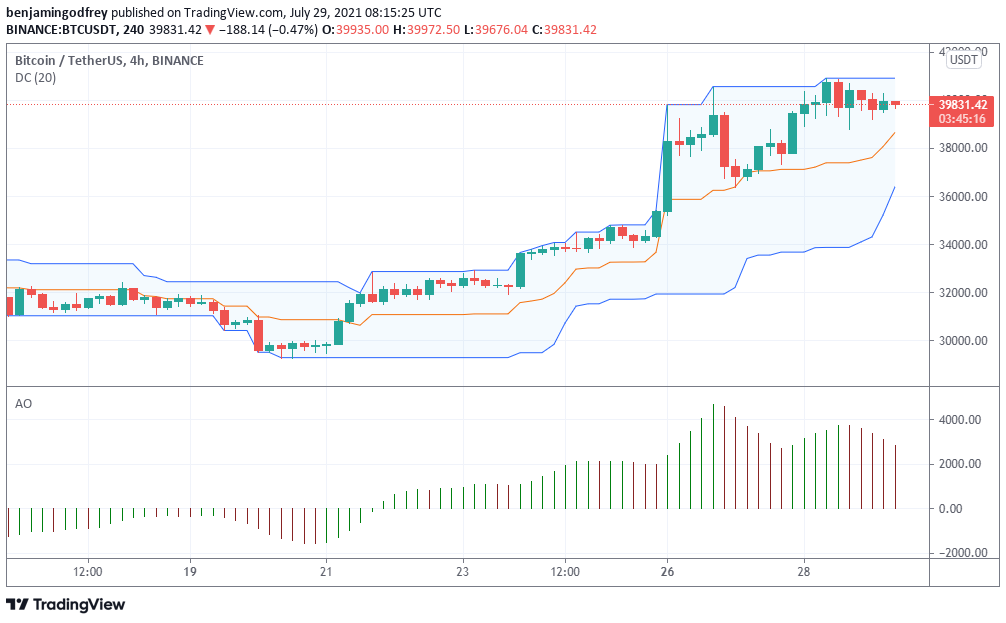
Following Bitcoin’s impressive run in the past 24 hours, the premier coin is currently seeing extreme volatility around the $40,000 support level. The coin is presently paring off its accumulated gains and changing hands at $39,775.60, down by 0.12% in the past 24 hours.
BTC-USDT.png

Consider the BTC/USDT 4-hour chart on TradingView. The latest uptrend has seen Bitcoin breakthrough major resistance points, including the $32,000, $36,000, and $40,000 price points since July 20th. Such endless run to the top calls for consolidation as some short-term buyers may opt to take profits. Both the RSI and the Donchian Channels indicators are showcasing the consolidation setting in.

At this point, the strength of the bulls is required to prevent a freefall beyond the $37,000 support zone, noting that a breach below this level can ignite a new sell-off that will push the price lower. However, should the ambition of the past days be replicated, a move toward the $45,000 resistance point may be tested in the coming weeks.

Image source: Shutterstock


Source link

Continue Reading

Blockchain

Top 10 Privacy Enhancing Technologies (PETs) in 2021

Published

on

By


The importance of data for enterprises has increased profoundly in recent times. It helps businesses make decisions quickly with better possibilities for success. On the other hand, enterprises also have to deal with a continuously expanding wave of data risk challenges. So, many data protection regulations such as CCPA and GDPR are encouraging organizations to safeguard consumer data.

At the same time, matters get more complicated with the growing adoption of technologies that allow individuals to connect and communicate with each other. The increasing dominance of such issues fostered the growth of top privacy-enhancing technologies. As the volume of personal information of users on the network continues to increase every day, privacy is definitely an essential requirement. Let us find out more about privacy enhancing technologies (PETs) and some of the top PETs in 2021.

Enroll Now: Blockchain and Data Privacy Masterclass

Why Do You Need PETs?

Various recent developments have been responsible for increasing awareness regarding the need for privacy and security in online activities. The technologies that help people connect and communicate with each other, such as online social networks, instant messaging apps, email, and others, leave a large volume of personal information available online.

Subsequently, corporations have shown additional interest in collecting the personal information generated by individuals. Corporations use the sensitive personal information of users to perform various tasks such as personalization, auto insurance rates reduction, targeted advertising, and more.

At the same time, government surveillance on individual communications alongside other online activities also creates questions on privacy. Furthermore, the best privacy enhancing technologies are clearly essential for countering the concerns of data breaches at government institutions and private corporations.

All of these factors showcase the possibilities of risks in linking data traffic and identity, disclosing location for data transfer, information disclosure, and identity disclosure. Privacy enhancing technologies or PETs can serve as plausible alternatives for solving these problems. However, it is also important to know the definition of PETs before diving into an outline of the top alternatives.

Must Read: Blockchain Security Algorithms Used To Protect The Blockchain Security

Definition of Privacy Enhancing Technologies (PETs)

When you are looking for the top privacy enhancing technologies, it is reasonable to find their definition. However, you may end up disappointed if you look for a single definition for PETs. Privacy enhancing technologies commonly point out approaches or technologies which could help in resolving security and privacy risks. On the other hand, many leading researchers have attempted to provide standard definitions for PETs.

One of the widely accepted definitions of privacy enhancing technologies suggests that they are a wide assortment of technical instruments and approaches tailored for safeguarding the privacy of users. Similarly, PETs also have a unique definition from the perspective of industry stakeholders. Industry stakeholders assume PETs as the different technical ways for ensuring privacy protection through the facility of anonymity, opaqueness, inaccessibility, pseudonymous identity for data subjects.

Policymakers have different connotations for PETs as they consider them as technical tools or methods for achieving compliance with data protection requirements or legislations. Generally, policymakers imply the functionality of PETs in unison with different organizational measures. The organizational measures include personnel management and access controls, audits, information security policies, and procedures.

The most commonly accepted definition for understanding the best privacy enhancing technologies comes from ENISA or The European Union Agency for Cybersecurity. ENISA classified privacy enhancing technologies as the special type of technology tailored for supporting pseudonymous identity for data, anonymity or data and minimizing data. The definition of ENISA also suggests that PETs have been tailored for supporting core data protection and privacy principles.

Want to know more about blockchain technology? Check out our ultimate blockchain definitions guide right now!

Popularity of PETs

The principles associated with top privacy enhancing technologies are being largely integrated into laws for entities involved in processing personal data. With the help of such laws, entities would have to use the best practices for safeguarding and maintaining personal data. One of the prominent examples of such obligations can be identified in the case of the General Data Protection Regulation (GDPR) of Europe. GDPR states that data controllers should deploy data protection as a default requirement and basic design aspect. In addition, GDPR also posits that data controllers should also use state-of-the-art technological processes for employing data protection.

Now, it is quite confusing to determine the state-of-the-art technological processes for data protection. As a matter of fact, the evolution of technological processes points out the need for constant evaluation of tools. The same is applicable for the best privacy enhancing technologies that continue to set new benchmarks in data privacy.

The popularity of privacy enhancing technologies is largely the artwork of the GDPR with the contributions of the California Consumer Privacy Act (CCPA) and the successive California Privacy Rights Act (CPRA) as well as other new data protection and privacy protection regulations and laws worldwide. As of now, PETs represent a significantly growing market with a profound influx of investment.

On the other hand, PETs are yet to get a proper definition before they move out of the generalized classification under ‘privacy tech’ or digital rights management techniques. Therefore, it is extremely difficult to place an accurate value for the privacy enhancing technology solutions market. Interestingly, the European market for homomorphic encryption tools had reached the value of $31.99 million in 2019. Estimates suggest that the privacy enhancing technology of homomorphic encryption tools would achieve a market value of almost $66.50 million by 2027.

Aspiring to become an expert in blockchain security? Enroll now in our Certified Blockchain Security Expert (CBSE) Course!

Top Picks among Privacy Enhancing Technologies (PETs)

Enterprises are looking at every possibility of innovation to address the concerns of data security and privacy. Most important of all, businesses are not only focusing on safeguarding data privacy in direct interactions with customers but also in B2B communications. As a result, many enterprises are interested in finding out the top privacy enhancing technologies. Here is an outline of some of the common entries among popular privacy enhancing technologies.

1. Homomorphic Encryption

Considered the most secure option, homomorphic encryption is often referred to as the ‘holy grail’ of encryption. The most interesting feature of homomorphic encryption is the support for computation in ciphertext or encrypted form. Furthermore, you should also note that homomorphic encryption is not a new technology and has been around in academic discussion for over 30 years.

The conventional perspectives on homomorphic encryption focused largely on its computationally intensive nature. However, recent developments have made homomorphic encryption one of the best privacy enhancing technologies around. Homomorphic encryption enables two primary operations in the encrypted or ciphertext domain.

The first operation refers to the ability for the multiplication of two different homomorphically encrypted values. The second operation involves the addition of two homomorphically encrypted values. Homomorphic encryption ensures that decryption of the product or sum could offer a meaningful value.

Here’s a guide to know How Does Blockchain Use Public Key Cryptography?

2. Differential Privacy

Another entry among top privacy enhancing technologies in 2021 is differential privacy. It is actually a rigorous mathematical representation of privacy with quantification of risk due to the inclusion of an individual in a data set. Differential privacy utilizes techniques for anonymity with the addition of statistical ‘noise’ to data sets before computation of calculation and results. It is also important to note that differential privacy could be local or global.

Global DP basically involves server-side anonymity of identity or de-identification, while local DP focuses on the application in the client device. Presently, many differentially private variants of machine learning algorithms, statistical estimates, streaming and game theory, and economic mechanism design. Differential privacy is better suited for larger databases due to the diminishing effect of a particular individual on a particular aggregate statistic alongside growth in the number of individuals in the database.

3. Generative Adversarial Networks

The scope of innovation is also one of the prolific reasons for coming across the best privacy enhancing technologies like GANs. Generative Adversarial Networks or GANs are actually a variant of artificial intelligence focused on creating algorithms in pairs. One of the algorithms focuses on learning while the other entry in the pair works as the judge.

Generative Adversarial Networks find prominent applications in unsupervised machine learning. Their application involves competition between two neural networks in a framework for delivering profoundly effective simulation of real data. The most prolific application of GANs is evident in the development of synthetic data sets.

Courses can provide a better understanding of various blockchain elements and helps to develop a better business strategy. So, enroll in our blockchain courses and take your Blockchain based business to the next level.

4. Secure Multi-Party Computation

If you look further into top privacy enhancing technologies, you are most likely to come across secure multi-party computation (SMPC). Secure multi-party computation is actually a distributed computing system or technology capable of offering abilities for computing values of interest. SMPC takes input from multiple encrypted data sources without any party revealing private data to others.

The most common example of secure multi-party computation is evident in secret sharing. In the process of secret sharing, data from each party has to be divided and distributed in the form of random, encrypted shares between the parties. The combination of random shares could help you in obtaining the desired statistical result.

5. Identity Management

Identity management solutions utilize different platforms such as distributed ledger technology and local processing to help individuals validate their identity. Identity management solutions are also capable of capitalizing on the device-level machine learning capabilities for verification and validation.

Therefore, people without any internet access develop secure connections and exchange identity-based credentials without the involvement of centralized intermediaries. The users’ device could help access the verified personal data and share it through secure channels to third parties.

Not sure what are the benefits of Identity Management? Check out this blog and know about the Top 7 Benefits Of Blockchain Identity Management.

6. Zero Knowledge Proofs

Zero Knowledge Proofs or ZKPs are also one of the examples of best privacy enhancing technologies in the present times. ZKPs are actually cryptographic methods that allow one party to prove that they know a fact to another party. Interestingly, the first party does not have to disclose any additional information about the fact to the second party.

The applications of ZKPs could make a profound mark in identity verification contexts. For example, ZKPs could help in proving the age of an individual without revealing their personal information such as date of birth. Basically, zero knowledge proofs support data minimization and safeguarding. In addition, ZKPs also ensure the incorporation of privacy as a default element in transaction design.

Also Read: How Can ZKP Deliver Better Security?

7. Synthetic Data Sets

Synthetic data sets also represent another prolific addition to top privacy enhancing technologies. They are basically collections of artificial data developed for replicating the patterns and analytical potential of real data about individuals or events. Synthetic data sets are created through the replication of significant statistical traits in the real data.

Interestingly, it is possible to create synthetic data sets at a massive scale while reducing the necessity of large test data or training sets. They find promising applications in AI and ML use cases with a focus on reducing data sharing or secondary use concerns.

8. Federated Learning

Federated learning is unique to other PETs due to support for enabling the training of automated learning models from data. Interestingly, the data never leaves the company or the device in which it was generated. The application of federated learning as a privacy enhancing technology would find prolific value in IoT use cases. For example, federated learning could help in training intelligence systems in virtual assistants without compromising data integrity.

9. Edge Computing and Local Processing

The use of edge computing and local processing in combination is also one of the best privacy enhancing technologies. It involves running away of applications, data, and services from centralized nodes at the network’s endpoints. This is an evident highlight in cases of devices that need high speed or without any constant connectivity. Local processing addresses the need for data minimization through the reduction of the amount of data that the service provider should collect or retain in cloud storage or centralized service.

10. Trusted Execution Environments

Trusted Execution Environments or TEEs are also one of the promising examples of PETs. However, they are known for being the least secure option among the top privacy enhancing technologies. The security for TEEs basically involves a perimeter-based security model. With all the information decrypted in the perimeter of the on-chain assembly, TEEs can ensure faster computational abilities. So, TEEs are suitable in use cases that don’t have strict security and privacy restrictions.

Watch now the full on-demand webinar on Approaches to Overcome Scalability, Confidentiality, and Data Privacy Issues for Enterprise Blockchains

Final Words

It is clearly evident that privacy is not just a new technology trend everyone is running after. At the same time, the importance of privacy enhancing technologies also becomes quite relevant in the present times. Increasing concerns of data breaches, new vulnerabilities, and changing regulatory landscapes for data protection and privacy drive the need for PETs.

Privacy enhancing technologies provide the most reliable answers for enterprises having data security and privacy as their priorities. Gradually, many businesses are leveraging the capabilities of best privacy enhancing technologies to derive value for their operations. However, it is also important to remember that PETs are considerably different from each other and fit with certain applications. Find out more about PETs and how to position them perfectly for desired advantages right now!


Source link

Continue Reading

Blockchain

Robinhood Explores New Feature to Protect Investors from Crypto Fluctuations

Published

on

By


Zero-commission financial trading platform Robinhood is exploring a new feature designed to protect investors from price fluctuations during investing in cryptocurrency trading.

According to a Bloomberg report, Robinhood is studying price fluctuation protection mechanisms to protect the interests of investors against the unpredictable high volatility of cryptocurrency prices based on the code of the iPhone app test version discovered by iOS developer Steve Moser.

The code shows:

“To protect your orders against price volatility, we may sometimes skip your recurring orders or buy less than your chosen amount.”

A spokeswoman representing Robinhood declined to comment.

In addition, American financial technology and financial services company Robinhood is developing an option called “comprehensive investment” through which investors can invest their debit or credit card change in designated stocks.

Robinhood said that at present, investing in small change has become a prevalent strategy for novice stock investors, and it is also an important market that competes with trading platforms such as Acorns, Chime and Wealthsimple.

The Chief Financial Officer Jason Warnick said that on the firm’s growth strategy:

“There is more we can do with direct deposit and debit cards, particularly given the opportunity to connect rewards with our brokerage and crypto offerings.”

According to the files from financial trading platform Robinhood for an IPO in the US amidst a growing sect of brokerages exploring public listings, Robinhood, known for charging zero commissions to its traders, has room for cryptocurrencies, a growing asset class that accounted for 17% of the firm’s total revenue.

Image source: Shutterstock


Source link

Continue Reading

Trending