
Bitcoin
Heightened Fears in Ukraine Leads to Risk-Off Sentiment – Blockchain News, Opinion, TV and Jobs



By Marcus Sotiriou, Analyst at the UK based digital asset broker GlobalBlock
Last week there was a risk-on sentiment after the FOMC meeting where the Federal Reserve raised rates by 0.25% as expected. Bitcoin reached a high of $42,400. However, yesterday and today we saw a fall to the mid $40,000 region, as there are heightened fears surrounding the Russa/Ukraine war.
Firstly, Russia gave Ukraine a deadline to surrender Mariupol at 3am UK time, and the Russian Defense Ministry made clear anyone who chooses to remain in the city will face a military tribunal held by the Donetsk People’s Republic. Ukraine have rejected the offer to surrender. In addition, Russia now accuses “Ukrainian nationalists” of planning terrorist attacks on Ukrainian cities and foreign nationals “to blame Russia.” This is concerning as the Kremlin blames others of doing what it seeks to orchestrate. Lastly, Ukraine’s defense ministry warned that another group of Russian Wagner Group mercenaries arrived in Ukraine to assassinate the President Zelensky. These events have lead to a risk-off sentiment for global markets this morning, as the Dollar Index climbed whilst Bitcoin and equities sold off.
Amongst the war atrocities, Bitcoin and crypto have received great support from regulators worldwide in recent weeks. Ukraine legalised crypto last week as President Zelensky signed the digital assets bill into law.
Furthermore, there are reduced fears of stringent crypto regulation from the US in response to Russia potentially using crypto to evade sanctions. The secretary treasury official said that the crypto market is currently not large enough to run an economy on, and the crypto ecosystem is too underdeveloped to effectively facilitate sanctions evasion on a large scale. She added that, “while it’s growing because the use of crypto is growing, its share as a medium for illicit finance is not anywhere as large as just using cash.” This is a promising development as it demonstrates awareness and understanding of the crypto industry from the top regulators.
Senator Elizabeth Warren remains concerned though, as she introduced a bill last week “to ensure that Vladimir Putin and Russian elites don’t use digital assets to undermine the international community’s economic sanctions against Russia following its invasion of Ukraine.” Despite Warren’s fears, the secretary treasury official’s expertise is promising for the industry.
Source link







On-chain data shows the Bitcoin exchange whale ratio has been going up recently, something that may be bearish for the price of the crypto.
Bitcoin Exchange Whale Ratio Has Been Going Up In Recent Weeks
As pointed out by an analyst in a CryptoQuant post, the current BTC whale ratio value suggests whales are still selling large amounts.
The “exchange whale ratio” is an indicator that measures the ratio between the sum of the top ten Bitcoin transactions to exchanges and the total exchange inflows.
In simpler terms, what this metric tells is how much of the total inflows to exchanges is contributed by the whales (the ten largest transactions are assumed to be from whales).
When the value of the ratio is high, it means the whales are making up for a large part of the inflows right now. Such a trend can be a sign of dumping from these humongous holders, and hence can be bearish for the crypto.
Related Reading | Glassnode: Bitcoin LTHs Who Bought During 2017-2020 Aren’t Selling Yet
On the other hand, low values of the metric can suggest whales are selling at a healthy rate right now. This could be either neutral or bullish for BTC’s price.
Now, here is a chart that shows the trend in the Bitcoin exchange whale ratio over the last couple of years:
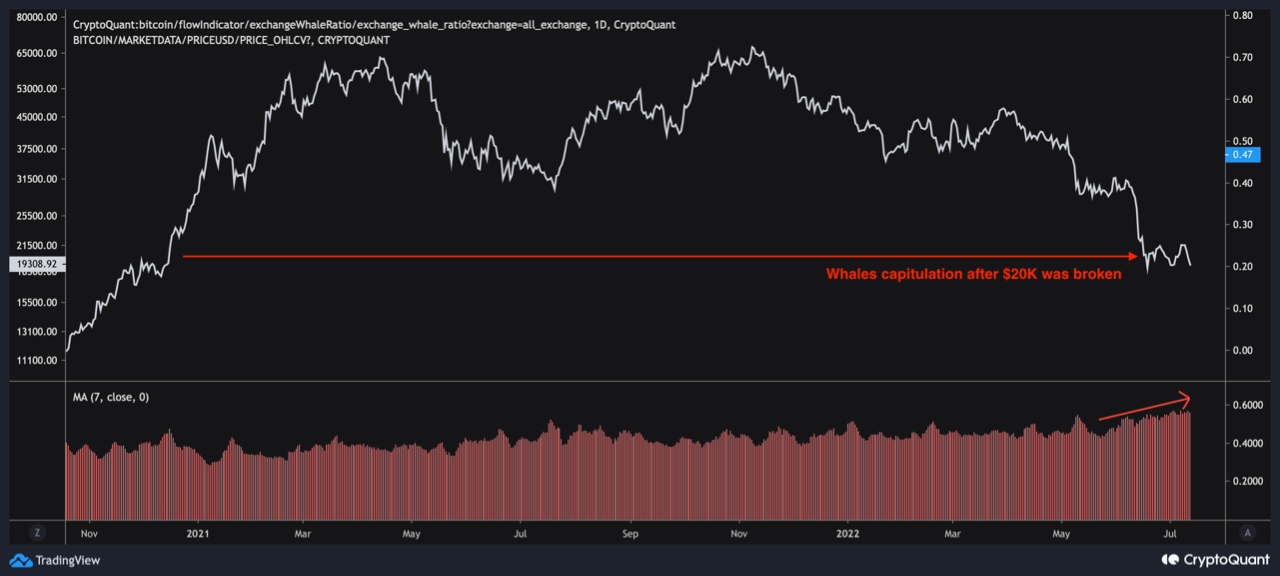
Looks like the value of the indicator has been going up recently | Source: CryptoQuant
As you can see in the above graph, the Bitcoin exchange whale ratio has been rising up in recent weeks.
The increase seems to have started around when the coin dropped below the $20k support. A large part of the market went underwater following this crash and the subsequent ramping up of dumping from whales could suggest they are in a capitulation phase right now.
Related Reading | Inflation Hits New 40-Year High, Will Bitcoin And Ethereum Plummet Again?
The quant notes that while this heavy selling from the whales can be bearish for the crypto’s price in the short term, it could also be a sign that the bottom is coming near.
BTC Price
At the time of writing, Bitcoin’s price floats around $19.4k, down 3% in the last seven days. Over the past month, the crypto has lost 27% in value.
The below chart shows the trend in the price of the coin over the last five days.
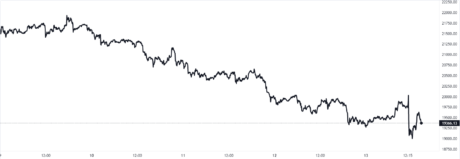
The value of the crypto seems to have been going down over the last few days | Source: BTCUSD on TradingView
Bitcoin looked to be holding above $20k a week ago or so, but during the past few days the coin has once again started moving down below the level.
Featured image from Karl-Heinz Müller on Unsplash.com, charts from TradingView.com, CryptoQuant.com
Source link

With the recent trend in the crypto market, the world-leading digital asset seems to be getting attention. From the general price fall for all crypto tokens, Bitcoin is one of the assets that has seen a drastic cut in its value. BTC has plunged by over half of its value as of November 2021.
As a result, many participants in the industry have shown considerable concern and focus on the trend of BTC. Such attention to Bitcoin had invariably pushed the token to have a spike in its social dominance metric.
Data from Santiment revealed a rise in the yearly high for the BTC Social Dominance metric. The firm noted an increase in people’s interests and discussions concerning the most significant global crypto asset by market cap. It maintained that since June 2021, the Bitcoin vs. other crypto discussion ratio has skyrocketed on social media.
Suggested Reading | Ethereum (ETH) Continues To Lose Luster, Drops Below $1,100 Support
The rise is mainly linked to the drastic price dip as BTC recently hovers around the $20K level. This spike in social dominance is recorded historically as a positive indication for BTC and the broader crypto market. Also, the crypto bulls would benefit immensely from the rising trend.
Altcoins Have Different Sentiments
Most of the altcoins have different stories to tell. However, for Dogecoin and Shiba Inu, there are progressive strengths seen in their prices. This robust stance is due to the backing the tokens enjoy through increased whales’ transactions and new developmental additions.
But there is no significant price flows for some tokens like Ethereum, Cardano, Ripple, and Solana. Such dormancy has a solid link to the issues of insolvency and bankruptcy filing by some firms like Voyager Digital and Three Arrows Capital.
With the date for the U.S. CPI at hand, different folks have diverse opinions on the potential flow of cryptocurrency. Bitcoin and Ethereum record an increase in their discussion rates as reports expect price drops beyond support levels.
A survey by MLIV Pulse indicated only 40% of Wall Streets investors believe BTC’s price hitting the $30K level. The remaining 60% anticipate a drop up to $10,000 per BTC token.
Bitcoin Price And Sentiment Report
Through the little spike in sentiments, cryptocurrency prices significantly improved last week. As of July 8, Bitcoin prices hover through the $22,000 region. The volatility of crypto tokens is getting pronounced as the CPI date is quite close.
Suggested Reading | Tezos (XTZ) Nears 3-Week High – Can Bulls Barrel Towards $1.80?
The current prices for BTC and ETH are respectively above $19,000 and $1,068. They indicate a significant drop on the daily chart.
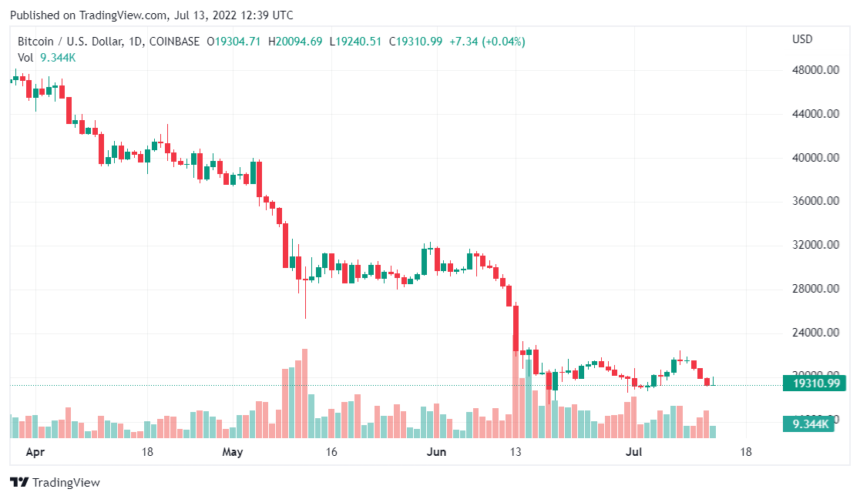
July 13 is the scheduled date for the U.S. June CPI data. The press secretary, Karine Jean-Pierre, anticipates increased inflation data since there was a rise in food prices and gasoline. But July’s experience of a drop in energy costs signifies a positive shift for the coming months.
Featured image from Pexels, chart from TradingView.com
Source link

Exchange Whale Ratio Is Trending Up

Why Alex Tapscott quit his high-paying job to write a book about Bitcoin

Bears Refuse To Budge As Bitcoin Struggles To Reclaim $20,000

Fighting the crypto winter and token protocol inflation in 2022

Social Dominance Rate Of Bitcoin Marks An All-Time High in 2022

NFT volume sees yearly low in June, but first-time buyers remain consistent

Crypto Wallets, Explained. What is a crypto wallet? | by Blockchain.com | @blockchain | Jul, 2022

With Revulution NFTs, Revuto Offers Lifetime Access To Netflix & Spotify And Reinvents How Subscriptions Are Managed

Dogecoin misses bullish target after Elon Musk snubs Twitter — what’s next for DOGE price?

Loopring Wobbles In Last 2 Months

Crypto winter presents an opportunity amid chaos, says asset group exec

Ethereum (ETH) Continues To Lose Luster, Drops Below $1,100 Support

Why Coinbase is banning slide decks and ‘endless meetings’

Ethereum Bears Are Back, Why ETH Could Dive Below $1K

Judge denies SEC motion to keep Hinman docs secret in Ripple case
BNM DAO Token Airdrop
New Minting Services

Could an Earnings Recession Lead to More Pain for Crypto? – Blockchain News, Opinion, TV and Jobs

A Bear of Historic Proportions – Blockchain News, Opinion, TV and Jobs

Virginia passes new crypto law whilst macro headwinds mount up – Blockchain News, Opinion, TV and Jobs

‘Crypto is just like the end of the 90s with the internet bubble,’ says Hodl CEO Maurice Mureau

Interview with Ruud Feltkamp, Owner of AI-driven Trading Bot Cryptohopper – Blockchain News, Opinion, TV and Jobs

High-profile BAYC collector denies allegations of wrongdoing brought by DeFi detective

Are expiring copyrights the next goldmine for NFTs?

BNM Live Stream

Dollar Strength Causes Bitcoin Weakness – Blockchain News, Opinion, TV and Jobs

Live Stream Block News Media

Block News Media Live Stream

Tesla, Blockstream and Jack Dorsey’s Block Team-up to Mine Bitcoin Sustainably – Blockchain News, Opinion, TV and Jobs

Fintech-Ideas brings blockchain functionality to its range of platforms – Blockchain News, Opinion, TV and Jobs
-
Uncategorized6 months ago
BNM DAO Token Airdrop
-
Uncategorized8 months ago
New Minting Services
-
 bear market2 weeks ago
Could an Earnings Recession Lead to More Pain for Crypto? – Blockchain News, Opinion, TV and Jobs
-
 bear markets2 weeks ago
A Bear of Historic Proportions – Blockchain News, Opinion, TV and Jobs
-
 Bitcoin2 weeks ago
Virginia passes new crypto law whilst macro headwinds mount up – Blockchain News, Opinion, TV and Jobs
-
 Blockchain2 weeks ago
‘Crypto is just like the end of the 90s with the internet bubble,’ says Hodl CEO Maurice Mureau
-
 Blockchain2 weeks ago
Interview with Ruud Feltkamp, Owner of AI-driven Trading Bot Cryptohopper – Blockchain News, Opinion, TV and Jobs
-
 Blockchain Analytics2 weeks ago
High-profile BAYC collector denies allegations of wrongdoing brought by DeFi detective