ETH 2.0
Vitalik Buterin Gives Expected Timeline for Ethereum 1.0 and 2.0 Merge





- Sygnum bank has launched Ethereum 2.0 staking.
- Clients’ can generate a yield as high as seven percent per annum.
Sygnum Bank, the world’s first digital asset bank has officially launched Ethereum 2.0 staking. To start, clients can generate a yield of up to seven percent per annum from their existing wallets. According to the official announcement, Sygnum has integrated this service into its banking platform designed to be simple and user-friendly.
Staked Ethereum will be protected with the highest available security and will be held in clients’ individual accounts, taking full advantage of the fully segregated wallet and institutional-grade custody.
📣 NEWS: Sygnum first Bank to offer Ethereum 2.0 staking.
Sygnum Bank clients can now conveniently and securely stake Ethereum through Sygnum’s institutional-grade banking platform and generate a yield of up to 7 percent per annum currently.https://t.co/HmGzjkw9pT
— Sygnum Bank (@sygnumofficial) July 6, 2021
The Total Value Locked (TVL) of the Defi sector has grown by more than three times since the start of the year as the majority of the decentralized products and services are based on Ethereum.
Head of Accounts and Custody at Sygnum Bank Thomas Brunner, in a statement, mentioned that this development is for the benefit of the long-term investors.
Sygnum clients can participate in the new proof-of-stake Ethereum and benefit from potentially higher staking rewards now. This is a compelling choice for long-term investors in the Ethereum ecosystem.
Sygnum seeks to support more DeFi assets
Ethereum 2.0 is the long-awaited upgrade of the Ethereum network and has been designed to drastically reduce its environmental impact while it increases efficiency. Scalability and security are part of the main area of focus to position the network for any future growth.
Ethereum 2.0 is the second-largest Proof-of-Stake network by stake capitalization with $13.5 billion. It is only behind Cardano which has a staked capitalization of $31.8 billion.
According to Thomas Eichenberger, Head of Business at Sygnum bank, Ethereum staking emerges as “the core element for digital asset portfolios which can now be accessed in a convenient, secured and regulated setting.”
This further expands Sygnum’s offering of attractive, regulated yield generating products to meet the needs of clients to accumulate other forms of return in addition to capital appreciation.
In August and October 2019, Sygnum Bank obtained its banking license in Switzerland and its capital markets services license in Singapore respectively.
In November 2020, the bank approved staking service for Tezos (XTZ) and later offered a fixed-term deposit product for its Digital Swiss Franc Stablecoin, DCHF.
The bank has over the past few months sought to launch regulated banking services for eight leading tokens as well as provide support for DeFi assets. As it stands, Sygnum is strongly competing with popular native staking providers and centralized exchanges like Kraken.
Source link

Whales can be bashful and clever creatures, but when you manage to catch one in action it’s a sight to behold — consider, for instance, the single entity responsible for depositing 100k ETH into the Eth 2.0 deposit contract from 133 different addresses last week.
Deposits into the ETH 2.0 staking contract have been picking up as of late, with 100k ETH pouring into the Eth 2 deposit contract on a single day last week. It caught the attention of the crypto space and, like most stories about on-chain activity, looking at the actual transactions and associated accounts can shed light on what went down. In this case, it seems the 100k ETH influx can be traced back to a single Ethereum address and a wallet that is responsible for funnelling upwards of 258k ETH ($541.8 million at 2100 per ETH) into the deposit contract.
Searching for the mega whale who is mega bullish ETH and Eth 2.0
Given the relatively steady increase the deposit contract has seen since launching in December, it is likely a single entity was behind last week’s unexpected surge. But can we prove it? Can it be reasonably shown that a single entity was behind the 100k ETH worth of deposits?
Unfortunately, actually finding the transactions and addresses on-chain was not a quick “first page of Etherscan” find.
In hopes of getting a quick win, the first place we checked was the largest total deposits made by a single address to the deposit contact. While this strategy did find one address that had recently deposited some 12,800 ETH across 400 transactions to the deposit contract, unfortunately, it was not the address of interest, as the date of the transactions (June 20, 2021) is a couple days too early and the amount is only ~13% of the total 100k ETH, even though “only ~13%” in this case is still over $26.8 million (at $2100 per ETH). It is clear that if the 100k ETH had come from a single entity, they were more discreet than a straight 100k YOLO deposit from one address.
A deeper analysis was required, so we downloaded the transactions to the deposit contract from Etherscan for June 22, 2021 and uploaded them into Excel. The data was clear.
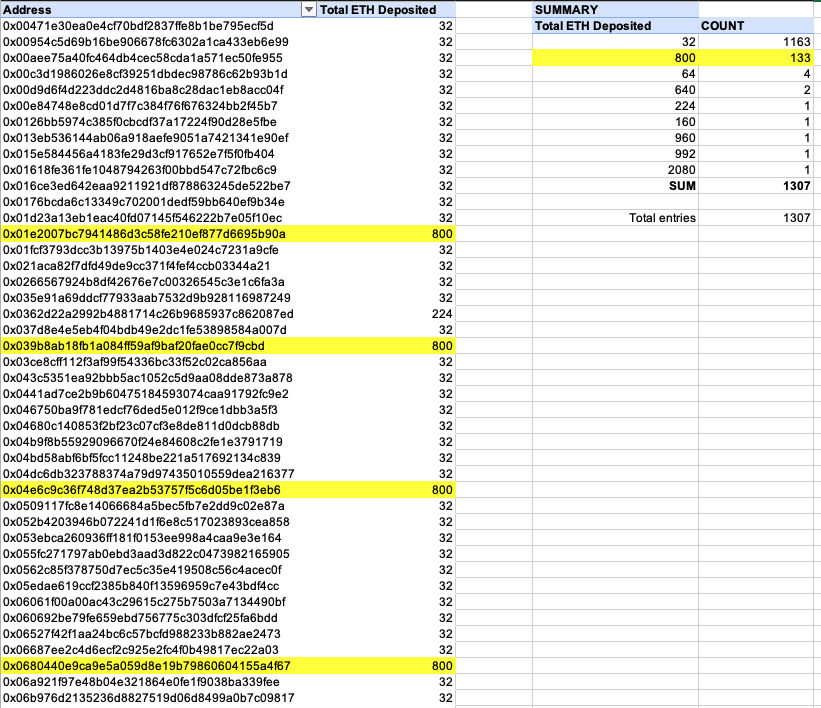
From the data pulled for June 22, 2021, there were 1163 addresses that deposited a total of 32 ETH into the deposit contract, 133 addresses that deposited 800 ETH into the deposit contract, and 11 other addresses that deposited other various multiples of 32 ETH.
For those unfamiliar, ETH 2.0 is the protocol change Ethereum has been planning since launch that will transition Ethereum from a proof of work to a proof of stake network. Proof of stake validators will secure the network and receive ETH for doing so. One validator starts off as 32 ETH and is currently acquired by sending 32 ETH to a deposit contract on Ethereum mainnet, the current proof of work chain.
Depositing is a one way bridge since the full amount of ETH including any interest earned is not accessible until the network merge, which is currently unlikely to happen until late 2022.
With the same total deposit amount of 800 ETH on the same day from 133 addresses, our confidence grew that the 100k ETH had in fact come from a single address. To confirm this, there had to be some similarity between the addresses. Sure enough, a quick look revealed that each address was funded by a common address.
Eureka! A whale sighting.
The picture of our whale was starting to become more clear. Let’s take a high level look at how they executed their operation:
- In each of the new addresses, 800 ETH was deposited into the deposit contract - 25 deposits of 32 ETH. The remaining 10 ETH was sent to cover gas costs and once the deposits had finished the leftover ~9.86 ETH in each address was sent to a common address. These funds were eventually sent to the deposit contract.
- They laid the foundation for their plan with a casual 100k ETH transaction ($210 million at $2100 per ETH) on June 16th. In a juxtaposition for such a large amount, the transaction was in no rush to go through, taking 1 minute and 41 seconds to confirm. The ‘somewhere between standard and fast’ gas price channels some serious, “Well, I don’t want to over pay for this transaction” vibes that, while understandable for most plankton using Ethereum, is more surprising coming from such a behemoth of a whale.
- Using the 100k ETH in the new wallet they funded 133 fresh wallets over an 8-minute span, each with 810 ETH for a total of 107,730 ETH.
Looking at the address that was funded with the 100k ETH, they have seen over 258k ETH ($541.8 million at 2100 per ETH) flow through it according to Nansen. Without clicking through to every address, it appears that all of the ETH flowing through this address has been funnelled into the deposit contract in a similar manner to what is described above - starting with a 90,000 ETH transaction on May 21st and a 49,990 ETH transaction on June 14th.
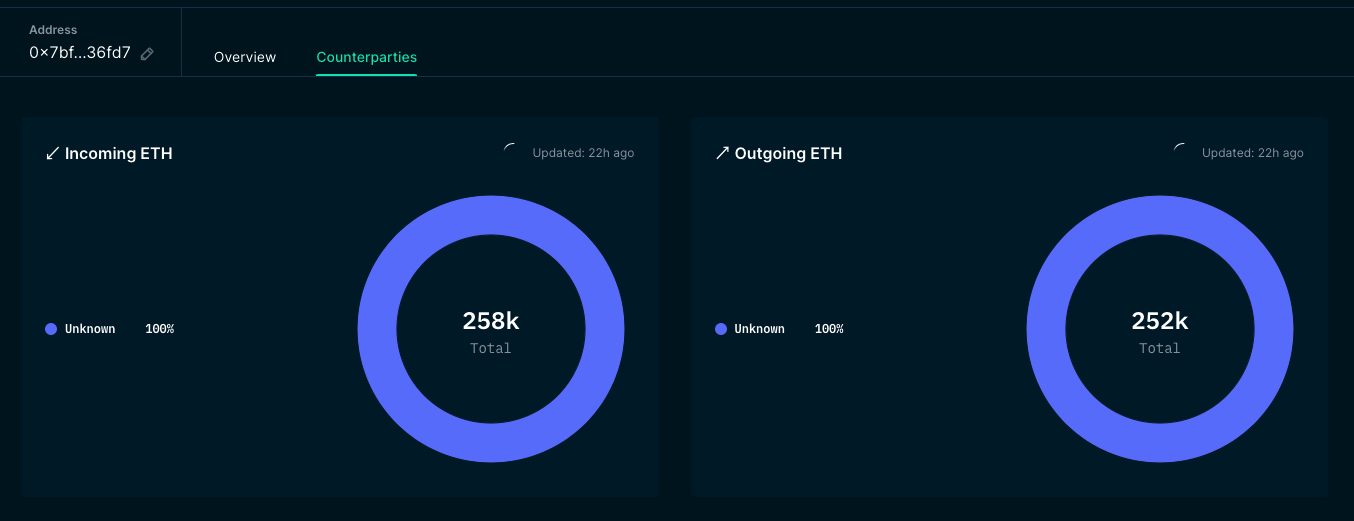
The address is also showing no signs of slowing down. While writing this piece, the address was funded twice more for 6119 ETH and 792 ETH. Based on their seeming Michael Saylor “sell the office furniture” mentality, this is almost surely destined for the deposit contract.
Looking at the 100k ETH transaction, it was funded from an OG Ethereum address who had immediately received the funds before that from an address that Nansen shows as having received 100% of its 302k ETH from a wallet Nansen has tagged as crypto-lender Celsius.
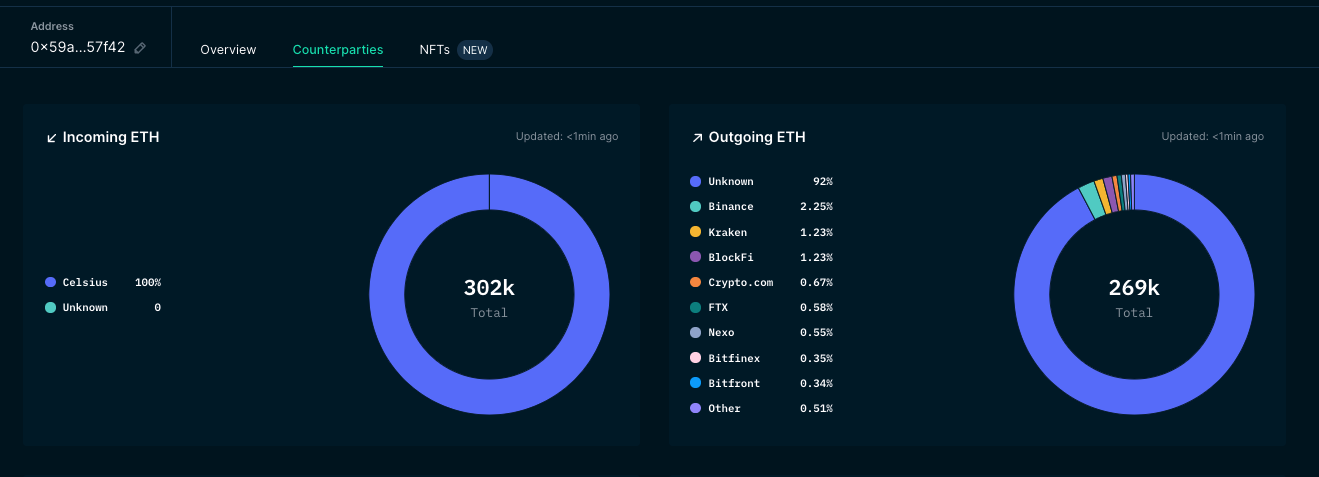
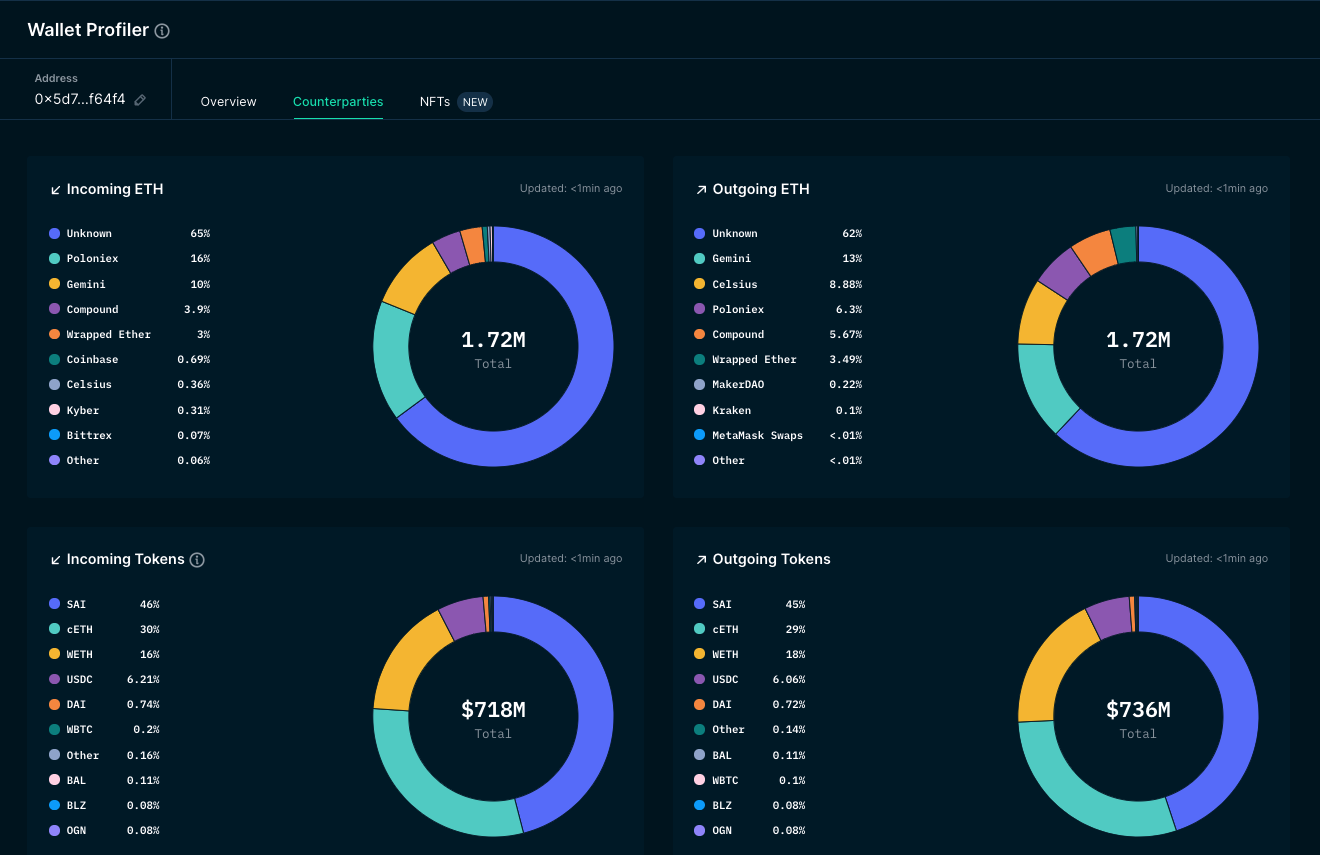
The OG address in question has transactions going back to September 2016 and looking at their early ERC-20 transactions is a trip down r/ethtrader memory lane including SPANK, KIN, FUN, OMG (airdropped - still haven’t sold 💎🙌) and lots of SAI. They also receive regular deposits of BOND from a contract that Nansen has labeled as vesting indicating they are an early team member or investor.
Their total activity according to Nansen is massive, seeing 1.72 million ETH flow in and out. There are only so many OGs with this kind of cash and conviction in Ethereum, and it doesn’t look like they’re going anywhere anytime soon.
Source link

Ether’s (ETH) $1.5 billion monthly expiry on June 25 was slightly favorable for bears, and at the time, Cointelegraph reported that the $2,200 price was critical to eliminate 73% of the neutral-to-bearish put options.
However, bulls were not able to sustain their advantage because the expiry price was near $1,950. In the end, the protective put options outnumbered the neutral-to-bullish call options by $30 million.
Fast forward to July, and after a noticeable 10% rally, Ether’s price again struggles to sustain the $2,100 support. Bitcoin’s negative 3.5% performance could partially explain last week’s price move, but the London hard fork scheduled for this month could also be responsible.
The proposal EIP-1559 will cap gas fees, making it more predictable for users. However, miners’ revenue will be negatively impacted. Any pushback from miners could delay Eth 2.0 even more, which could be a reason for the recent price weakness.
Lastly, regulatory pressure could also be blamed for the negative sentiment. For example, the United States Financial Crimes Enforcement Network announced that cryptocurrencies would be among its top national priorities for countering terrorism financing and ensuring proper Anti-Money Laundering policies.
Related: Bulls and bears fight over $34K Bitcoin price as $445M options expiry looms
Bulls have a slight advantage, but overall the expiry should be small
The July 2 $230 million Ether options expiry perfectly reflects a scenario where both bulls and bears expected extreme price changes.
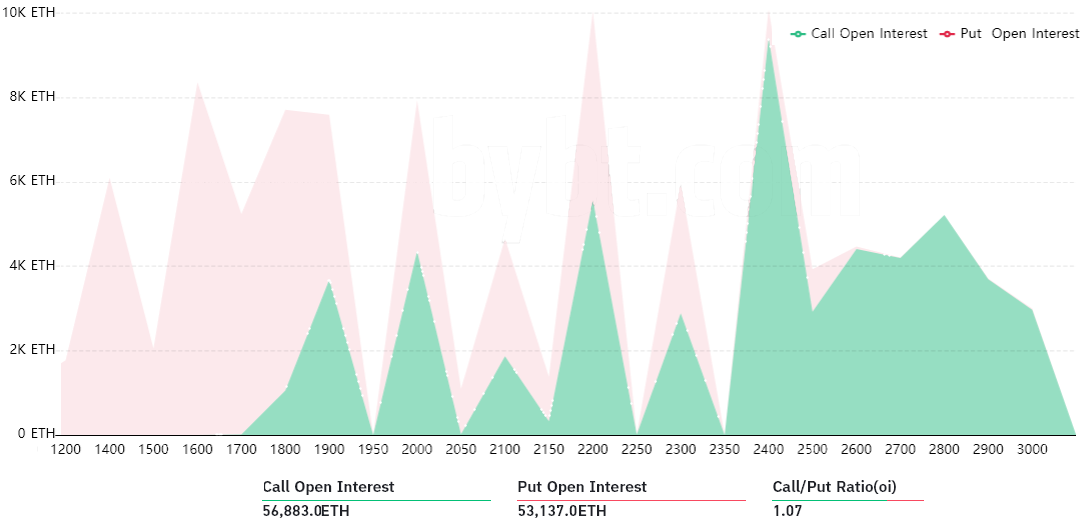
110,000 Ether contracts seem initially balanced between the call (buy) and put (sell) options. However, only 30% of the neutral-to-bullish call options have been placed at $2,200 or below, which is equivalent to a $36 million open interest. The remaining 70% of the call options are unlikely to take part in Friday’s expiry.
On the other hand, protective puts were mostly placed at $1,900 and lower. However, these contracts are now worthless as there are less than 14 hours before they expire. Therefore, the remaining neutral-to-bearish options down to $2,100 amount to a $26 million open interest.
In a nutshell, Friday’s Ether expiry will be relatively small, but the $2,200 mark is extremely important. Above that level, the bulls’ lead increases by $18 million, causing a $28 million imbalance that favors call options.
Bears aim for $2,100 or lower to eliminate the bulls’ advantage
For bears, any expiry price below $2,100 is enough to balance out the situation. However, it is worth noting that Friday’s expiry size has been greatly reduced because both sides had extreme bets, but none of them were fulfilled.
At the time of writing, there is no reason to believe that either side will try to force Ether’s price in a particular direction ahead of the expiry. Traders will likely concentrate their bets (and efforts) for the end of July, depending on whether or not the London hard fork faces any delays or surprises.
The views and opinions expressed here are solely those of the author and do not necessarily reflect the views of Cointelegraph. Every investment and trading move involves risk. You should conduct your own research when making a decision.
Source link
Tron (TRX) Coin Price Prediction 2021 | TRX Technical Analysis | Crypto News Today ! Urgent Update
Let's Find the Newest PLAY-TO-EARN Crypto Games.

PAID Network ($PAID) and Meerkat Finance SCAM?

Daily Farm Update | Token n Farm Launches | BSC & Polygon

How to Transfer Crypto From Binance to Trust Wallet (2021) | CryptoCurrency Tutorial

BTT (BITTORENT) SIAP NAIK !?? SETELAH EVENT 10 JUNI?? PREDIKSI DAN ANALISA BTT (BITTORENT) 2021 !!
-
 liquidity1 month ago
Daily Farm Update | Token n Farm Launches | BSC & Polygon
-
 Usecase2 months ago
How to Transfer Crypto From Binance to Trust Wallet (2021) | CryptoCurrency Tutorial
-
 Usecase2 months ago
BTT (BITTORENT) SIAP NAIK !?? SETELAH EVENT 10 JUNI?? PREDIKSI DAN ANALISA BTT (BITTORENT) 2021 !!
-

 Blockchain1 week ago
SmartFi To Issue First Mineable Stablecoin & Payment System without Transaction Fees
-

 Education2 months ago
Karan Dwivedi Zoom Meeting Crypto Bulls, ESPN Global, Master Nodes
-

 Usecase3 months ago
Next SAFEMOON | MARSMISSION Coin 100X ? Low Price Cryptocurrency 2021 | Best Profitable Crypto 2021
-

 Education2 months ago
Best Crypto Coin To Invest in 2021 | Best Cryptocurrency To Invest 2021 | Wazirx | Safemoon Binance
-

 liquidity2 months ago
How to Use Bunny Swap to Maximize Your Yield Farming on Binance Smart Chain