
Bitcoin
MicroStrategy CFO Says the Michael Saylor-Led Firm May Buy More Bitcoin on This Condition

MicroStrategy’s chief financial officer (CFO) Phong Le says the enterprise analytics software firm, which currently holds over 100,000 Bitcoin, is open to buying more of the flagship crypto asset.
In a Q2 earnings call, Le says MicroStrategy could buy more Bitcoin when financial conditions allow for it.
“Going forward, you should expect that we may purchase additional Bitcoin when our cash, cash equivalents and short-term investments exceed current working capital requirements.”
MicroStrategy’s CFO also says that when market conditions permit, the tech firm could also raise funds to buy more Bitcoin.
“And we may from time to time, subject to market conditions, issue debt or equity securities and capital-raising transactions with the objective of using the proceeds to purchase Bitcoin.”
Michael Saylor, the company’s CEO, adds that MicroStrategy is currently following two business approaches.
“With the exception of just a few people in legal and finance, the entire company is focused upon enterprise business intelligence. That is our micro strategy…
And our macro strategy is to acquire and to hold Bitcoin.
Our plan with regard to that, of course, is to continue to acquire Bitcoin, continue to hold Bitcoin. It’s a very straightforward strategy.”
MicroStrategy currently owns 105,085 Bitcoin, 10% of which the software firm bought in the second quarter, according to Saylor.
“In the entire quarter [Q2 of 2021], we were able to acquire more than 13,005 Bitcoin. We acquired 13,759 Bitcoin at [a] slightly higher average price: $38,467. We are very comfortable with that acquisition. I was very pleased to see us making such good progress and ending the quarter with 105,085 Bitcoin. At this point, we’ve now invested $2.741 billion in Bitcoin.”
I
Don’t Miss a Beat – Subscribe to get crypto email alerts delivered directly to your inbox
Follow us on Twitter, Facebook and Telegram
Surf The Daily Hodl Mix

Disclaimer: Opinions expressed at The Daily Hodl are not investment advice. Investors should do their due diligence before making any high-risk investments in Bitcoin, cryptocurrency or digital assets. Please be advised that your transfers and trades are at your own risk, and any loses you may incur are your responsibility. The Daily Hodl does not recommend the buying or selling of any cryptocurrencies or digital assets, nor is The Daily Hodl an investment advisor. Please note that The Daily Hodl participates in affiliate marketing.
Featured Image: Shutterstock/Tithi Luadthong
Source link



Bitcoin
Will Crypto History Repeat? On-Chain Analyst Willy Woo Questions Conventional Wisdom on Bitcoin’s Trajectory
Widely followed on-chain analyst Willy Woo says Bitcoin (BTC) traders shouldn’t expect the current market cycle to end up resembling the 2013 BTC bull run.
In a new episode of What Bitcoin Did with Peter McCormack, Woo says the crypto space has a “cycle imprint” in which traders are looking too much at past bull runs in order to time the current one.
Woo says that some traders might be hoping that Bitcoin experiences something similar to its 2013 mid-cycle crash, in which the flagship cryptocurrency dropped nearly 80% before breaking new highs.
“We’ve got this cycle imprint. People are now cycle-imprinting 2013 now that we’ve got this big dent in the bull market. I think everyone’s now agreeing that it is still a bull market, and now we’re cycling back to 2013…
I’m beginning to think this is not going to happen. I’m actually siding towards this being unlike anything. I think we’ll go past the end of this year, and there’s a fair amount of likelihood that it won’t come into a full-blown bear market like we saw in the prior cycles, and then people start talking about the extended cycle theory.”
According to the closely followed analyst, Bitcoin is more likely to experience a random grind upwards with less dramatic peaks and shorter bear trends.
“I think this thing is just going to do a crazy wander around demand and supply and the halvening has less impact. And maybe Michael Saylor is right: there is no top. It just keeps wandering and discovering. You might have things that we just experienced, mini-bear seasons.”
In June, MicroStrategy CEO Michael Saylor outlined a slew of catalysts that he believes can drive Bitcoin’s price in the coming years.
As for the current state of Bitcoin, Woo names the $42,000 level as the key area to break before BTC can start challenging the $50,000-$60,000 range. At time of writing, Bitcoin is trading at $39,120, according to CoinGecko.
I
Don’t Miss a Beat – Subscribe to get crypto email alerts delivered directly to your inbox
Follow us on Twitter, Facebook and Telegram
Surf The Daily Hodl Mix
Disclaimer: Opinions expressed at The Daily Hodl are not investment advice. Investors should do their due diligence before making any high-risk investments in Bitcoin, cryptocurrency or digital assets. Please be advised that your transfers and trades are at your own risk, and any loses you may incur are your responsibility. The Daily Hodl does not recommend the buying or selling of any cryptocurrencies or digital assets, nor is The Daily Hodl an investment advisor. Please note that The Daily Hodl participates in affiliate marketing.
Featured Image: Shutterstock/Mia Stendal
Source link
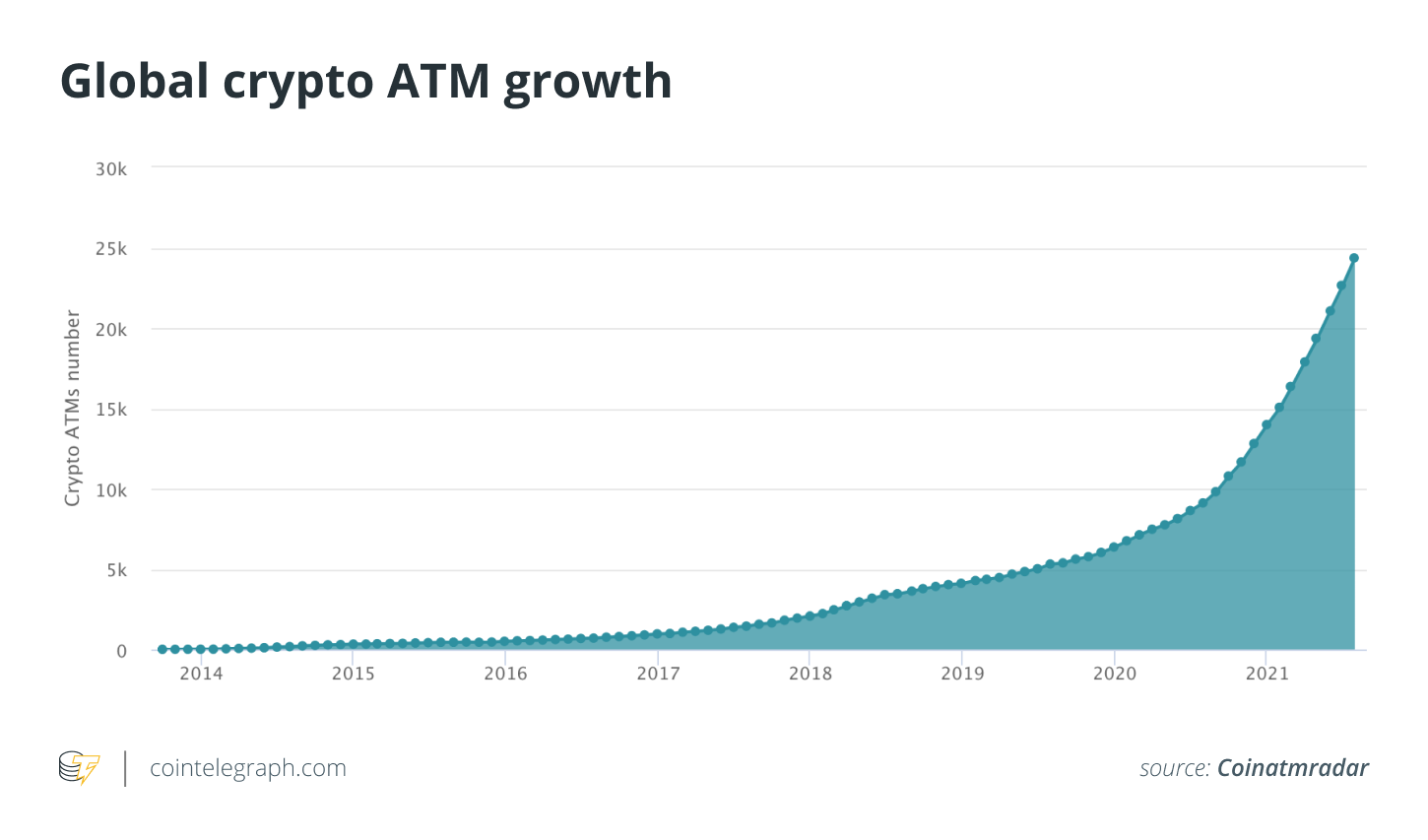
Cash may be king when it comes to purchasing Bitcoin (BTC), as recent data states that there has been a spike in crypto ATM installations during 2021, showing a 71.3% increase from Jan. 1, 2021, until the time of reporting. Specifically speaking, there are currently over 24,000 crypto ATMs located across the globe. Data further suggests that crypto ATMs are being installed at a rate of about 52.3 machines per day.
While growth is clearly underway for the cryptocurrency sector, the reason behind the surge in crypto ATMs may be due to a demand for using cash to buy Bitcoin. Alona Lubovnaya, director of product operations for Bitcoin Depot — a Bitcoin ATM operator — told Cointelegraph that more people from all walks of life are becoming interested in crypto, particularly the underbanked community. “We’ve entered a new era where traditional bank accounts can be replaced with digital wallets, and because of this, more people are choosing to buy crypto with cash.”
Cash is easy and familiar for the mainstream
While there are many reasons as to why certain individuals would want to buy cryptocurrency from an ATM versus an exchange, most of the common use cases seem to be focused on easy and quick access to crypto.
For instance, one piece of research claims that over 50 million Americans are likely to buy cryptocurrency in the next year. Findings also indicate that a lack of understanding is the biggest barrier for new investors. Specifically, 20% of those surveyed said that they still don’t understand how to buy cryptocurrency.
Derek Muhney, director of marketing and strategy at Coinsource — a provider of Bitcoin ATMs — told Cointelegraph that many people looking to get started with crypto value the haptic element of a physical machine, such as an ATM. According to Muhney, Bitcoin ATMs are the best way to buy Bitcoin for an increasing target group of unbanked and underbanked. While this may be obvious, Muhney further pointed out that this has become the case with baby boomers and millennials, noting that these users make up the lion’s share of Bitcoin ATM transaction volumes to date.
Echoing Muhney, Ben Weiss, CEO of CoinFlip — a Chicago-based Bitcoin ATM operator — told Cointelegraph that Bitcoin ATMs function primarily to make crypto digestible and attainable to new users who may not understand the intricacies of cryptocurrency or blockchain technology. To demonstrate this point, CoinFlip conducted a Twitter poll to find out how many people on Crypto Twitter have used a Bitcoin ATM. CoinFlip’s survey revealed that 72.2% of individuals never used a Bitcoin ATM, while only 27.8% noted they have.
Weiss explained that he wasn’t surprised by these results, noting that Crypto Twitter is composed of people who are passionate about cryptocurrency and have a relatively deep understanding of the technology. As such, Weiss commented that mainstream users are the primary customers of Bitcoin ATMs:
“Using a crypto ATM is the simplest way of purchasing crypto. You don’t have to wait weeks or months for verification and will normally receive your crypto before you get back to your car. People understand ATMs, and crypto ATMs are not too different of a concept.”
Alex Mashinsky, CEO and co-founder of Celsius — a centralized cryptocurrency lending platform — further elaborated on this, noting that there are many groups of customers in the crypto space. For example, Mashinsky explained that hodlers will never sell their crypto, while speculators aim to time the market. Yet, Mashinsky noted that “tourist” users will be the ones to likely leverage a Bitcoin ATM. Mashinsky added:
“For temp workers and the 25% of those who do not have a bank account, a Bitcoin ATM is cheaper than Western Union or a bank wire. This segment will continue to grow and take market share from traditional finance companies that overcharge their clients.”
Bitcoin ATMs will grow, but security concerns remain
Considering the fact that over 6% of United States households, or a total of 14.1 million American adults, are currently unbanked, Bitcoin ATMs will undoubtedly multiply moving forward. The estimate, further supported by Muhney, suggests that “more than 100,000 Bitcoin ATMs will be installed by 2025 and that the industry will grow to beyond $1.7 billion.”
While this is notable for the growing cryptocurrency sector, security challenges may hamper adoption. John Jefferies, chief financial analyst of CipherTrace — a cryptocurrency intelligence firm — told Cointelegraph that as recently as last year, Bitcoin ATMs operating in Canada did not require any form of Know Your Customer, or KYC, processes. “None of these Bitcoin ATMs required KYC, making these the wild west,” Jefferies said. As the crypto space matured, Jefferies noted that the majority of Bitcoin ATMs in the U.S. now require KYC from users:
“KYC is critical for these money service businesses to become a part of the traditional financial system. We are now seeing a lot of Bitcoin ATM vendors (those who make the hardware), along with the operators, focused on compliance.”
Jefferies added that this has also become the case due to examinations from entities like the Internal Revenue Service, or IRS: “Similar to traditional money services businesses, Bitcoin ATM providers will get visited by examiners. The IRS does this for the Financial Crimes Enforcement Network.”
Moreover, Jefferies pointed out that CipherTrace is starting to see Bitcoin ATM providers take an interest in a solution to comply with the travel rule. The Financial Action Task Force’s (FATF’s) Travel Rule came into effect for Virtual Asset Service Providers, or VASPs, in 2020. The Travel Rule requires regulators and VASPs to collect and share customer data during transactions.
According to Jefferies, CipherTrace is working with six Bitcoin ATM operators to apply a travel rule solution called “Traveler” to specifically address the counterparty VASP’s due diligence that is demanded by the FATF guidelines. While the Traveler tool was recently implemented by some exchanges like Binance and Crypto.com, Jefferies shared that CipherTrace is making the product more viable for Bitcoin ATM operators to be compliant.
Related: Crypto cowboys: Texas counties welcome Bitcoin miners with open arms
Although this may be, some industry experts believe that Bitcoin ATMs are just as safe as traditional ATMs. Jonathan Ovadia, CEO and co-founder of Ovex — a South Africa cryptocurrency exchange — told Cointelegraph that based on the company’s research, “we don’t believe Bitcoin ATMs will be used for extremely large transactions.” As such, Ovadia noted that there is no need for specialized security compared to regular ATMs, both in terms of physical and cybersecurity.
Eric Grill, CEO of Chainbytes — a Bitcoin ATM manufacturer — told Cointelegraph that the company operates HippoAtm.com, charging a hefty 17% fee per transaction. Grill shared that the average transaction amount on HippoAtm.com machines was $1183.92 for July 2021 and $1325.98 for June 2021.
This is an important point to consider in terms of security. Jefferies shared that Bitcoin ATMs processing large transactions may be suspicious. For example, Jefferies referenced that in August 2019, Kunal Kalra, also known as “shecklemayne,” was operating an unlicensed money services business where he exchanged U.S. dollars for Bitcoin and vice versa. According to Jefferies, Kalra worked on commission and only dealt with customers willing to exchange at least $5,000 per transaction.
Despite these concerns, Bitcoin ATM providers remain optimistic. Muhney stated that Coinsource end-users have already invested “several hundreds of millions” into Bitcoin. “This is why we are extremely bullish about the next phase of spike adoption, similar to 2017/2018, which we expect for the second half of 2021.”
Source link
Earn Passive Income on Your Cosmos ATOM by Using the Crypto Earn Program from Crypto.com

How Blockchain Technology can protect us online | Shermin Voshmgir | TEDxUniHeidelberg
Cryptocurrency Education with The Master Nodes

Daily Farm Update | Token n Farm Launches | BSC & Polygon

How to Transfer Crypto From Binance to Trust Wallet (2021) | CryptoCurrency Tutorial

BTT (BITTORENT) SIAP NAIK !?? SETELAH EVENT 10 JUNI?? PREDIKSI DAN ANALISA BTT (BITTORENT) 2021 !!
-
 liquidity1 month ago
Daily Farm Update | Token n Farm Launches | BSC & Polygon
-
 Usecase2 months ago
How to Transfer Crypto From Binance to Trust Wallet (2021) | CryptoCurrency Tutorial
-
 Usecase2 months ago
BTT (BITTORENT) SIAP NAIK !?? SETELAH EVENT 10 JUNI?? PREDIKSI DAN ANALISA BTT (BITTORENT) 2021 !!
-

 Blockchain1 week ago
SmartFi To Issue First Mineable Stablecoin & Payment System without Transaction Fees
-

 Education2 months ago
Karan Dwivedi Zoom Meeting Crypto Bulls, ESPN Global, Master Nodes
-

 Usecase3 months ago
Next SAFEMOON | MARSMISSION Coin 100X ? Low Price Cryptocurrency 2021 | Best Profitable Crypto 2021
-

 Education2 months ago
Best Crypto Coin To Invest in 2021 | Best Cryptocurrency To Invest 2021 | Wazirx | Safemoon Binance
-

 liquidity2 months ago
How to Use Bunny Swap to Maximize Your Yield Farming on Binance Smart Chain