Uncategorized
Key Bitcoin price metrics say BTC bottomed, but traders still fear a drop to $10K


The crypto market is currently going through a period of heightened volatility as global economic conditions continue to worsen amid a backdrop of rising inflation and interest rates.
As the headwinds impacting global financial markets beat down all traces of bullish sentiment, many crypto investors are predicting that Bitcoin (BTC) price could drop to as low as $10,000 before a market bottom is found.
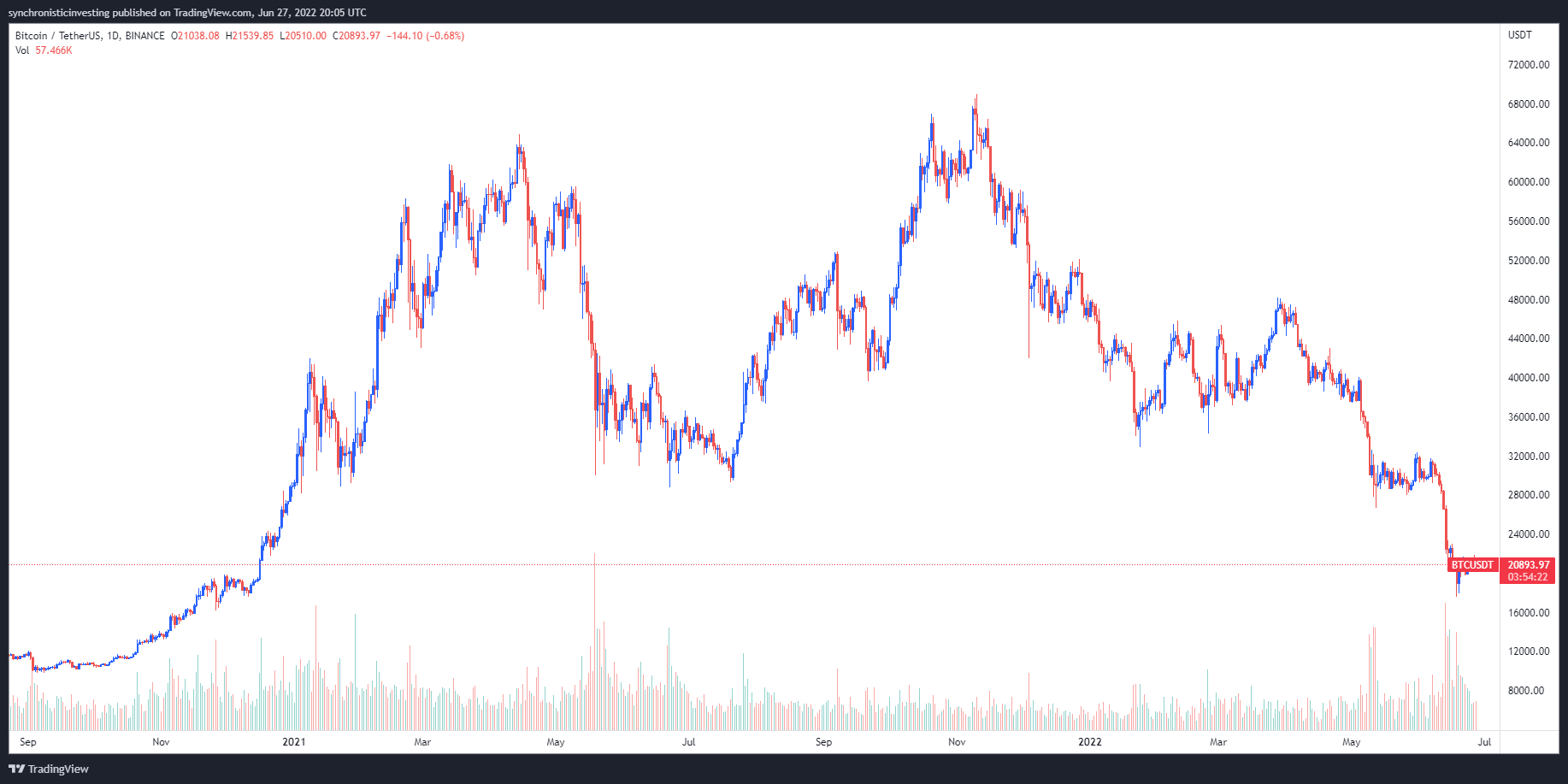
While many traders scoffed at the idea of BTC falling below its 2017 all-time high, the recent dip to $17,600 suggests that this bear market could be different from the last one.
Here’s what several analysts are saying about the possibility of Bitcoin falling to $10,000 in the next few weeks.
Historic pullbacks point to a low at $10,350
Insight into how BTC may perform in the short-term can be gleaned by looking at its performance during the bear market cycles of 2013 and 2017. In 2013, the maximum drawdown for Bitcoin was 85%, which took place over a period of 407 days. The maximum drawdown in 2017 was 84% and this period lasted for 364 days.
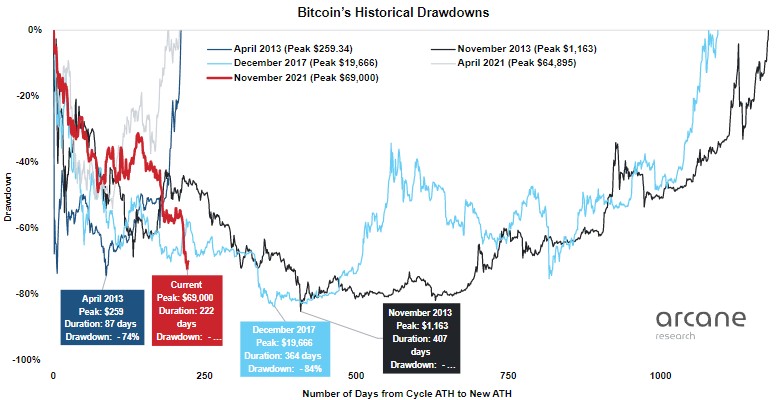
According to a recent report by Arcane Research, the current drawdown has been going on for 229 days and has thus far seen a maximum drawdown of 73%.
Arcane Research said,
“If Bitcoin follows the blueprint of these cycles, a bottom should occur sometime in late Q4 2022, at a price as low as $10,350.”
While there is always a chance that an 85% pullback is a possibility, Arcane Research also noted that “Bitcoin is now far more intertwined in the broad financial markets, with the Fed, U.S. elections, crypto regulations and stock market impacting its performance.”
Further evidence that supports the possibility of a drop to the $10,000 range was touched upon by cryptocurrency research firm Delphi Digital, who posted the following chart noting that “From a high timeframe market structure perspective, the next place we have to be looking at is $10K–$12K.”
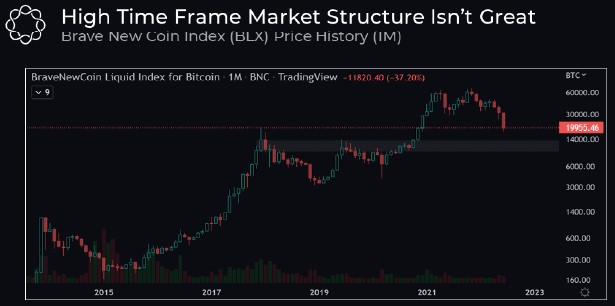
Based on the chart above, the high timeframe market structure support is likely to exist between $9,500 and $13,500.
Delphi Digital said,
“Coincidentally, this area lines up with the implied low if BTC experiences an 85% drawdown from peak to trough.”
Would $10,000 be a good spot to go long?
Not every analyst expects a drop to $10,000. Take for example, Will Clemente of Blockware Solutions. According to Clemente, Bitcoin’s current range reflects a good spot for accumulation.
Bitcoin is incredibly cheap right now.
It has only traded this far below its 200-day trend and its aggregated cost basis for 3% of its entire existence. pic.twitter.com/kW6BysdkQ0
— Will Clemente (@WClementeIII) June 27, 2022
Additional data from Glassnode shows that Bitcoin’s 200-week moving average, balance price and delta price in its bear market floor model align with the 0.6 Mayer Multiple metric analyzed by Clemente.
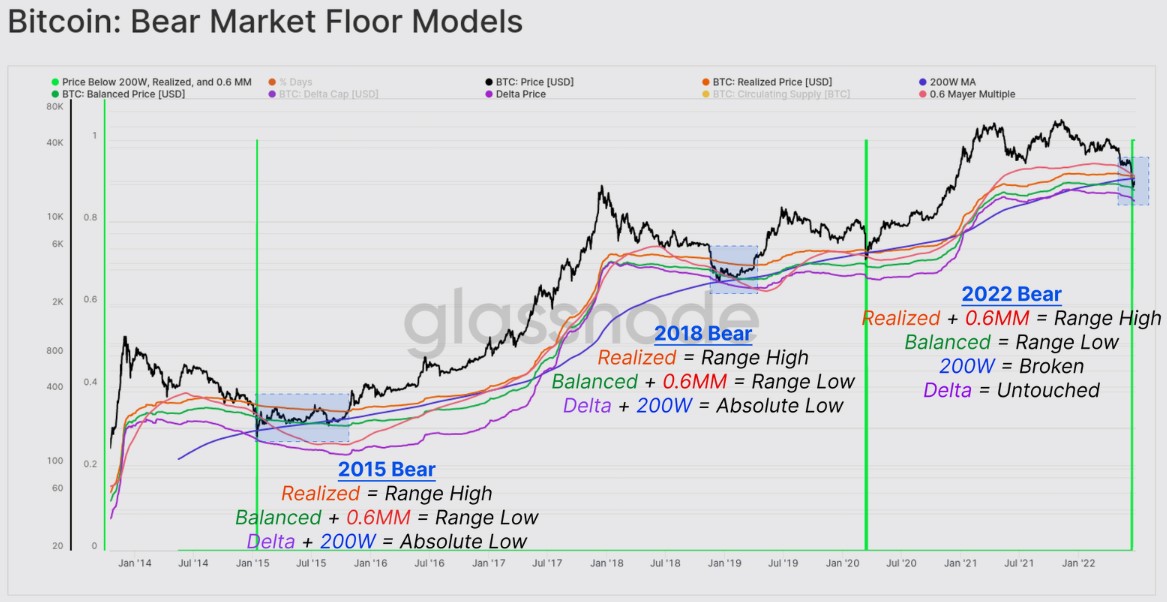
Glassnode said,
“Only 13 out of 4,360 trading days (0.2%) have ever seen similar circumstances, occurring in just two prior events, Jan 2015 and March 2020. These points are marked in green on the chart.”
Based on the Delta price metric, which still remains untouched, the potential low for BTC is $15,750.
Related: Bitcoin’s short-term price prospects slightly improved, but most traders are far from optimistic
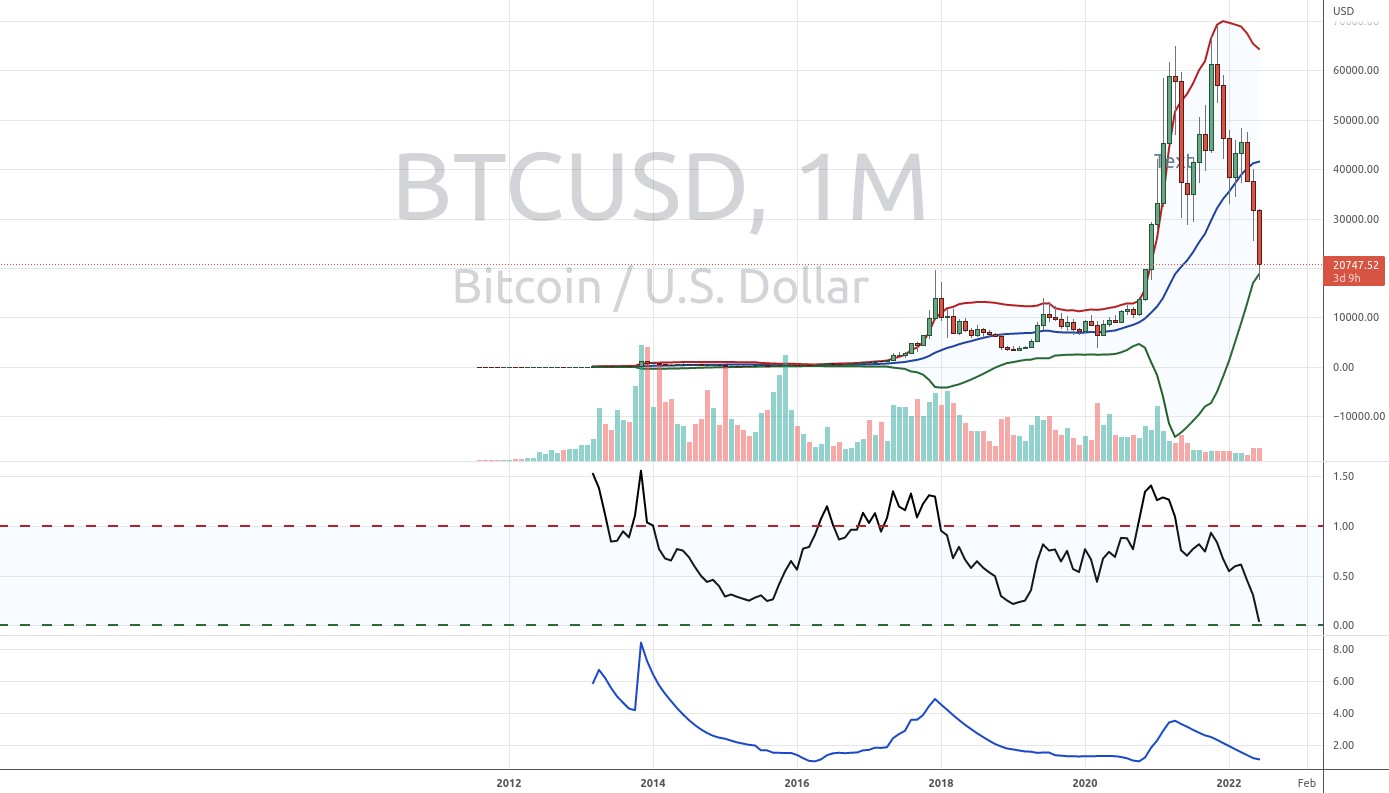
John Bollinger, the creator of the popular Bollinger Bands trading indicator also suggested that Bitcoin price may have bottomed.
According to Bollinger:
“Picture perfect double (M-type) top in BTCUSD on the monthly chart complete with confirmation by BandWidth and %b leads to a tag of the lower Bollinger Band. No sign of one yet, but this would be a logical place to put in a bottom.”
The views and opinions expressed here are solely those of the author and do not necessarily reflect the views of Cointelegraph.com. Every investment and trading move involves risk, you should conduct your own research when making a decision.
Source link





The Ethereum (ETH) network moved one step closer to completing its transition to proof-of-stake (PoS) this week after the successful completion of its second-to-last major Merge trial on the Sepolia public test network.
Data from Cointelegraph Markets Pro and TradingView shows that following the Sepolia Merge on July 6, the price of Ether rallied to a high near $1,280 on July 8 but has since trended down to hit a daily low of 1,153 on July 10.
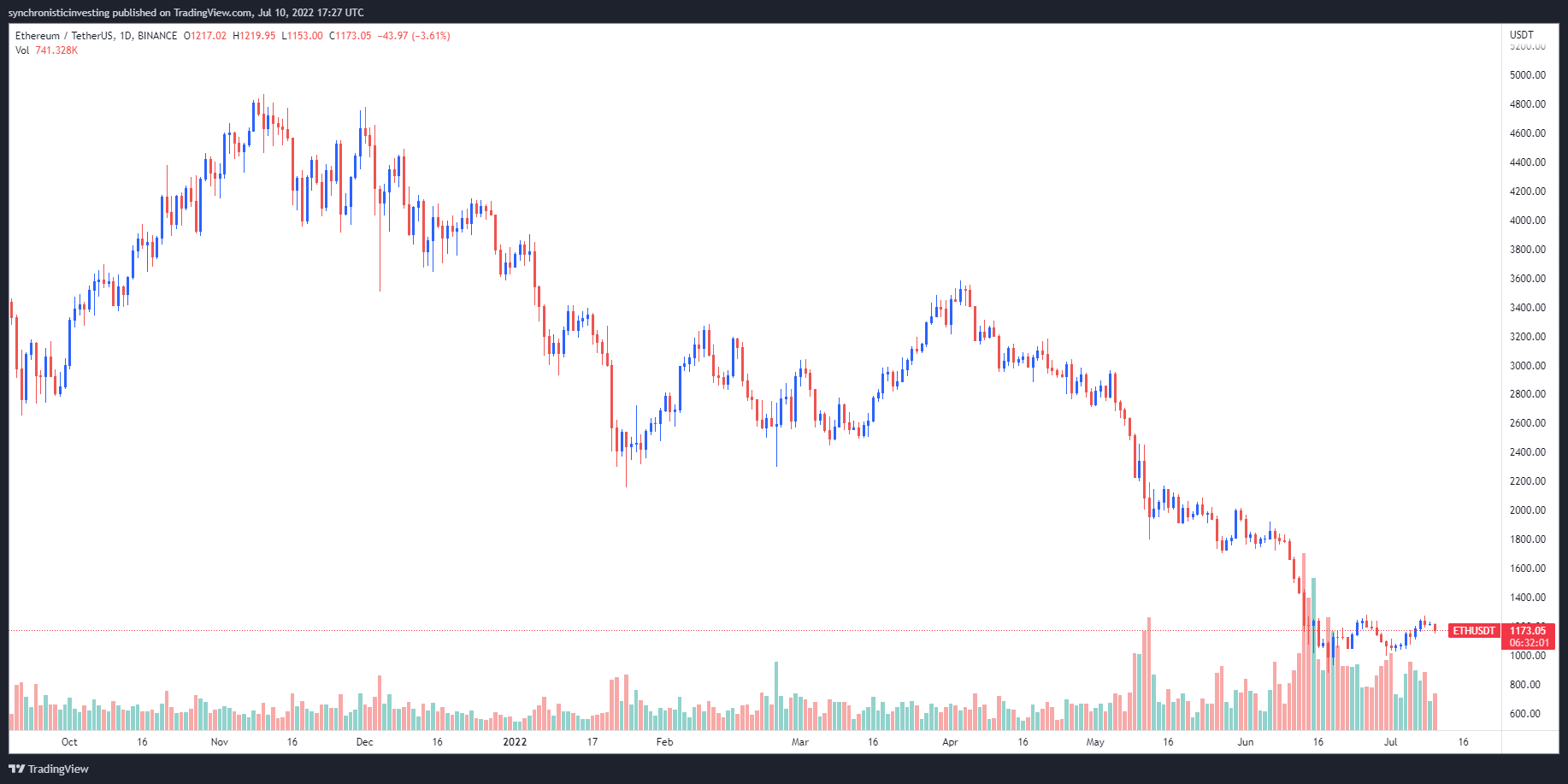
With the Ethereum network nearing the home stretch in its shift to PoS, here is what analysts are saying could happen with its price in the short term.
Look out for a pullback to $1,020
The recent price action for Ether that followed the successful Merge on Sepolia “is giving more clarity than $BTC atm [at the moment]” according to crypto trader and engineer Crypto Feras, who posted the following chart outlining the rejection at $1,280.
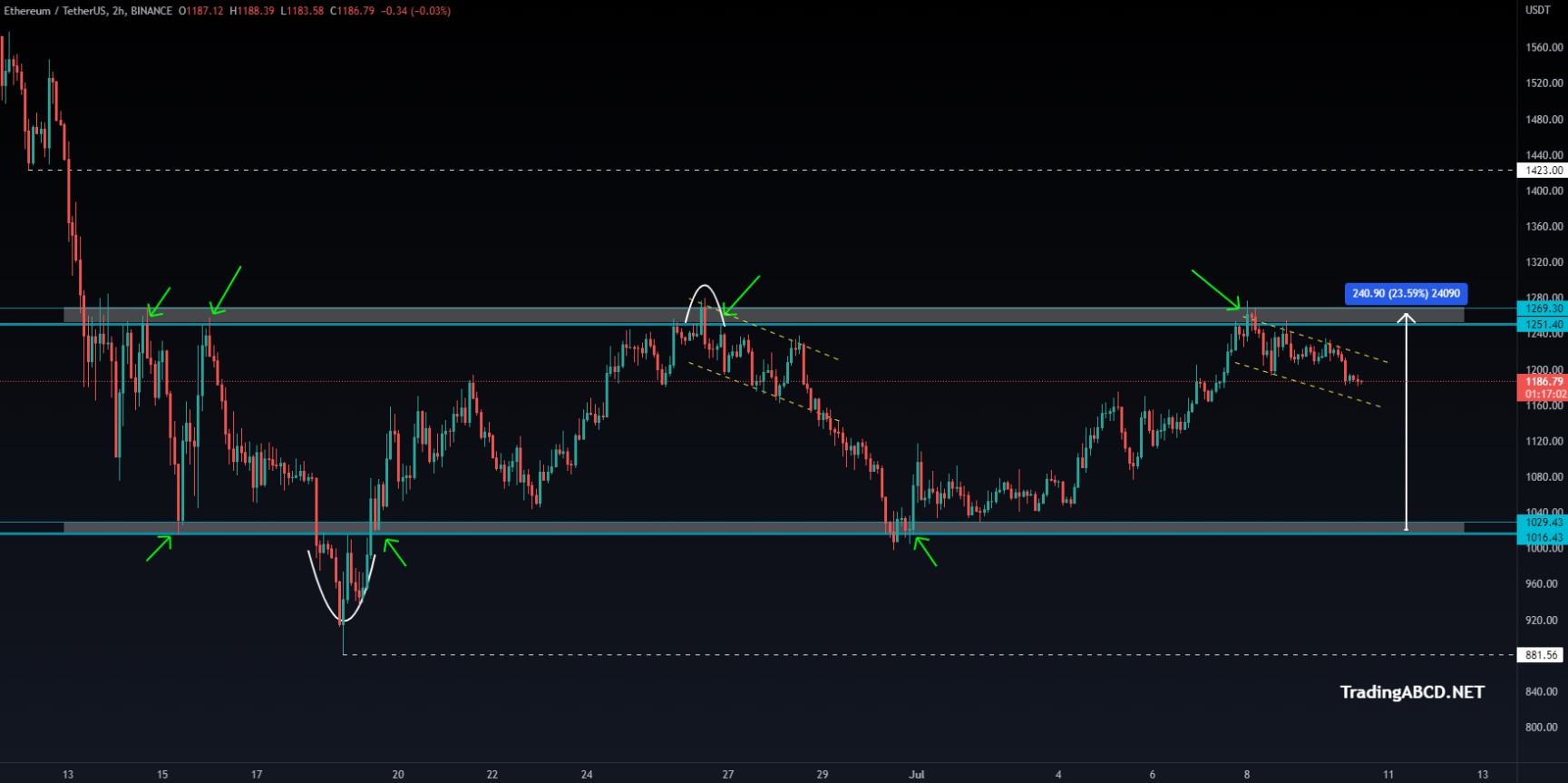
Crypto Feras said,
“PA is still showing clean rejection of the range-high. Potential bull-flag being formed (not enough yet). If we continue bleeding below flag support, $1,020 is coming.”
Double top warning
A potentially bearish formation on the chart for Ether was pointed out by analyst and pseudonymous Twitter user Profit Blue, who posted the following chart warning that “both BTC and ETH are forming the same double top pattern and bearish PA.”
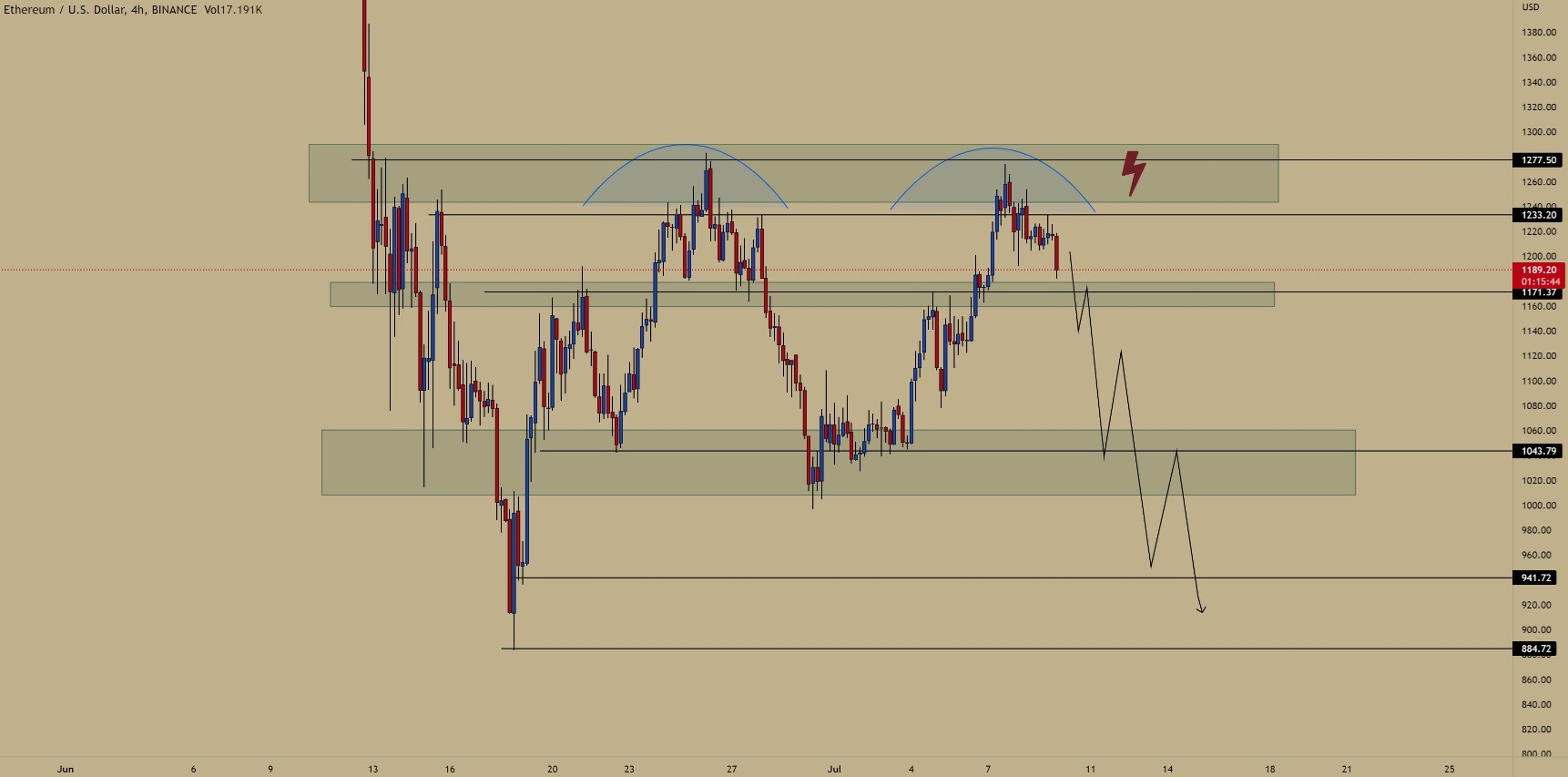
Profit Blue said,
“More downside is likely, pay attention to the important levels in this chart.”
Based on the chart provided, the major levels of lower support are found at $1,170, $1,043 and $941.
Related: BTC bull Michael Saylor: Ethereum is ‘obviously’ a security
Ascending triangle formation
Overall, the price of Ether has been trading in a range between $1,050 and $1,245 for the past couple of weeks as shown in the following tweet posted by Twitter user Nika Deshimaru, which lays out the major support and resistance levels for the top altcoin.
Weekly S/R for $ETH: ~1050/1200
Monthly S/R for #ETH: ~1100/1700 (argument for 1400 as a waypoint also)Daily S/R ~1130/1245
Bullish TA lads want to see the triangle meme play out off the back of 1M/1W support confluence bounce.
Bears looking at EMA failure, strong resistance. pic.twitter.com/icEe5Sq0m5
— Nika Deshimaru (@Nikadesh) July 10, 2022
As highlighted by Deshimaru, bulls need to break through the resistance at $1,200 if they want to make a sustained move higher, while bears are looking for the resistance provided by the 21-day Exponential Moving Average (EMA) to hold firm and continue to apply downside pressure.
The views and opinions expressed here are solely those of the author and do not necessarily reflect the views of Cointelegraph.com. Every investment and trading move involves risk, you should conduct your own research when making a decision.
Source link

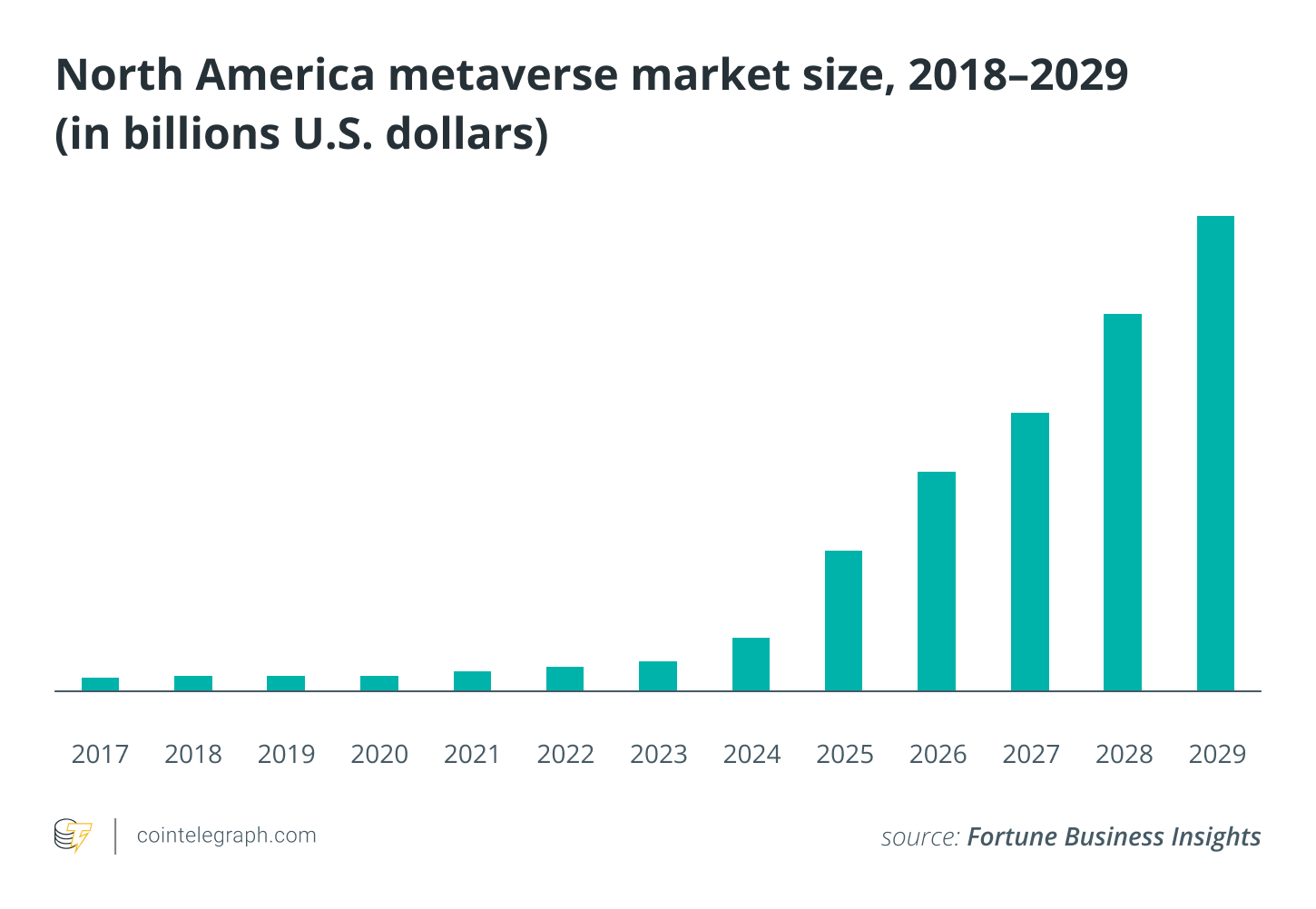
The metaverse space is moving rapidly in terms of hype and the volume of new projects being launched — so much so that the industry market size is projected to grow from $100.27 billion in 2022 to $1,527.55 billion by 2029. But how many of these new projects are even remotely capable of realizing the actual vision set out?
We’re a long way from seeing a true metaverse
Many of the metaverse projects that have been launched are in the world of gaming. However, more often than not, these projects simply consist of standard gaming features combined with virtual reality and NFTs. A true metaverse, in the sense of a digital parallel universe to our analog world, a digital simulated reality in which participants can take part in diverse social, economic, entertainment and artistic activities in a variety of self-organized groupings and environments, has yet to be realized.
Realizing this full vision requires easy portability of users, numerous wildly diverse metaverse shards, and simple user construction of new places and spaces — a vision that we are still developing the technology for.
Related: Here’s how the Metaverse enables inclusivity for genderqueer people
One underappreciated fact about the Metaverse is that it fundamentally needs artificial intelligence woven in at its core in order to provide a lasting user value proposition. Mark Zuckerberg clearly realizes this, but the majority of crypto-world entrants into the space are far less AI-oriented. But how exactly will AI improve the Metaverse?
Solving the “underpopulated metaverse” problem
Competition between developers will land early adopters in thinly populated worlds — an issue that AI can remedy.
The Metaverse presents a huge opportunity for new and existing tech companies to expand their offerings, generating new revenue streams. There are over 160 companies currently working on their own worlds — each competing to be the leading metaverse provider. It’s unlikely that we’ll have “one provider to rule them all,” but will instead have a large variety of options available to us, each with its own unique offerings.
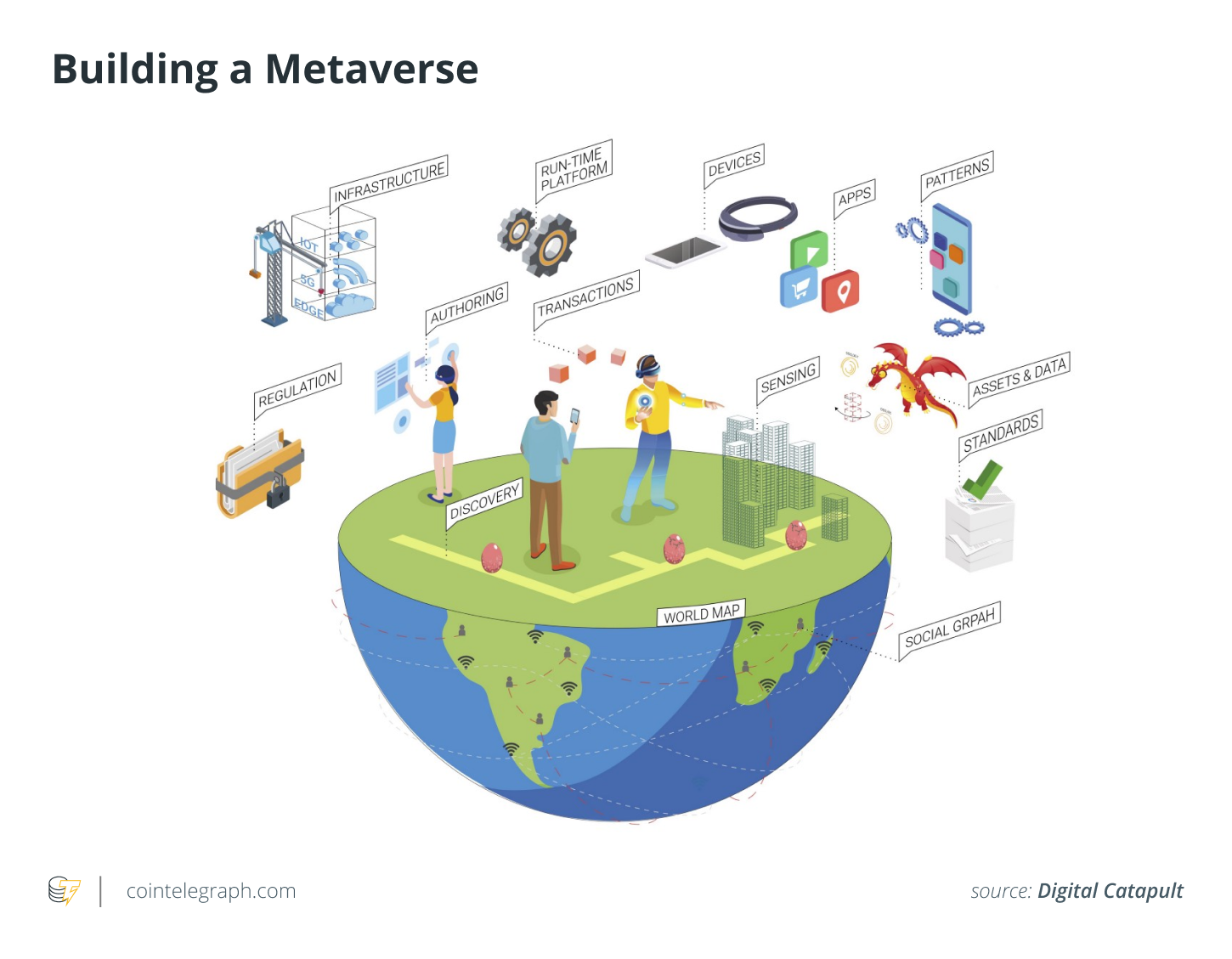
The advantage of this is a more diverse environment for end users, who will be able to choose from a variety of experiences. The downside is that, with so many platforms vying for customer attention and offering so many different experiences, the various metaverses will be sparsely populated in their early days. As interacting with a metaverse is an inherently social experience, this presents a huge problem.
AI-driven non-player characters can help tremendously with the underpopulated metaverse problem. Being one of the first few users in a new world may feel briefly exciting — but if there’s nobody there to interact with and nobody doing interesting things, it will get old fast. A society of AI characters building, conversing, playing music, making art and buying and selling can turn a metaversal ghost town into a scintillating hotbed of digital activity.
The result of this will be countless lively worlds, which will inspire more people to join the Metaverse — eventually reaching a point where non-player characters (NPCs) will be a bonus, rather than a necessity.
Related: Web3 is crucial for data sovereignty in the metaverse
Guiding users through the Metaverse
With a number of tech companies working on their own metaverses, users will not only require the ability to choose the one they want to interact with, but also the ability to seamlessly move between each individual metaverse. This is where blockchain will be an essential tool. Blockchain allows easy portability of property between all of the small, manageable chunks of data that make up a blockchain network — shards. This feature of the technology will allow users to move between each unique metaverse with ease. However, moving between worlds presents another issue: Users will require an introduction to each new world they enter.
It is projected that, by 2026, 25% of people will be using the Metaverse daily. From users dipping their toes in for the first time who need a thorough introduction, to the tech savvy hopping between worlds, everyone will need to be guided through each new metaverse that they spend time in.
Related: In the Economy 3.0, metaverses will create jobs for millions
With such a huge number of people crossing into different worlds, it will be impossible for humans to manage the number of introductions necessary. The most effective way to introduce users to each metaverse will be through the use of an AI guide. Guides will be able to explain all the required information of an individual world to the user, ensuring the best user experience.
Building a truly digital world
Perhaps the most profound benefit that AI will bring to the Metaverse lies in the area of world-building. AI providers will be able to use transformer neural nets (the processing power behind AI), neural-symbolic AI (AI technology with advanced learning capabilities) and related technology to generate bespoke scenarios for each user. This would work by letting the user describe a few details about a desired scenario and then letting the AI generate the complete description of said scenario.
Providers can then use another neural network that takes an inputted verbal description and brings it to life using virtual reality technology. By then putting these two neural models together, we get a system that takes a partial suggestion from a user about a potential scenario and automatically spins up a complete VR experience, incorporating the user’s suggestion and expanding on it.
This would be fine-tuned over time as more scenarios are generated. Once there’s a large enough community of users leveraging these features to create unique content, AI can then be used to data-mine through it all — looking for common patterns and then using these to generate additional material and bias its style of user-guided content creation.
Realistic and unrealistic scenarios could then be extrapolated from the mass-mind of humanity and directed using an interactive storytelling interface, letting each user pick the unique scenario they’d like to experience. AI would ultimately be used to create immersive content within the Metaverse.
All these use cases demonstrate an acute need for AI services that work together with VR and blockchain technology. As the Metaverse grows in popularity, we will see funding pour in — helping with the creation of the required technology. As AI technologies are appropriately deployed, they will unlock the true potential of the Metaverse and we will see the development of exciting digital landscapes that run alongside our analog world.
This article does not contain investment advice or recommendations. Every investment and trading move involves risk, and readers should conduct their own research when making a decision.
The views, thoughts and opinions expressed here are the author’s alone and do not necessarily reflect or represent the views and opinions of Cointelegraph.
Ben Goertzel is a leading innovator within the artificial intelligence space, acting as the chairman of the Artificial General Intelligence Society. He has worked as a research scientist at a number of organizations, most notably as the chief scientist at Hanson Robotics, where he co-developed Sophia alongside David Hanson. During his time at Hanson Robotics, he founded SingularityNET and began building a network of AI tools with unique use cases.
Source link

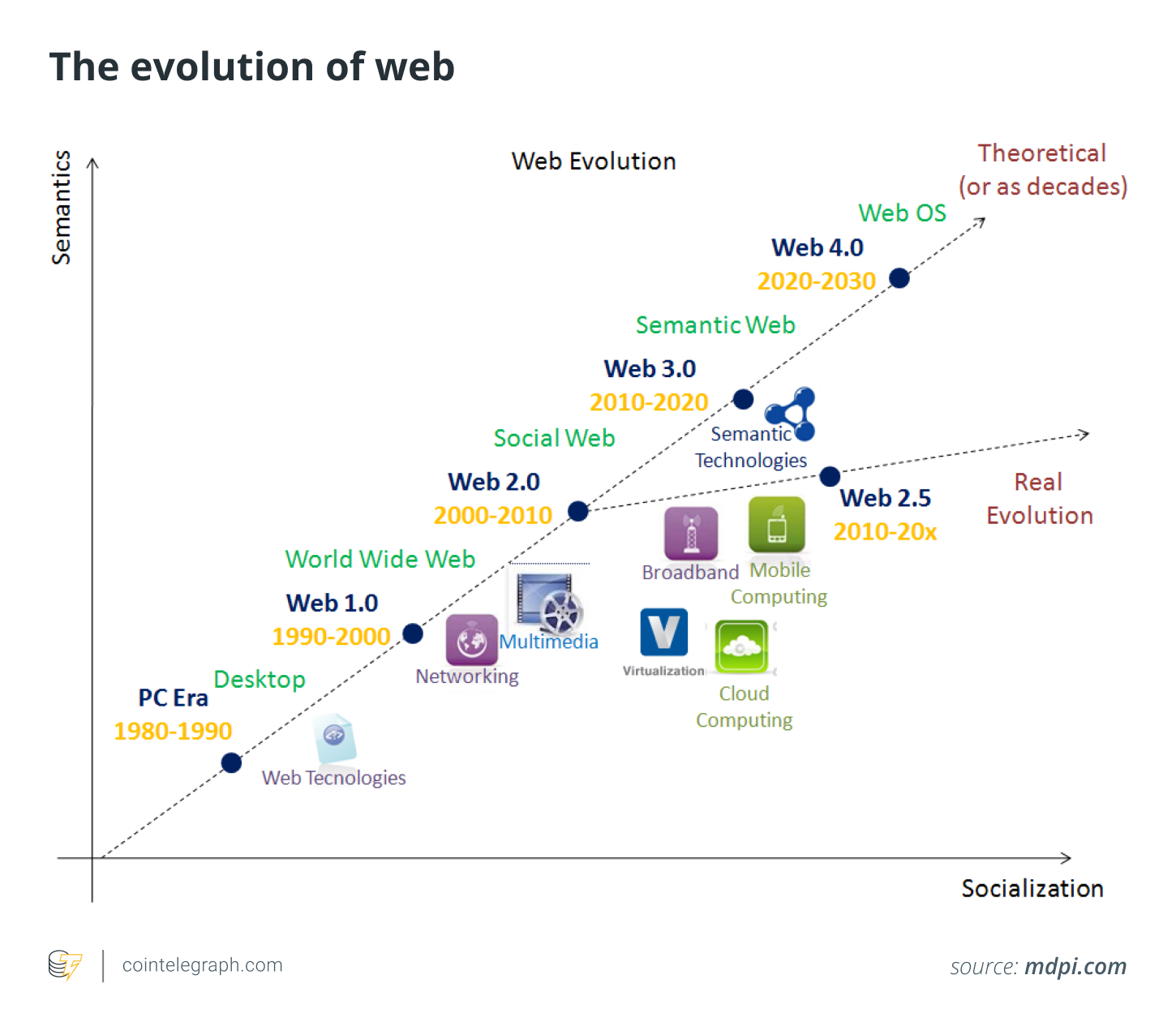
Digital identity has been a fraught subject since the earliest days of the internet. Web2 bridged the gap between people’s offline lives, online identities, and creative and consumer habits, which has given way to a thoroughly integrated internet experience designed to be as personalized and targeted as possible. As a new phase of virtual interaction and digital identity appears on the horizon — one even more interconnected than Web2 — we need to rethink personalization and ownership with an eye to what did and didn’t work in the world of Web2.
While there is no blueprint for the Web3 identity procedure, we can predict the trajectory that digital identity in the metaverse will follow. This trajectory is already taking shape.
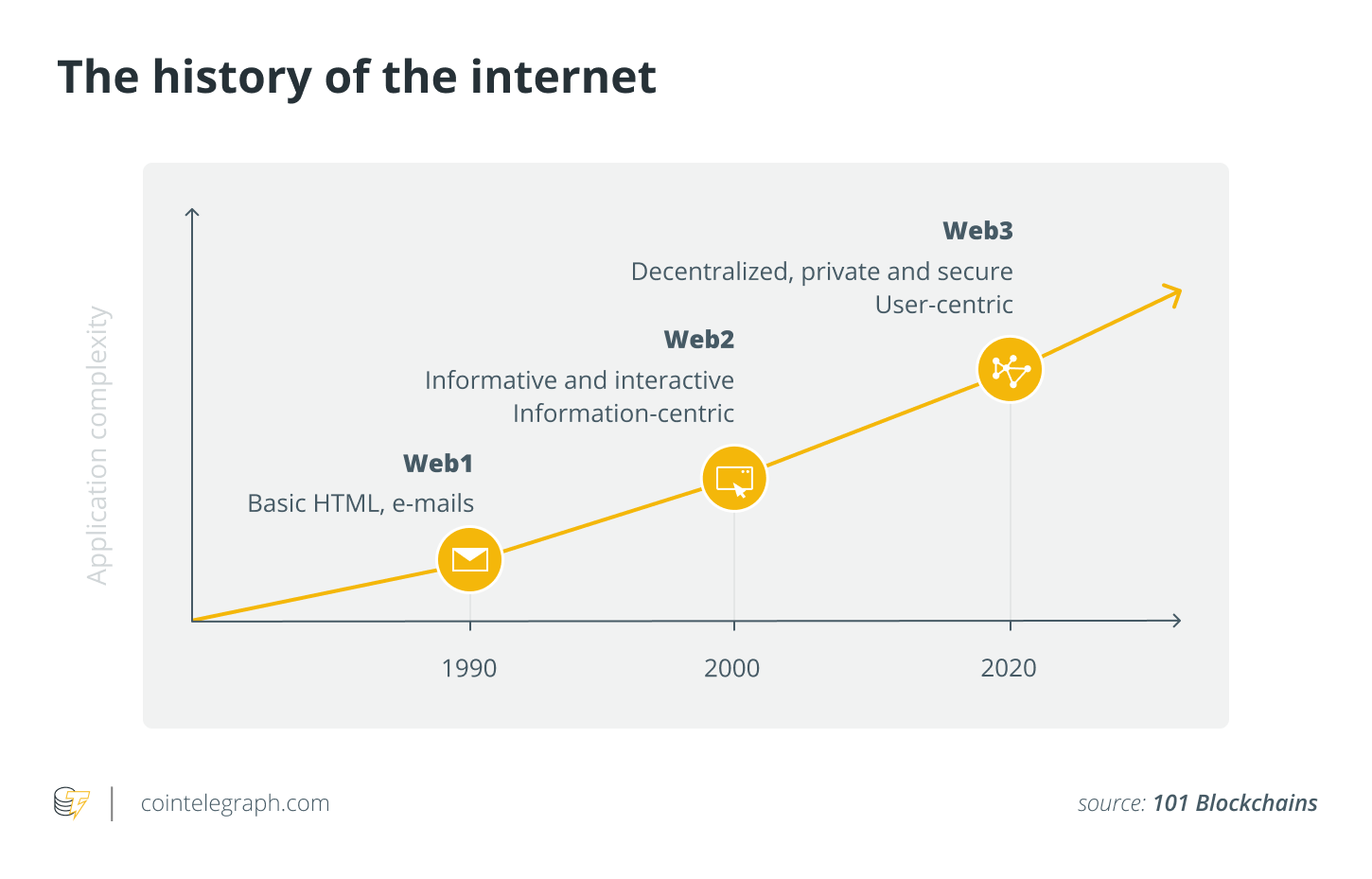
Everything you know, decentralized
Virtually all aspects of the internet as we know it are ripe for decentralization. Chat and messaging services are private and encrypted, browsing is incognito, and transactions happen between individual bank accounts (albeit mediated by an intermediary) — all signs point to a system that is user-controlled and caters to the individual rather than to the collective.
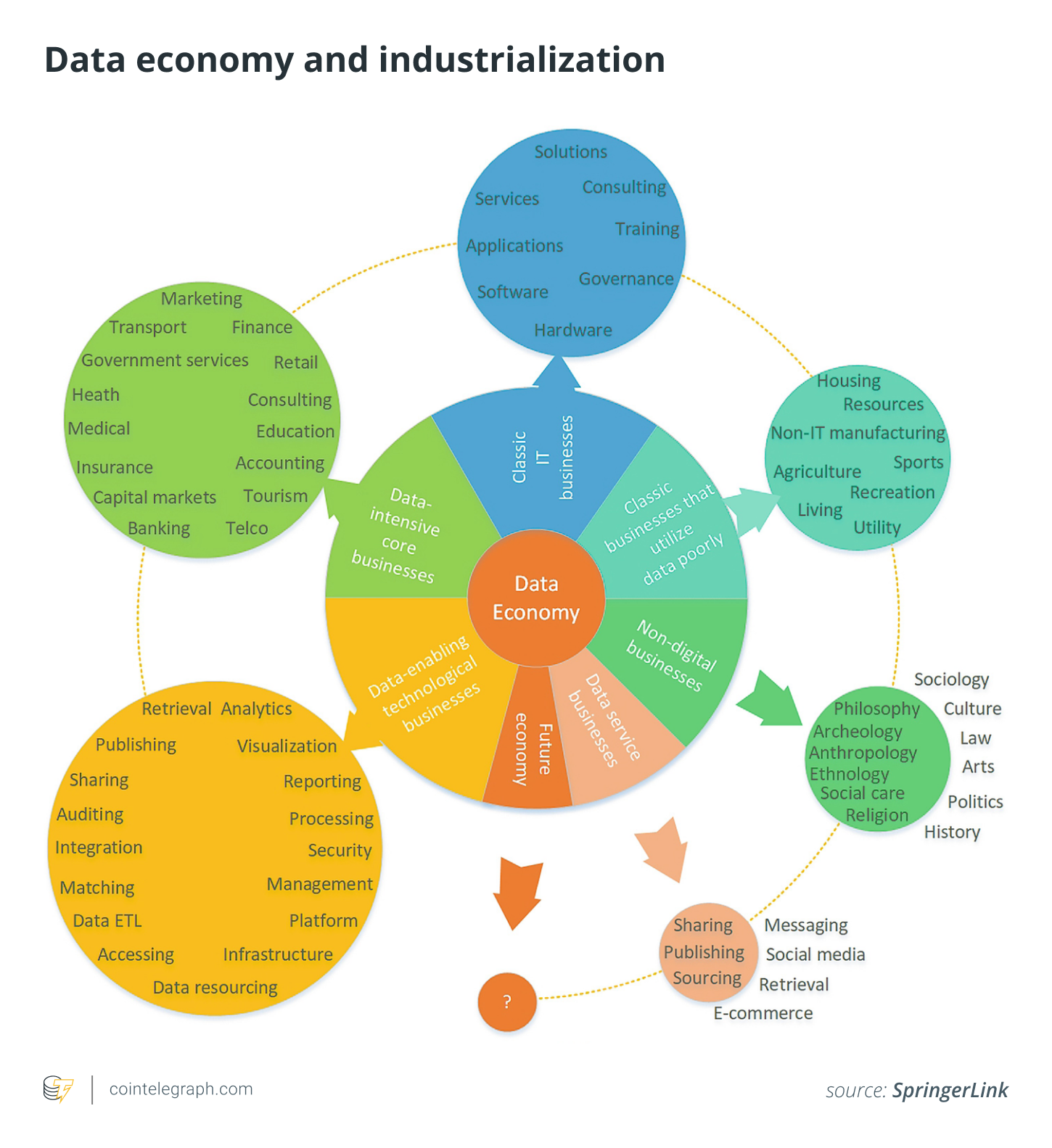
The rise of the internet isn’t the first time we’ve seen this progression, either. The radio began as a series of AM stations, gradually expanded to include FM, and then developed satellite capabilities that provided universal access to a variety of stations. Web3 and the way identity functions within it roughly correlate to satellite radio. So, in the history of modern communication systems, the arc bends toward decentralization.
In this new space, a person’s crypto wallet will be the key to their establishing a presence in the metaverse, from serving as an entryway into games to helping them build nonfungible token (NFT) collections to allowing them to do business. Crypto wallets will be connected to everything users already do on the internet and in every online activity yet to come.
Related: Web3 is crucial for data sovereignty in the metaverse
The future of ID(entity)
People who are accustomed to traditional markets can be confused, intimidated and even deterred by the crypto-based ownership revolution. But it’s the means (identification), not the ends (identity), that are changing.
A user’s crypto wallet will function as a key, accessing all their domains, real estate, NFTs and other virtual properties. Should they lose that key, they’ll have to wait until its term expires to renew it. That said, the wallet will be so integral to everyone’s online identity that a total loss is unlikely to happen, and there are companies actively developing solutions to combat such losses.
Identity won’t be transformed on its own, but in relation to ownership as well. For instance, crypto wallets will have a hand in the purchase of web domains. Third-party supervisors like the Internet Corporation for Assigned Names and Numbers (ICANN) will no longer hold sway over users’ ability to buy a top-level domain (TLD) or mint a subdomain off of it, and users will not have to request permission to do this themselves. Ownership of domains will become newly permanent; even minting a subdomain off of a previously-owned TLD will grant a user indefinite ownership of that subdomain.
This will all be possible only through a crypto wallet. With the hype we’ve seen around the metaverse and NFTs, Ethereum and other wallet addresses will be the primary conduit for amassing virtual wealth.
Related: Identity and the metaverse: Decentralized control
But what of Web2?
All this is not to say that Web2 will become completely or instantaneously obsolete. It won’t fade away, but it will be incorporated into Web3 spaces. Domain ownership, for example, will become backward compatible with ICANN standards, meaning individual owners will attain the same legitimacy as they did in the past by acquiring a domain through ICANN.
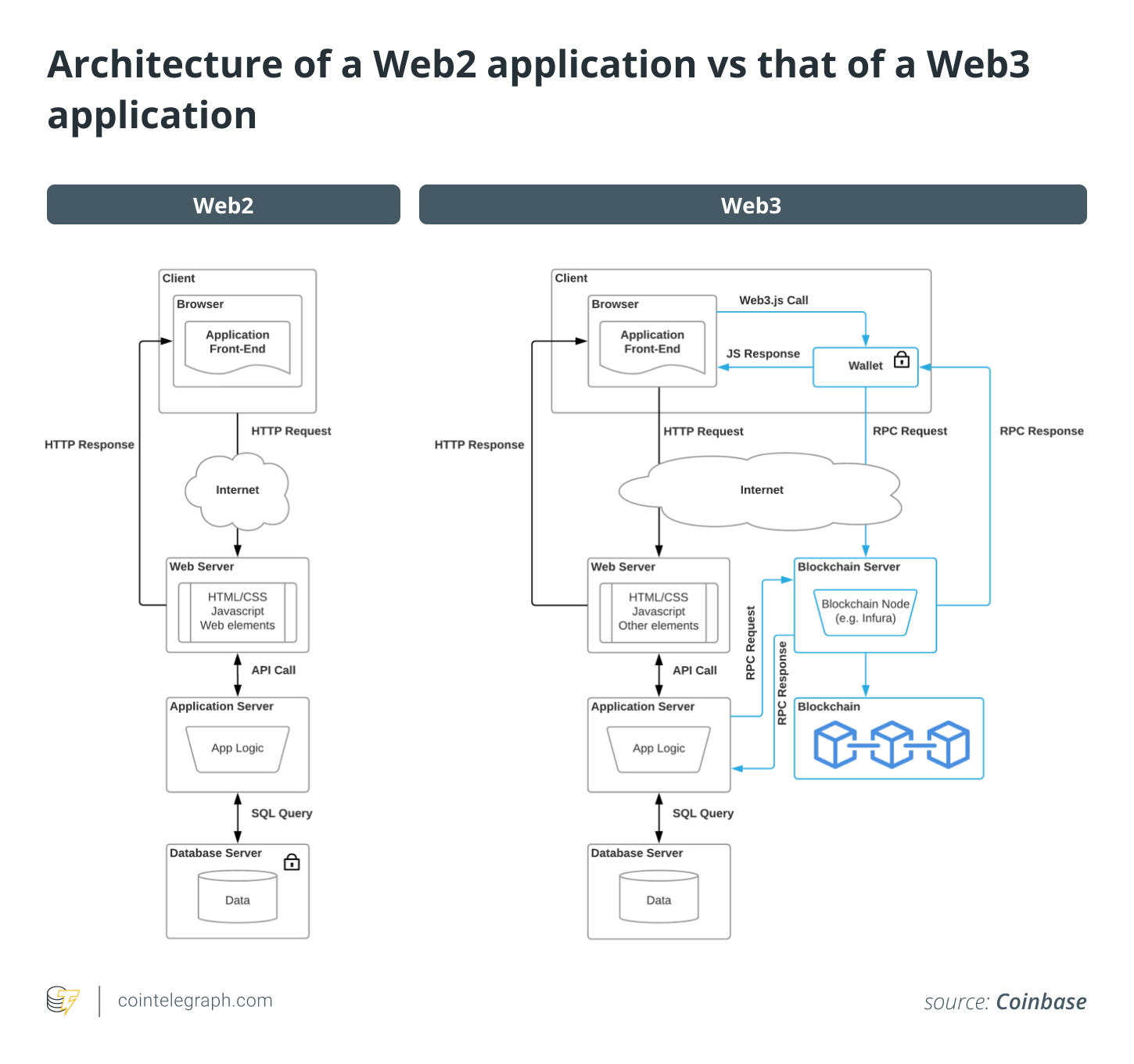
Services like PayPal will naturally continue to exist: Those accounts will eventually be connected to a wallet address instead of to an email address. This shift is already happening across mainstream finance platforms and retailers.
Streamlined and accessible
Given the possibilities of crypto wallets, the future of domain purchasing and digital identity will pair a collective-benefit mindset with individual ownership. It will revolutionize the way we identify online. Domain name service (DNS) records, which are used to trace URLs to IP addresses, have thus far been needed for resolvers, but this resolution will occur natively in a fully realized Web3 environment. In a similar way, many of the extra steps needed in Web2 ownership and identification processes will be rendered unnecessary.
These changes will ultimately result in immutable proof of identity on the blockchain. Once a user purchases a property, be it a domain or an NFT, they will own it; no organization can retract or tamper with that ownership. The prime goal is accessibility across the metaverse. We need to develop systems that promote viability, practicality and utility in order to create an internet that works for everyone.
This article does not contain investment advice or recommendations. Every investment and trading move involves risk, and readers should conduct their own research when making a decision.
The views, thoughts and opinions expressed here are the author’s alone and do not necessarily reflect or represent the views and opinions of Cointelegraph.
Michael Calce is the founder and CEO of DecentraWeb. He is the chairman of the board of advisors for HP and works with many Fortune 500 companies. Michael gained notoriety in 2000 for launching one of the highest-profile DDoS attacks in history at the time, taking down Yahoo, eBay, CNN and other high-profile sites. Since then, Michael’s mission has been to raise awareness around cybersecurity and to make the internet a safer place.
Source link

Why Coinbase is banning slide decks and ‘endless meetings’

Ethereum Bears Are Back, Why ETH Could Dive Below $1K

Judge denies SEC motion to keep Hinman docs secret in Ripple case

If Ethereum Falls Below $1,000, Here’s The Next Support

Institutional investor sentiment about ETH improves as Merge approaches

Bitcoin Price Could Recover If It Holds This Key Support

Bitcoin to make new all-time-highs within 24 months: Coinshares CSO

Solana Retraced Below $38, Is There A Chance For Comeback?

US Treasury study finds CBDCs a plus for commercial bank stability

Bitcoin Daily Exchange Net Flows Shows Sell-Offs Have Not Subsided

US Treasury calls for public comment on digital asset policy, following Biden’s executive order

Experts Claim Cyber Attacks On Crypto Firms Will Rise, What’s Ahead?

Sri Lanka central bank reiterates crypto warning following protestors seizing president’s residence

Into Crab Mode, Bitcoin Bullish Potential Capped For The Coming Months?

How to build a passive income stream from cloud mining?
BNM DAO Token Airdrop
New Minting Services

Could an Earnings Recession Lead to More Pain for Crypto? – Blockchain News, Opinion, TV and Jobs

A Bear of Historic Proportions – Blockchain News, Opinion, TV and Jobs

Virginia passes new crypto law whilst macro headwinds mount up – Blockchain News, Opinion, TV and Jobs

‘Crypto is just like the end of the 90s with the internet bubble,’ says Hodl CEO Maurice Mureau

Interview with Ruud Feltkamp, Owner of AI-driven Trading Bot Cryptohopper – Blockchain News, Opinion, TV and Jobs

High-profile BAYC collector denies allegations of wrongdoing brought by DeFi detective

Are expiring copyrights the next goldmine for NFTs?

BNM Live Stream

Tesla, Blockstream and Jack Dorsey’s Block Team-up to Mine Bitcoin Sustainably – Blockchain News, Opinion, TV and Jobs

Block News Media Live Stream

Live Stream Block News Media

Dollar Strength Causes Bitcoin Weakness – Blockchain News, Opinion, TV and Jobs

Fintech-Ideas brings blockchain functionality to its range of platforms – Blockchain News, Opinion, TV and Jobs
-
Uncategorized6 months ago
BNM DAO Token Airdrop
-
Uncategorized8 months ago
New Minting Services
-
 bear market2 weeks ago
Could an Earnings Recession Lead to More Pain for Crypto? – Blockchain News, Opinion, TV and Jobs
-
 bear markets2 weeks ago
A Bear of Historic Proportions – Blockchain News, Opinion, TV and Jobs
-
 Bitcoin2 weeks ago
Virginia passes new crypto law whilst macro headwinds mount up – Blockchain News, Opinion, TV and Jobs
-
 Blockchain2 weeks ago
‘Crypto is just like the end of the 90s with the internet bubble,’ says Hodl CEO Maurice Mureau
-
 Blockchain2 weeks ago
Interview with Ruud Feltkamp, Owner of AI-driven Trading Bot Cryptohopper – Blockchain News, Opinion, TV and Jobs
-
 Blockchain Analytics2 weeks ago
High-profile BAYC collector denies allegations of wrongdoing brought by DeFi detective