Adoption
Web3 gaming gets competitive edge as Maniac Panda Games joins Cointelegraph Accelerator

As the Web3 gaming landscape is getting bigger by the day, mainstream players who enjoy playing popular titles games such as PUBG, Fortnite or Apex Legends are starting to take notice. However, there’s still a technical understanding barrier before Web3 gaming can reach a broader audience. Players need gameplay elements that they are familiar with to warm to blockchain games that usually come with technical lingo like play-to-earn (P2E), nonfungible tokens (NFTs) or crypto wallets.
The gaming world is no stranger to blockbuster titles that initially started as an adaptation of literary work. From The Witcher series to the first Bioshock (which was inspired by Ayn Rand’s dystopian classic Atlas Shrugged), using books as a reference for worldbuilding is a tried-and-true method for game developers. An upcoming Web3 game applies the same formula by building a virtual world around a fantasy saga to create the familiar feeling of ‘becoming someone else in an alternate world’ for players.
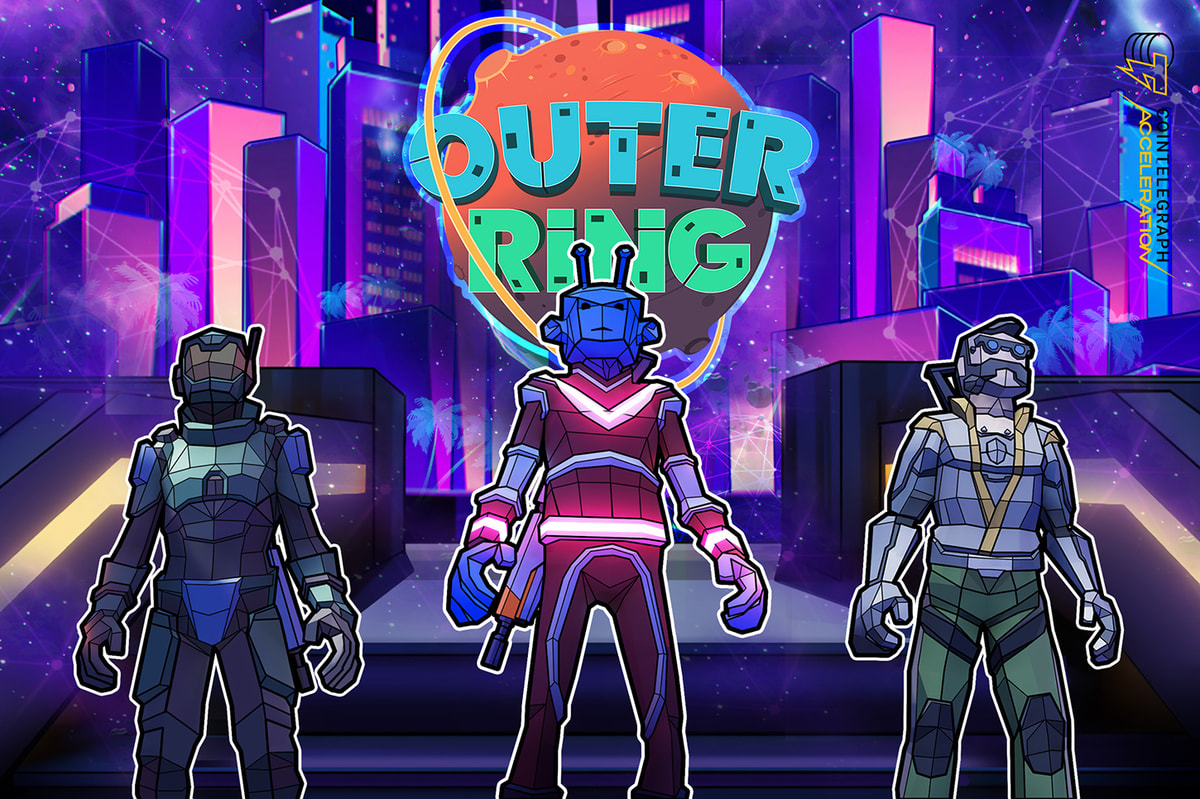
Inspired by the fantasy Outer Ring saga of novels of the same name written by Daniel Valdés-Araiz, CEO of the company, Outer Ring MMO is set in a lore-rich universe that has five species divided into four different factions, all fighting for control and resources. The game is a online multiplayer role-playing game (MMORPG) with extensive gameplay that ties in multiple components, including PvP, PvE, housing and crafting in a vast, sci-fi-themed metaverse.
Using 3rd person perspective, players can compete against each other, engage with brands and in-game businesses in real-time, socialize and monetize the time spent in the game. Known for their Valorant performance, major esports club Team Heretics announced that they will take part in the Outer Ring MMO PvP experience.
A defining characteristic of Web3 gaming is its user-centric economy, where players can own, trade and monetize game-related assets. As blockchain technology enables the creation of economic infrastructure in Web3 games, native tokens or NFTs created on the same network can act both as an in-game item and a crypto asset that can be traded on different marketplaces. Similarly, the player-driven economy found in Outer Ring MMO enables users to generate in-game assets and items and then convert them to NFTs. Through this process, players can own those objects and generate value by selling them.

Introducing a Scavengon, one of the 5 playable races in the game. Source: Outer Ring
In terms of tokenomics, Outer Ring MMO is built as a part of the developers’ Galactic Quadrant (GQ) ecosystem. It would use the same GQ token as the governance currency, while Exocredits (EXO) will act as the in-game currency. Other games to launch within the same ecosystem already available to play in their early stages are the racing game RacerLoop, the trading card game Underground Waifus and the gambling title CryptoDuels.
Developers at Maniac Panda Games, the gaming branch of Nexxyo Labs - a 300-employee Spanish studio regarded as one of the largest Web3-native video game studios in Europe - aim to seamlessly connect Web2 and Web3 gaming. The studio is looking to introduce Web3 gaming to the masses through their flagship AAA-tier game developed by former talent at Rockstar Games (the studio after Grand Theft Auto), Ubisoft and Electronic Arts. Cointelegraph Accelerator selected Maniac Panda Games as a participant of the program with an aim to boost adoption in Web3 gaming space.
Launched in 2023, the Cointelegraph Accelerator program aims to help up-and-coming Web3 ventures reach a broader audience and acts as a catalyst in assisting them in achieving their Web3 potential. By becoming a part of the program, Maniac Panda Games will tap into Cointelegraph’s global audience and its established leadership in the crypto and blockchain media landscape since 2013.
Aside from Cointelegraph Accelerator, Outer Ring MMO has seen interest from organizations in a wide range of industries, including basketball club Baskonia-Alavés, movie theater chain Kinépolis and decentralized finance app DexTools. All of them have sealed deals to tap into Web3 by the hand of Outer Ring and have their respective functional presence and integrations running within the game to interact with users and players. Following the closed pre-alpha release of Outer Ring MMO, which is slated for June 28, 2023 for PC and Mac operating systems, the team will continue to develop the game’s player-driven economy and expand the overall GQ ecosystem with more strategic partnerships.
Source link








Joe Tsai, the soon-to-be former executive vice chair of China-based technology giant Alibaba, will replace Daniel Zhang as company chair.
In a June 20 announcement, Alibaba said Zhang would be stepping down as chair of the company and CEO effective Sept. 10, whereupon he will continue to serve as the chair and CEO of Alibaba Cloud Intelligence Group. Tsai, through wealth manager Blue Pool Capital, has been behind investments in several crypto firms, including FTX, Polygon’s $450-million funding round in February and Web3 firm Artifact Labs.
I like crypto
— Joe Tsai (@joetsai1999) December 28, 2021
Eddie Yongming Wu, chair of Taobao and Tmall Group, will follow Zhang as Alibaba CEO as well as replace him on the company’s board of directors. Alibaba is one of the largest companies in the world, with a market capitalization of more than $225 billion at the time of publication, following Tencent, Kweichow Moutai and ICBC among China-based firms.
“I look forward to working with Eddie to spark our next phase of growth through technology and innovation,” said Tsai.
Related: Tech giant Alibaba to roll out ChatGPT competitor AI
China has had a mixed relationship with crypto and blockchain. The country was infamous for cracking down on mining firms in 2021, prompting an exodus of companies to other jurisdictions, but it also has been pushing trials of a digital yuan through the People’s Bank of China.
Nonfungible tokens (NFTs), however, seem to operate in a regulatory gray area in China. Alibaba started an NFT marketplace for copyright trading in 2021 as well as an NFT solution under its cloud business unit — the latter was deleted without explanation shortly following its launch.
Magazine: China’s wave of ChatGPT rivals, Alibaba goes multichain: Asia Express
Source link

A quarterly report focused on zero-knowledge (ZK) technology indicates that privacy, scaling and identity solutions are significant drivers of adoption in the blockchain space.
Validator service provider ZKValidator’s report titled “The State of ZK” explores insights from the zero-knowledge space, highlighting major and emerging use cases, research, product launches and notable investment rounds.
The key takeaway focuses on use cases of zero-knowledge proofs (ZK-proofs). The cryptographic method allows one party to verify data or a statement without exposing the information. Privacy stands out as the industry’s most significant driver of adoption at 12.9%. Scaling is the second most prominent use case for zero-knowledge technology, with 9.46%.
Identity solutions and new zero-knowledge use cases rank third and fourth, indicating that the blockchain ecosystem is interested in exploring how zero-knowledge technology can be applied in identity management and other novel applications. Zero-knowledge machine learning (ZK-ML) was also identified as the space’s most attractive new use case.
Insights were driven by the company’s work with industry participants, including ZK Hack, zkSummit, rhino.fi, Geometry and University College London. ZKValidator also gleaned data and information working with participants in the production and management of the Zero Knowledge Summit 9 in Lisbon on April 4.
The launch of Polygon and zkSync’s zero-knowledge Ethereum Virtual Machine’s (zkEVM) was also highlighted in zkValidator’s report, with key data from the two Ethereum scaling protocols.
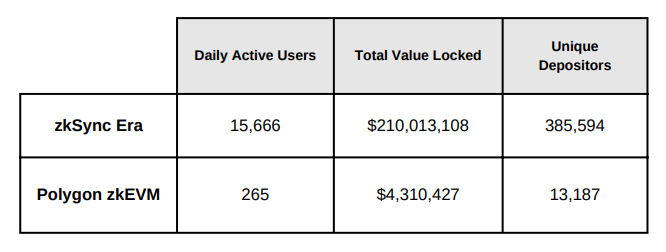
Having launched over a month ago, zkSync Era has attracted more daily active users than Polygon’s zkEVM. The report speculates that rumors of a possible zkSync airdrop later in 2023 may be a reason for the gulf in user numbers between the two zkEVMs.
Related: Polygon’s ‘holy grail’ Ethereum-scaling zkEVM beta hits mainnet
The report also covers the development of new products, including Geometry’s Semacaulk, a new zero-knowledge set membership protocol that offers gas savings over Merkle-tree constructions, while ensuring proofs can be generated quickly and verified for roughly the same gas cost.
2022’s $7 million ZPrize competition helped drive innovation of ZK technology, with multiscalar multiplication (MSM) on Android mobile devices stemming from the development competition aimed at fostering ZK solutions. According to ZKValidator’s report, MSM improved proof generation time from 2.4 seconds to around half a second, making mobile payments in ZK easier.
Related: Zero-knowledge proofs coming to Bitcoin, overhauling network state validation
The report also mentioned a paper proposing a fast GPU-accelerated zero-knowledge proof system that reduces proof generation time in ZK-proofs by leveraging hardware similarities of GPUs. Graphics processing units (GPUs) have become highly useful hardware for cryptocurrency miners, given its ability to process data simultaneously, and its use for machine learning, video editing and gaming.
Various other zero-knowledge projects were also identified in the fields of decentralized identity, interoperability and payments within the Ethereum and Polkadot ecosystems in 2023.
This includes Telepathy, a Zero-Knowledge Succinct Non-interactive Argument of Knowledge (zk-SNARK) interoperability protocol for Ethereum. The protocol allows users to read Ethereum state on any chain while retaining the security of Ethereum’s light client protocol.
Sismo Connect was also mentioned, which is a privacy-preserving single sign-on method for applications on both Web2 and Web3. The technology allows developers to implement ZK technology in their applications.
Lastly, the Manta Network also expanded its ZK capabilities, allowing for privacy support for nonfungible tokens and soul-bound tokens.
Investments were also highlighted, with Ethereum research and development firm The =nil; Foundation raising $22 million to continue the development of the Proof Marketplace. The solution allows layer-1 and layer-2 blockchains to outsource the production of ZK-proofs.
Zk-proof developer Proven raised $15.8 million in a seed round, while Polyhedra Network raised $10 million for its blockchain interoperability infrastructure platform.
Zero-knowledge rollups have been in the spotlight throughout the first quarter of 2023. Polygon released its open-source zkEVM Ethereum scaling technology to mainnet on March 27, while several Ethereum decentralized finance protocols have adopted zkSync since its alpha launch in March 2023.
Magazine: ZK-rollups are ‘the endgame’ for scaling blockchains: Polygon Miden founder
Source link
With one week to go until the Ethereum (ETH) Shanghai and Capella upgrades on April 12, all eyes are on Ether. The second largest cryptocurrency by market capitalization shrugged off rumors and regulatory action against exchanges to hit a 7-month high of $1,922 on April 5.
Ether price has momentum and here are three strong reasons why.
Multiple positive price achievements
According to data from Cointelegraph Markets Pro and TradingView, despite market volatility, Ether price has posted gains on the 7-day, 1-month and 3-month timeframes. Ether price gains are also notable on the year-to-date perspective, showing 59% growth.
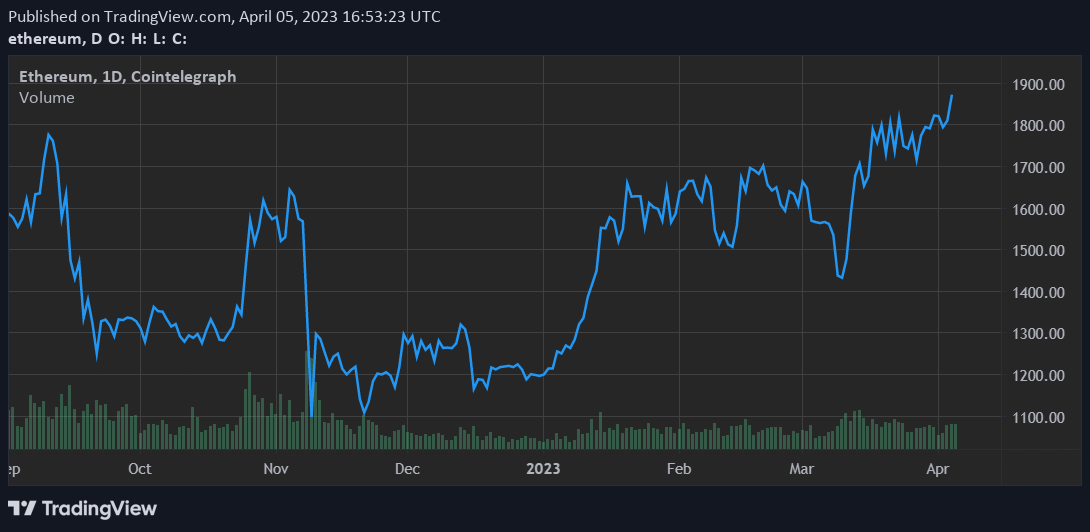
Ether’s ability to break resistance levels is leading some analysts to believe a $3,000 price target is on the horizon in Q2 2023. The trend shows that whale accumulation remains strong, growing by 0.5% in March according to data from analytics provider Santiment.
The bullish buying activity may prove on-chain data correct that Ether sell pressure after the Shanghai hardfork will be a non-event.
Related: US enforcement agencies are turning up the heat on crypto-related crime
The uptick in proof-of-stake validation by placing Ether in staking contracts is bullish for the Ethereum ecosystem. Since launching on Aug. 4, 2021, the Ethereum network has witnessed over 18 million in Ether staked on the blockchain.
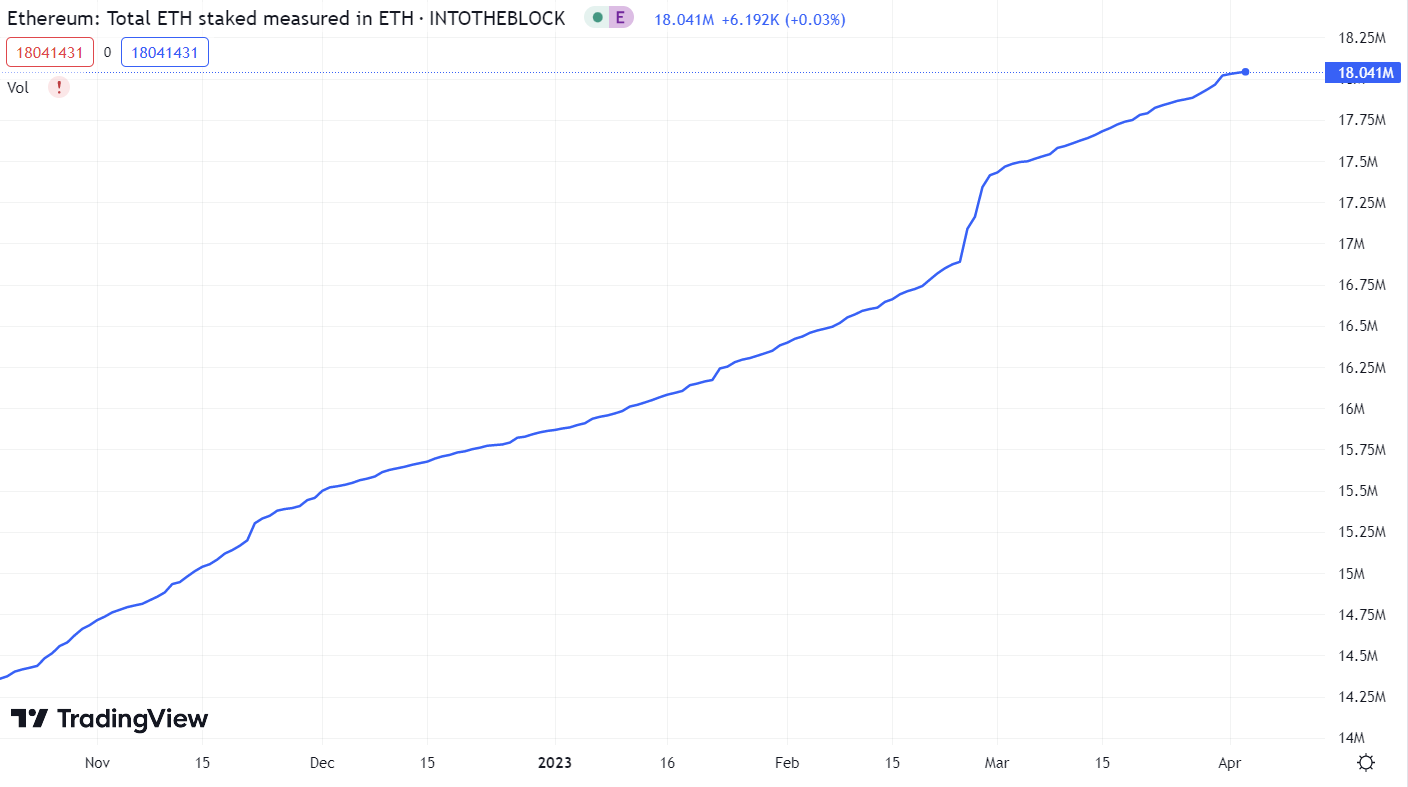
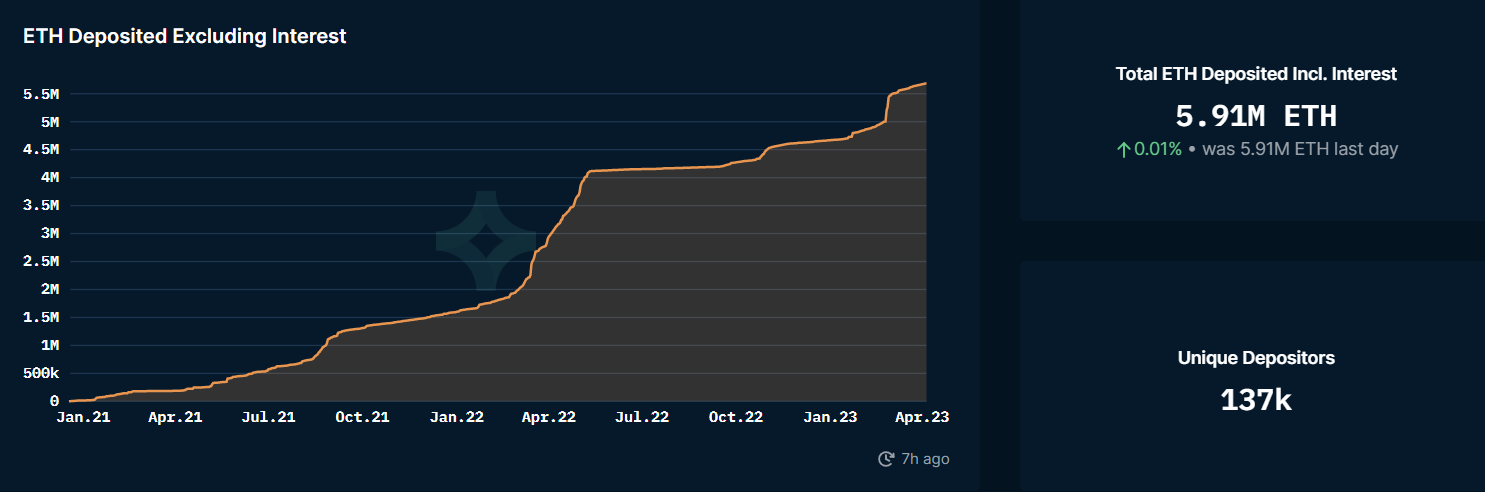
The emergence of liquidity staking derivatives has reduced the barrier to entry to participate in Ether staking. The leader in LSDs and the largest single entity by value, Lido has close to one-third of all staked Ether. Including interest received, Lido contracts hold 5.9 million Ether from 137,000 unique depositors.
Ethereum network TVL surges
The total value locked in the Ethereum network is also rising, partially as a result of Lido’s protocol comprising 22.4% of the TVL on the Ethereum network. Despite TVL starting to drop on March 10 due to regulatory and macro headwinds, the DeFi market seems to be recovering.
Related: 3 key Ethereum price metrics cast doubt on the strength of ETH’s recent rally
On April 5, TVL reached $50.8 billion, nearly reaching the yearly high of $51.4 billion which was reached on Feb. 21.
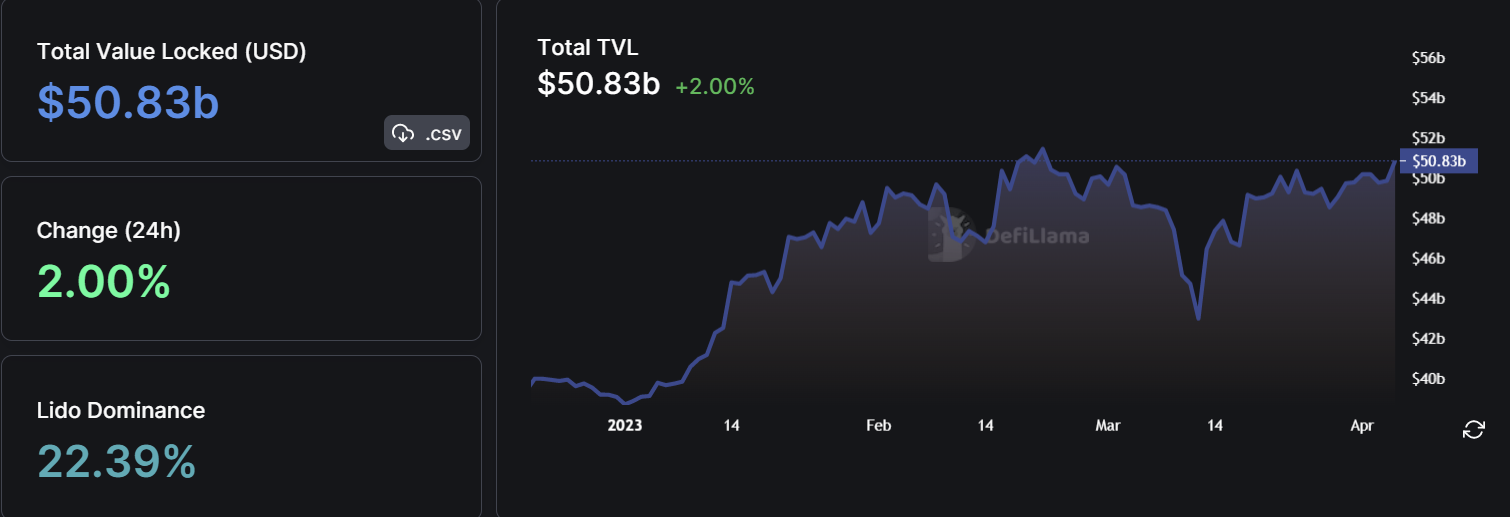
The strength of Ether price ahead of the Shanghai and Capella upgrade is visible on-chain through increased usage, whale accumulation and a steady uptick in staking. With only 7 days remaining until the upgrade, traders expect continued volatility in Ether price.
This article does not contain investment advice or recommendations. Every investment and trading move involves risk, and readers should conduct their own research when making a decision.
The views, thoughts and opinions expressed here are the authors’ alone and do not necessarily reflect or represent the views and opinions of Cointelegraph.
Source link

Uniswap Bullish But Struggles With Resistance, Potential For More Gains?

Nevada financial regulator petitions court to place Prime Trust into receivership

BTC Continues Uptrend As Fidelity Plans To Submit Bitcoin Spot ETF Filing

New Web3 ID app lets users find each other based on proven interests

PEPE Coin Shines Among Top Gainers, Tallies 78% In Last Week

Japanese and Singaporean regulators join forces on crypto pilot project

Bitcoin Holders Expect Retrace, Will BTC Move Against Crowd Once Again?

Bitcoin bulls grill $31K as Fidelity ETF move fuels BTC price strength

Robinhood To Lay Off 7% of Full-Time Staff In Latest Restructuring

Google says its next AI ‘Gemini’ will be more powerful than ChatGPT

ETHBTC Hit A 300-Day Low

Digital pound will be pseudonymous with a focus on privacy: BoE CBDC chief

Tezos Releases Nairobi, XTZ Bulls Unmoved As Bears Dominate

Will $30K be a new springboard for Bitcoin bulls?

TRX Could Surge And Revisit $0.085

Judge rules LBRY video platform’s token is a security in case brought by the US SEC

Silvergate Capital’s crypto-to-fiat transfers decrease by $50B compared to Q3 2021

Will the Bitcoin mining industry collapse? Analysts explain why crisis is really opportunity

Exchange Outflows Shows Bitcoin, Ethereum Accumulation Trend Continues

Bitcoin Dropped Below 2017 All-Time-High but Could Sellers be Getting Exhausted? – Blockchain News, Opinion, TV and Jobs
BNM DAO Token Airdrop

What does the Coinbase Premium Gap Tell us about Investor Activity? – Blockchain News, Opinion, TV and Jobs
Fed policy and crumbling market sentiment could send the total crypto market cap back under $1T
New Minting Services

Can Cardano’s July hard fork prevent ADA price from plunging 60%?

SEC’s Chairman Gensler Takes Aggressive Stance on Tokens – Blockchain News, Opinion, TV and Jobs

Friends or Enemies? – Blockchain News, Opinion, TV and Jobs

LUNA2 Recovers 70% In Nine Days From Historic Lows

Enjoy frictionless crypto purchases with Apple Pay and Google Pay | by Jim | @blockchain | Jun, 2022

Block News Media Live Stream
-
 SEC8 months ago
Judge rules LBRY video platform’s token is a security in case brought by the US SEC
-
 Banking8 months ago
Silvergate Capital’s crypto-to-fiat transfers decrease by $50B compared to Q3 2021
-
 Antminer11 months ago
Will the Bitcoin mining industry collapse? Analysts explain why crisis is really opportunity
-
 Bitcoin8 months ago
Exchange Outflows Shows Bitcoin, Ethereum Accumulation Trend Continues
-
 Altcoins12 months ago
Bitcoin Dropped Below 2017 All-Time-High but Could Sellers be Getting Exhausted? – Blockchain News, Opinion, TV and Jobs
-
Uncategorized1 year ago
BNM DAO Token Airdrop
-
 Binance11 months ago
What does the Coinbase Premium Gap Tell us about Investor Activity? – Blockchain News, Opinion, TV and Jobs
-
 Asia11 months ago
Fed policy and crumbling market sentiment could send the total crypto market cap back under $1T