SEC
Judge rules LBRY video platform’s token is a security in case brought by the US SEC

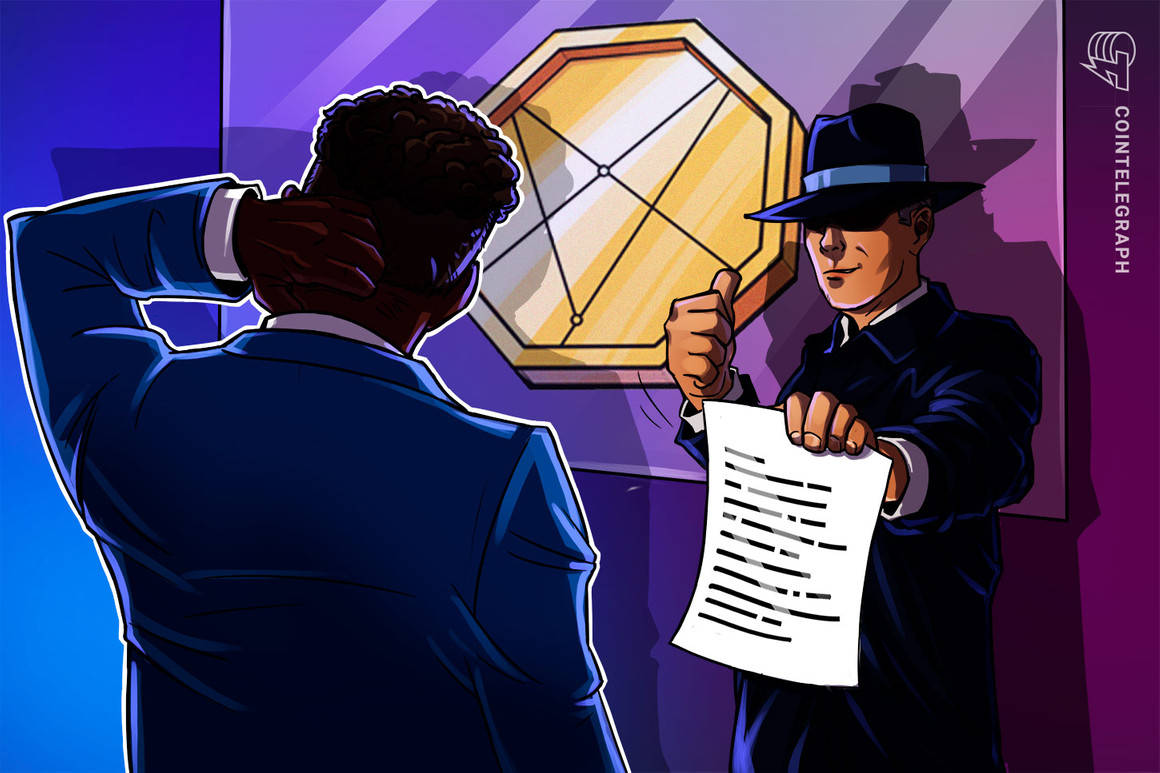
A United States District Court ruled in favor of the Securities and Exchange Commission (SEC) Nov. 7 in its case against blockchain-based file-sharing and payment network LBRY. The court granted the SEC’s request for a summary judgment filed May 5. The SEC sued developer LBRY, Inc. in March 2021 — after the agency had brought similar charges against Ripple — claiming that its LBRY Credit token (LBC) was sold as a security under the 1933 Securities Act.
According to the SEC, LBRY raised more than $11 million in U.S. dollars, Bitcoin, and services from investors between 2016 and 2021 without filing a registration statement containing “the information required for such an offering to the public.” LBRY did not hold an initial coin offering, and the SEC did not allege fraud in the case.
We lost. Sorry everyone.
— LBRY (@LBRYcom) November 7, 2022
LBRY operates the decentralized video sharing platform Odysee, which offers viewers the opportunity to earn cryptocurrency for watching videos while creators earn LBC for their work. LBRY denied that LBC was a security and claimed the SEC spurned its efforts to settle with it. According to the website for a petition addressed to the SEC defending LBRY:
“The LBRY Credit […] allows individuals to create an identity, tip creators, and publish, purchase, and boost content in a decentralized way. Millions of people have used it this way, and many were using it well before we sold any tokens to anyone. […] We’ve acted in extremely good-faith, attempted to follow all the rules, and complied with the SEC at every turn.”
However, Judge Paul Barbadoro of the District of New Hampshire found:
“No reasonable trier of fact could reject the SEC’s contention that LBRY offered LBC as a security, and LBRY does not have a triable defense that it lacked fair notice.”
The ruling means the case will not go to trial. The company stated, “Even if LBRY Inc is shut down by the SEC as a result of this lawsuit, the LBRY network will continue to function and grow through the effort of the distributed LBRY community.” LBRY founder Jeremy Kauffman is currently running to represent New Hampshire in the U.S. Senate as a member of the Libertarian Party.
Related: Former SEC official predicts regulator ‘will lose on the merits’ of case against Ripple
LBRY, Inc. did not respond to a Cointelegraph request for comment by press time.
Source link






Proof-of-work coins that had a fair distribution at their launch are the most likely to avoid being labeled as securities by the U.S. SEC, according to Bitcoin OG and educator Dan Held.
Last week, the SEC sued Binance and Coinbase, accusing them of offering a number of altcoins as unregistered securities. As a result, many of the tokens mentioned in the lawsuit were delisted by major trading platforms which made their price tank.
According to Held, Tokens that “had fair or transparent launches”, such as Litecoin, Dogecoin and Monero, do not match the definition of a security that the SEC is following and therefore are likely to avoid the current crackdown.
Related: SEC charges against Binance and Coinbase are terrible for DeFi
“It definitely seems like the SEC has carved that out as something that they won’t be going after”, he said in an exclusive interview with Cointelegraph.
According to Held, the vast majority of the tokens classified as securities by the SEC in its lawsuit against Coinbase and Binance were proof-of-stake coins, or tokens who had a pre-mined distribution, which means they have a more centralized ownership.
As Held also pointed out, the current crackdown is mainly carried out by a single government entity, the SEC, which means the level of pressure on the industry is still far from reaching the maximum level.
Held also stated that only Bitcoin and a few other cryptocurrencies that are decentralized enough will survive in the long run, as they are the only ones that can survive an all-out government attack.
To find out more about which cryptos can resist the ongoing SEC crackdown, watch the full video on our YouTube channel, and don’t forget to subscribe!
Source link

The lawyers representing the United States Securities and Exchange Commission (SEC) have contended that the additional documents submitted by Dentons, the legal counsel for Terraform and Do Kwon, in support of their motion to dismiss the lawsuit, lack adequate support for dismissing the case.
The SEC’s counsel asserts that the Binance.US transcript and internal SEC emails, presented by the defense, hold no relevance to the current case. They argue that the Howey Test clearly defines the parameters of an “investment contract” and contend that UST should be classified as a security.
In a court hearing on June 15, Dentons submitted supplementary documents to bolster their motion to dismiss the lawsuit filed by the U.S. SEC. The focus of the hearing was to determine if the digital assets developed by Terraform Labs should be classified as securities under the criteria of an “investment contract.”
The legal team from Dentons asserts with conviction that the algorithmic stablecoin UST (now USTC) is not classified as a security, emphasizing its practical purpose rather than being an investment contract. In support of their motion to dismiss the lawsuit, they submitted supplementary documents, which encompass the U.S. House Financial Services Committee hearing on digital asset regulation and stablecoin issuance, the SEC’s request for a restraining order against Binance.US, and the Hinman emails from the SEC v. Ripple lawsuit.
The defense lawyers highlighted the existence of a “regulatory gap” regarding the classification of crypto assets as securities, particularly as the U.S. Congress engages in discussions about regulatory frameworks for digital assets and stablecoin issuance. Additionally, they argued that the SEC is exceeding the scope of securities laws and relying on internal emails related to “investment contracts” to determine the security status.
Judge Jed Rakoff who is presiding over the case has announced that a decision on the motion to dismiss the case will be rendered by July 14th.
Dentons represented Do Kwon earlier to challenge the US SEC subpoena in its investigation of Mirror Protocol in 2021 and a class action lawsuit in the Singapore High Court in 2022. The law firm also represents Terra in other lawsuits.
Related: Do Kwon could serve prison in both US and South Korea, prosecutor says
Meanwhile, Montenegro High Court has approved the bail of Do Kwon and former CTO Han Chang-joon. Also, Do Kwon has been taken into extradition custody in Montenegro while the court decides on South Korea’s extradition request for him.
Magazine: Do Kwon kicked in the assets
Source link
In the past 48 hours, the price of XRP has experienced notable volatility, dropping below $0.50. The crypto market is closely focused on XRP due to a recent favorable development in the Securities and Exchange Commission (SEC) vs. Ripple lawsuit.
The emergence of the Hinman documents has sparked inquiries into the actions of the Securities and Exchange Commission. Although XRP witnessed positive price action earlier this year, the altcoin has faced challenges due to ongoing market volatility. This has led to a break below significant support levels.
Over the last 24 hours, XRP has seen a close to 7% dip. There has been an 8% depreciation on the weekly chart. Both the demand and accumulation of the asset have remained low. This indicated a dominant bearish trend. The fear index remains high in the market, contributing to a decline in investor confidence.
Failure to surpass the $0.50 level may result in a significant loss of value for XRP during the next trading session. Furthermore, the decrease in the altcoin’s market capitalization reinforces the weak buying power reflected on the chart.
XRP Price Analysis: One-Day Chart
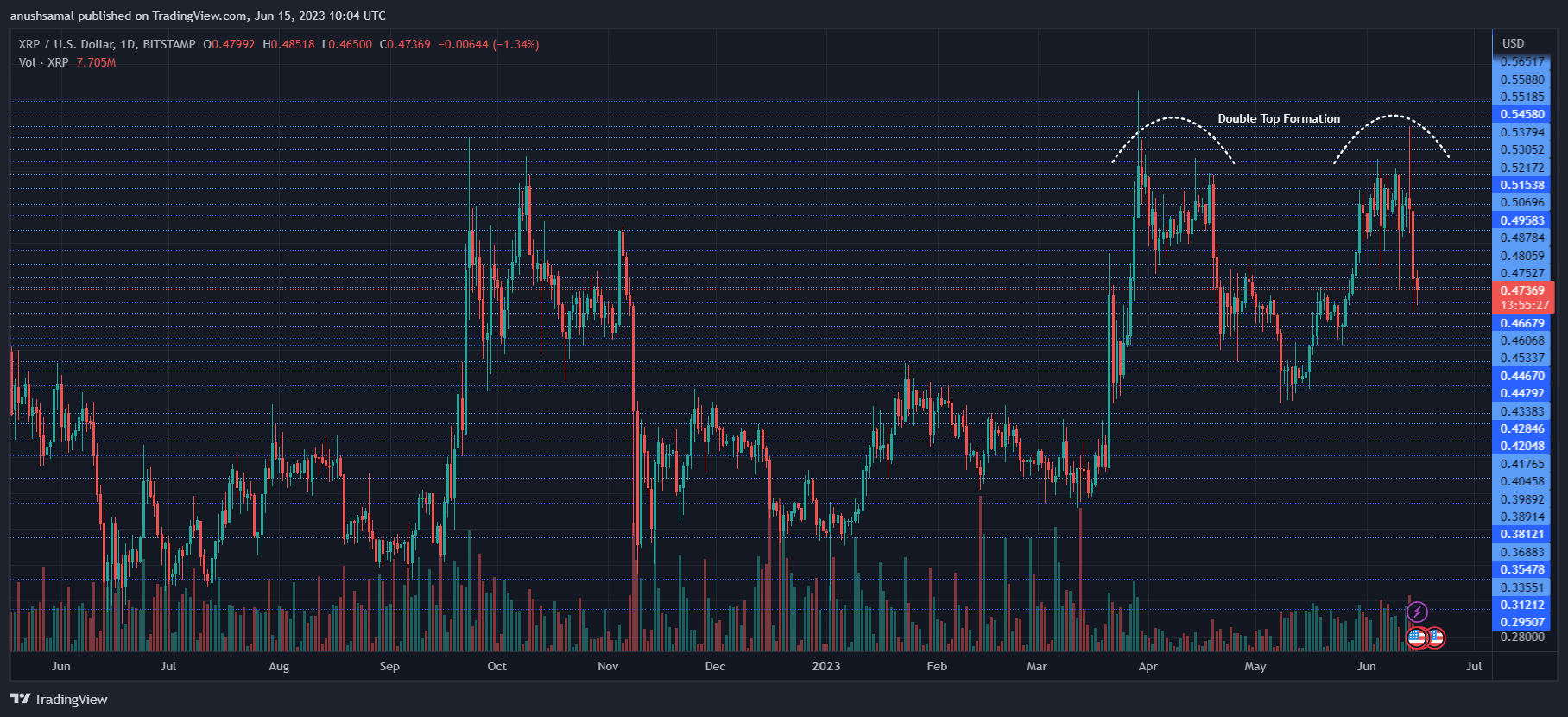
As of the time of writing, the altcoin XRP was trading at $0.47. Following the rejection of the bulls at $0.50, XRP has been experiencing a downward trend.
The coin faced resistance at $0.50, and it is anticipated that it may encounter even stronger resistance at $0.55. If the altcoin fails to surpass the $0.55 mark, it will likely dip to its local support level of $0.46 and potentially further down to $0.43.
Moreover, the altcoin has formed a bearish double-top pattern, indicating a potential reversal in its price trend as it moves downward on the chart. The trading volume of XRP has also declined in the last session, suggesting that sellers have taken control of the asset.
Technical Analysis
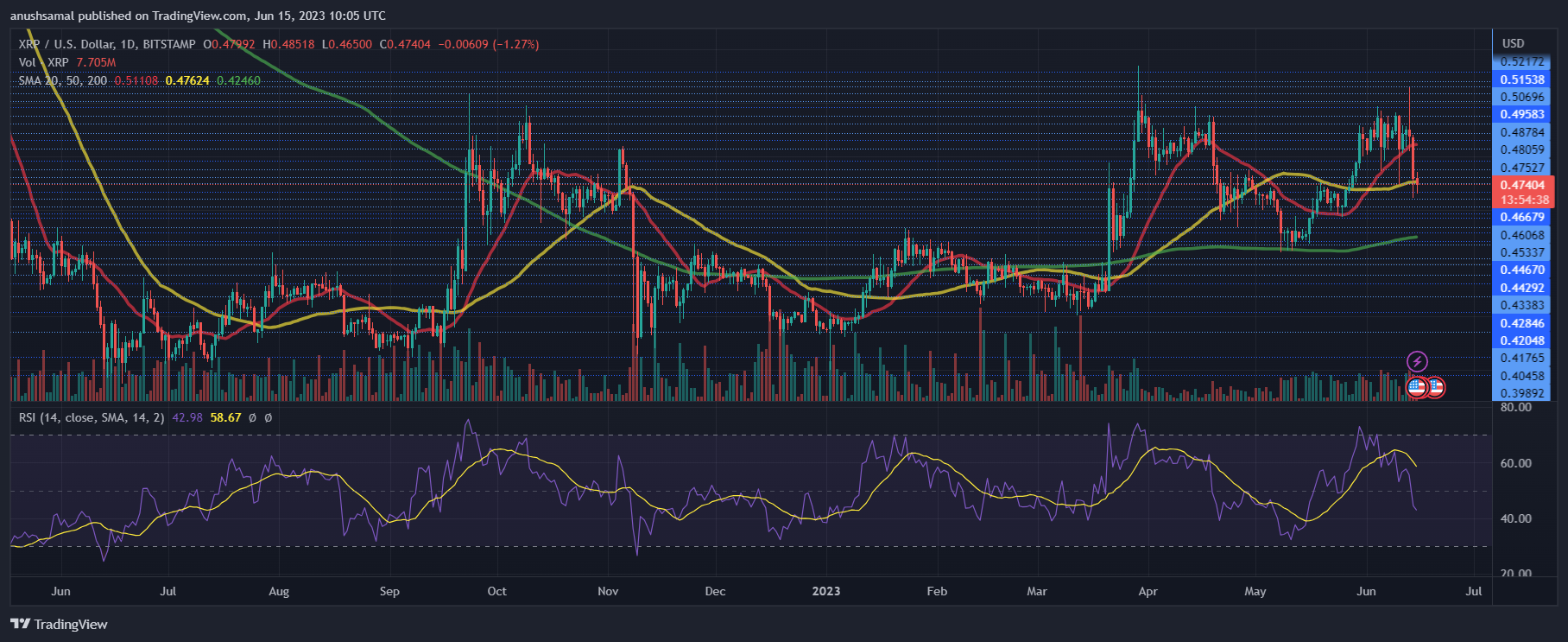
During the majority of this month, XRP witnessed a decline in demand. This was reflected by the Relative Strength Index (RSI) falling below the half-line, indicating that sellers had taken control of the asset.
Additionally, XRP fell below the 20-Simple Moving Average (SMA), suggesting low demand and indicating that sellers were driving the price momentum in the market.
However, if the altcoin trades near the $0.50 price mark, it can potentially bring the price back above the 20-SMA line. This would essentially indicate a resurgence in demand for the asset.
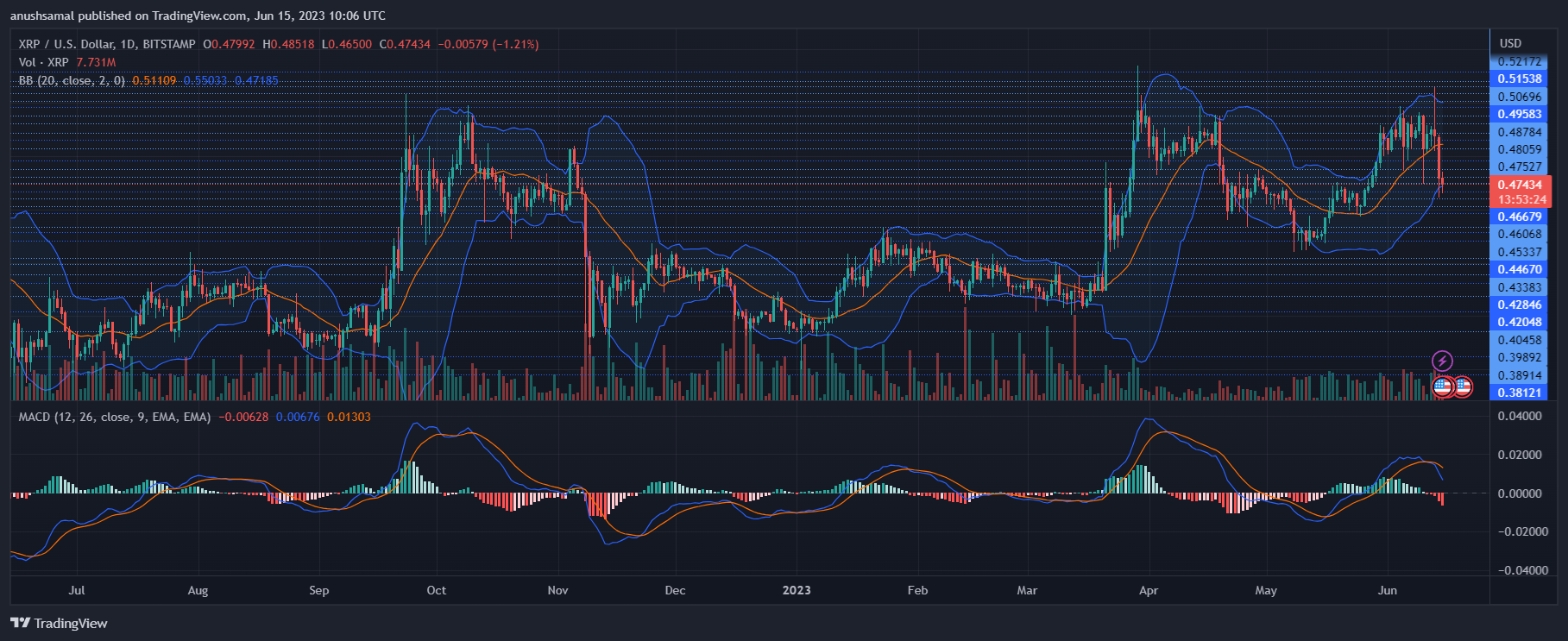
In addition to the mentioned technical indicators, other signals on the chart for the altcoin indicate selling pressure. The Moving Average Convergence Divergence (MACD) formed red histograms, signalling sell signals for the altcoin and indicating a bearish sentiment in the market.
Related Reading: Ethereum Bears Set Their Sights On Next Downside Target If $1,700 Support Breaks
Furthermore, the Bollinger Bands have widened, indicating increased volatility and potential price fluctuations for the altcoin in the upcoming trading sessions. This suggests that the price of XRP may experience significant changes and unpredictability in the near term.
Featured Image From UnSplash, Charts From TradingView.com
Source link

XRP Allegedly Attacked By SEC’s Hinman For Ethereum’s Benefit

On-chain sleuth ZachXBT sued for libel after claiming plaintiff drained funds from project

Percentage Of ETH Addresses In Profit Reaches 5-Month Low

Think AI tools aren’t harvesting your data? Guess again

Bitcoin Bullish Momentum Building: Expert Predicts Rise To $27,200

Which altcoins will survive the SEC crackdown? Bitcoin OG explains

Curve (CRV) Observes 7% Bounce As Short Squeeze Occurs

Bakkt follows Robinhood, eToro in delisting major altcoins: Report

Shiba Inu Lead Developer Unveils Shibacals, Advancing Shibarium Development

dApp Store kit adopts new tech stack to power Web3 gaming development

Polygon Sees Surge In Whale Buying: Recovery In The Cards?

7 alternatives to ChatGPT

What Happens To Bitcoin Price If Spot ETF Is Approved?

SEC argues against Dentons’ motion to dismiss Terraform and Do Kwon’s lawsuit

Why Is Bitcoin Up Today?

Judge rules LBRY video platform’s token is a security in case brought by the US SEC

Will the Bitcoin mining industry collapse? Analysts explain why crisis is really opportunity

Silvergate Capital’s crypto-to-fiat transfers decrease by $50B compared to Q3 2021

Exchange Outflows Shows Bitcoin, Ethereum Accumulation Trend Continues

Bitcoin Dropped Below 2017 All-Time-High but Could Sellers be Getting Exhausted? – Blockchain News, Opinion, TV and Jobs
BNM DAO Token Airdrop

What does the Coinbase Premium Gap Tell us about Investor Activity? – Blockchain News, Opinion, TV and Jobs
Fed policy and crumbling market sentiment could send the total crypto market cap back under $1T
New Minting Services

Can Cardano’s July hard fork prevent ADA price from plunging 60%?

Friends or Enemies? – Blockchain News, Opinion, TV and Jobs

SEC’s Chairman Gensler Takes Aggressive Stance on Tokens – Blockchain News, Opinion, TV and Jobs

LUNA2 Recovers 70% In Nine Days From Historic Lows

Enjoy frictionless crypto purchases with Apple Pay and Google Pay | by Jim | @blockchain | Jun, 2022

A String of 200 ‘Sleeping Bitcoins’ From 2010 Worth $4.27 Million Moved on Friday
-
 Antminer11 months ago
Will the Bitcoin mining industry collapse? Analysts explain why crisis is really opportunity
-
 Banking8 months ago
Silvergate Capital’s crypto-to-fiat transfers decrease by $50B compared to Q3 2021
-
 Bitcoin8 months ago
Exchange Outflows Shows Bitcoin, Ethereum Accumulation Trend Continues
-
 Altcoins12 months ago
Bitcoin Dropped Below 2017 All-Time-High but Could Sellers be Getting Exhausted? – Blockchain News, Opinion, TV and Jobs
-
Uncategorized1 year ago
BNM DAO Token Airdrop
-
 Binance11 months ago
What does the Coinbase Premium Gap Tell us about Investor Activity? – Blockchain News, Opinion, TV and Jobs
-
 Asia11 months ago
Fed policy and crumbling market sentiment could send the total crypto market cap back under $1T
-
Uncategorized2 years ago
New Minting Services