ADA Price
Can Cardano’s July hard fork prevent ADA price from plunging 60%?


Cardano (ADA) has started painting a bearish continuation pattern on its longer-timeframe charts, raising its likelihood of undergoing a major price crash by August.
ADA price in danger of a 60% plunge
Dubbed the “bear pennant,” the pattern forms when the price consolidates inside a range defined by a falling trendline resistance and rising trendline support after a strong move downside. Additionally, the consolidation moves accompany a decrease in trading volumes.
Bear pennants typically resolve after the price breaks below their trendline support and, as a rule, could fall by as much as the height of the previous big downtrend, called a “flagpole,” as illustrated in the chart below.
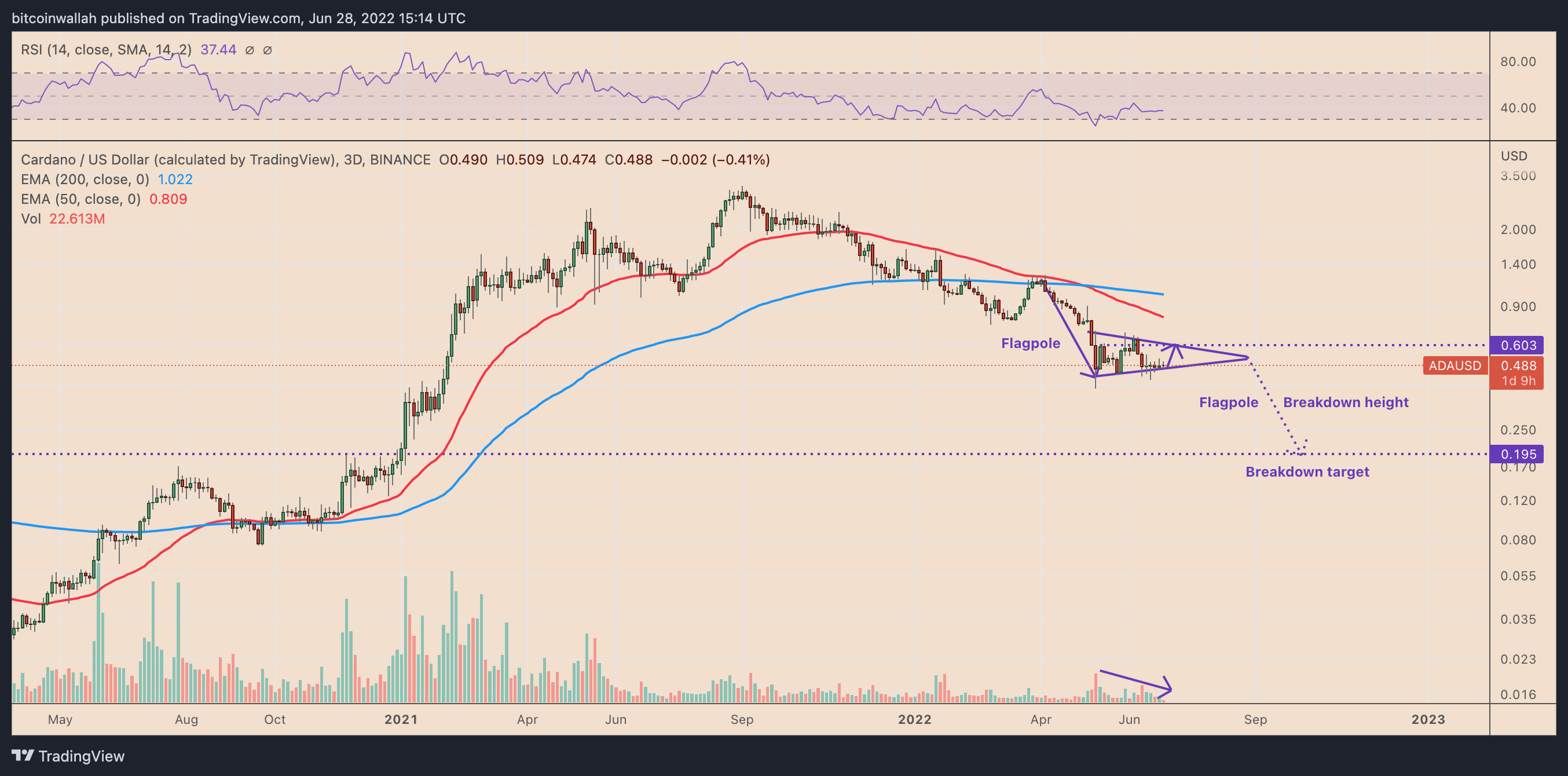
As a result, a decisive breakdown below ADA’s bear pennant structure could mean extended declines to the level at length equal to the flagpole. In other words, the target for Cardano’s price will be $0.20, down over 60% from June 28’s price.
In the meantime, ADA shows signs of consolidating inside the pennant’s range with its imminent bias looking skewed toward bulls. This opens the door for ADA/USD to rebound from the pennant’s rising trendline support near $0.46 to rally toward its falling trendline resistance around $0.60 by July.
Cardano’s Vasil hard fork
Despite the interim bearish outlook, Cardano could get a boost from its upcoming “Vasil” hard fork.
The upgrade, originally scheduled for June end, will now go live sometime in July and aims to improve the Cardano network’s speed and scalability.
Related: Institutional crypto asset products saw record weekly outflows of $423M
In addition, Vasil is expected to make Cardano more developer-friendly, which proponents argue could even attract projects from rivaling layer-one blockchains, leading to a higher demand for ADA.
ADA’s price has a history of rising in the days leading up to Cardano hard forks, which should boost its chances at a rally alongside favorable technicals, as shown below.
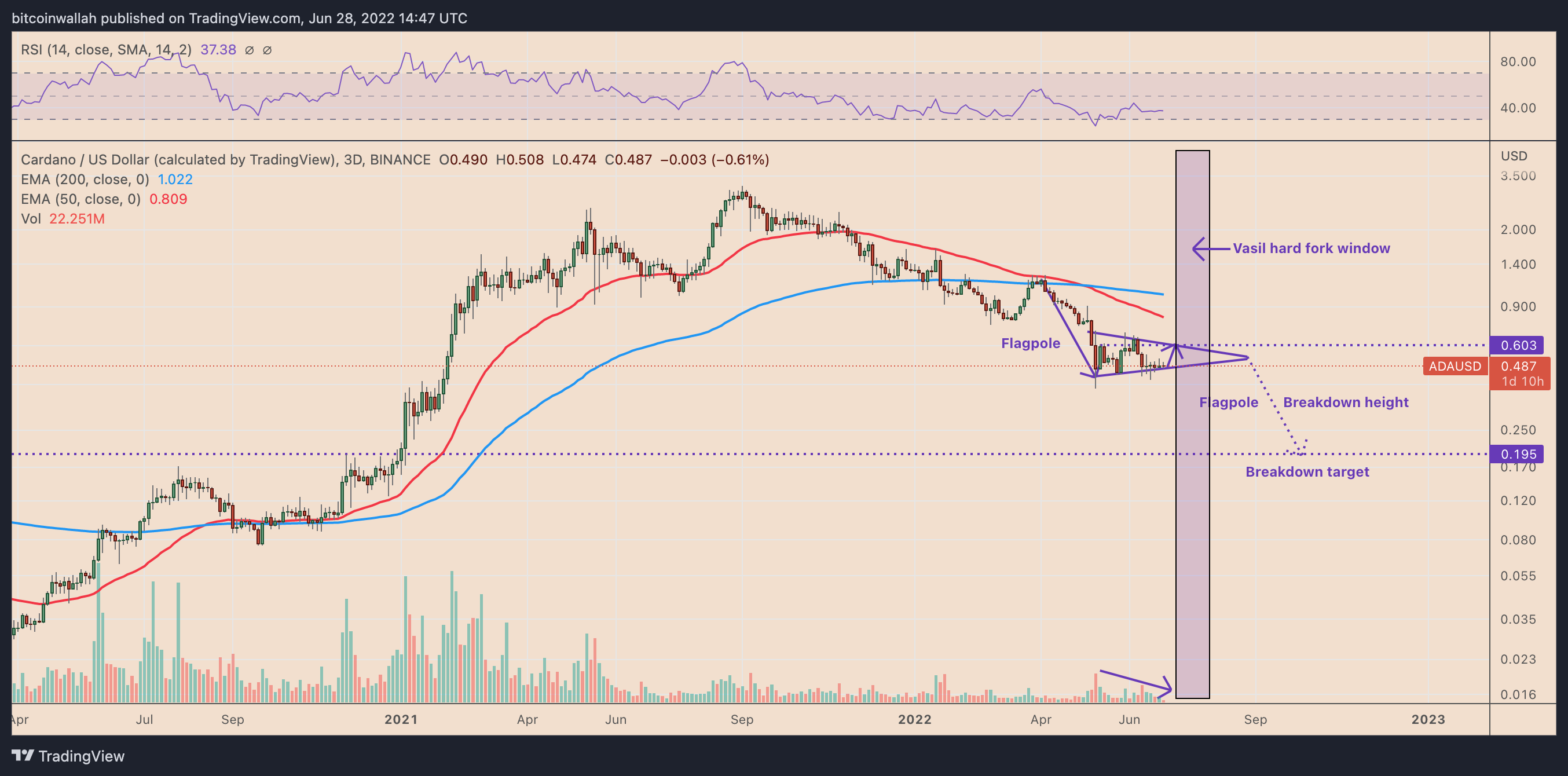
What’s more, ADA also has a history of plunging hard after its hard forks in a sell-the-news fashion.
Thus, Cardano could be setting up to resume its downtrend after Vasil goes live in July, which would fall in line with the bear pennant discussed above.
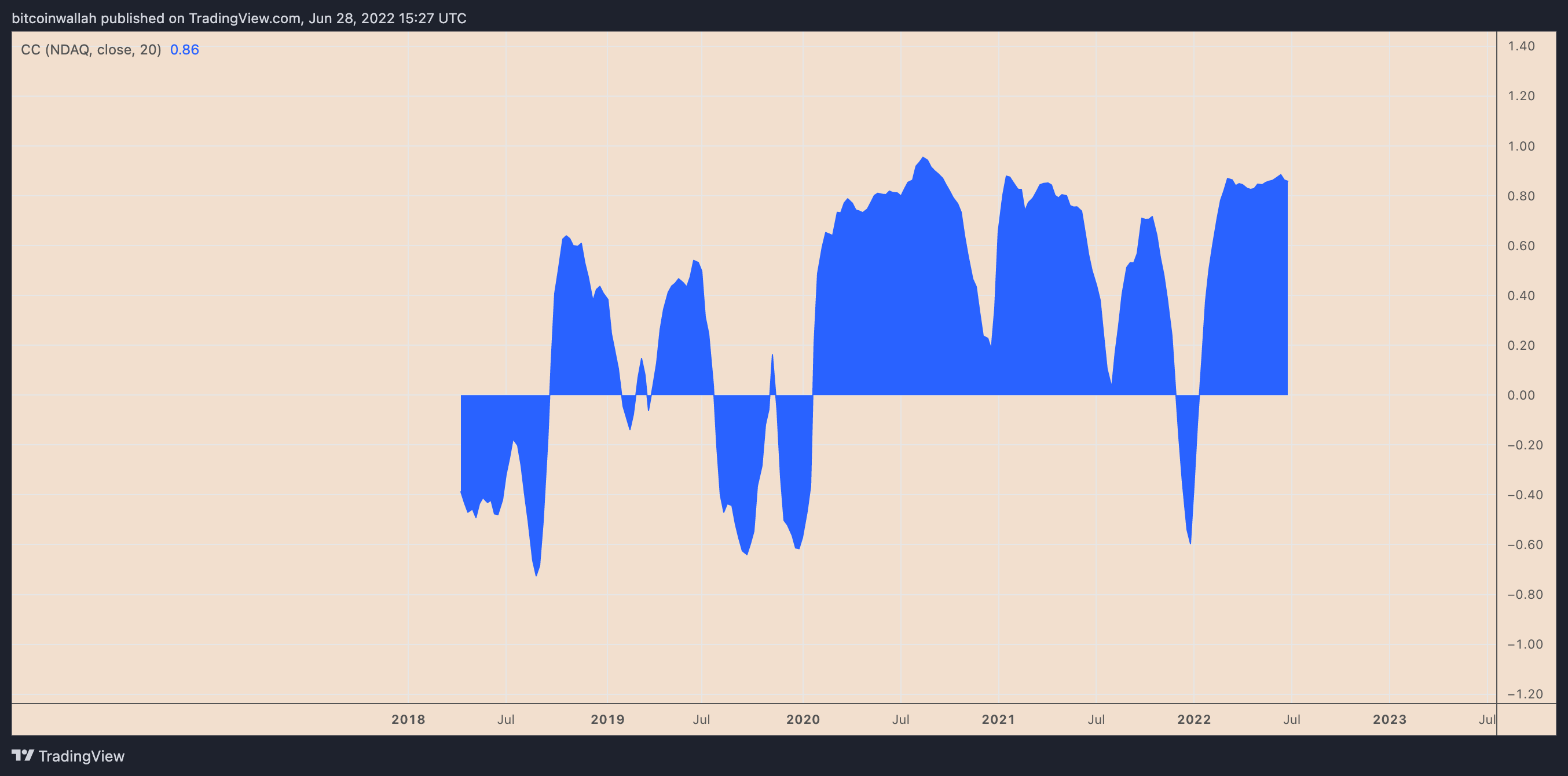
At the same time, Cardano’s price remains almost in lockstep with U.S. equities amid the Federal Reserve’s interest rate hiking, which should continue to put downward pressure on its price in the short to medium term.
The views and opinions expressed here are solely those of the author and do not necessarily reflect the views of Cointelegraph.com. Every investment and trading move involves risk, you should conduct your own research when making a decision.
Source link







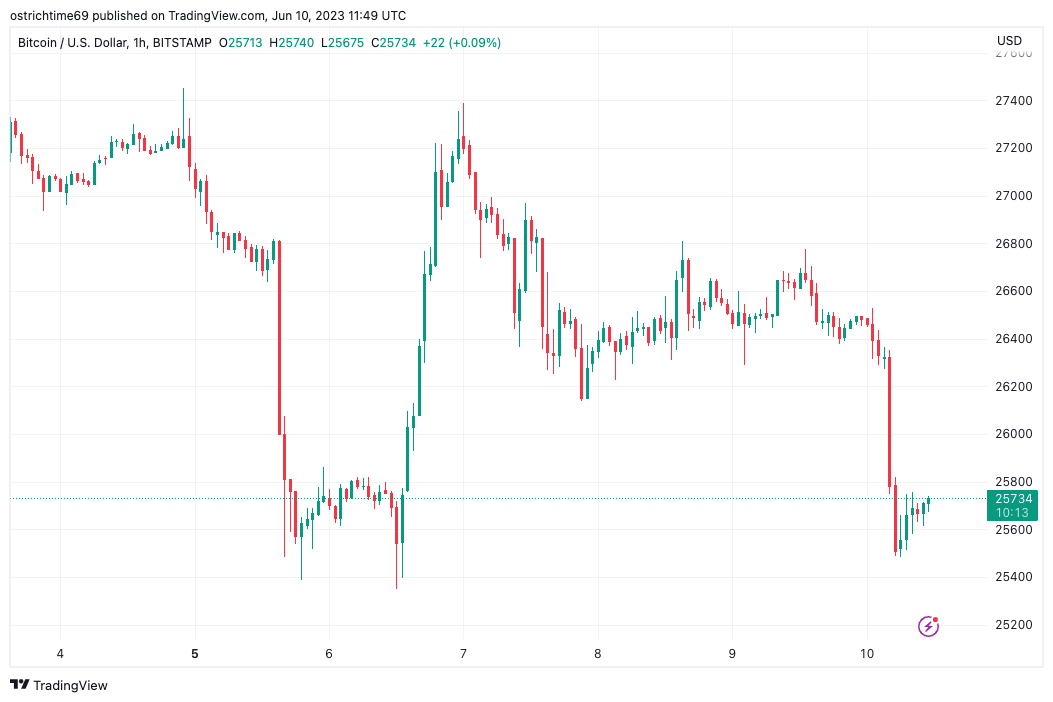
Bitcoin (BTC) challenged three-month lows into June 10 as altcoins in particular felt the heat from United States regulatory pressure.
Altcoin bloodbath as exchanges reshape landscape
Data from Cointelegraph Markets Pro and TradingView showed BTC/USD hitting $25,483 on the day, down over $1,200 from the previous day’s high.
While showing weakness, Bitcoin was spared the fate of major altcoins, which reacted strongly to delisting that accompanied U.S. legal action against major exchanges.
Trading app Robinhood announced that it would remove support for several cryptocurrencies named in the lawsuit against Binance and Coinbase by the U.S. Securities and Exchange Commission (SEC).
These subsequently hemorrhaged value, with both Cardano (ADA) and Solana (SOL) down nearly 25% in 24 hours at the time of writing.
“We regularly review the crypto we offer on Robinhood,” the firm stated on its website.
“Based on our latest review, we’ve decided to end support for Cardano (ADA), Polygon (MATIC), and Solana (SOL) on June 27th, 2023 at 6:59 PM ET.”
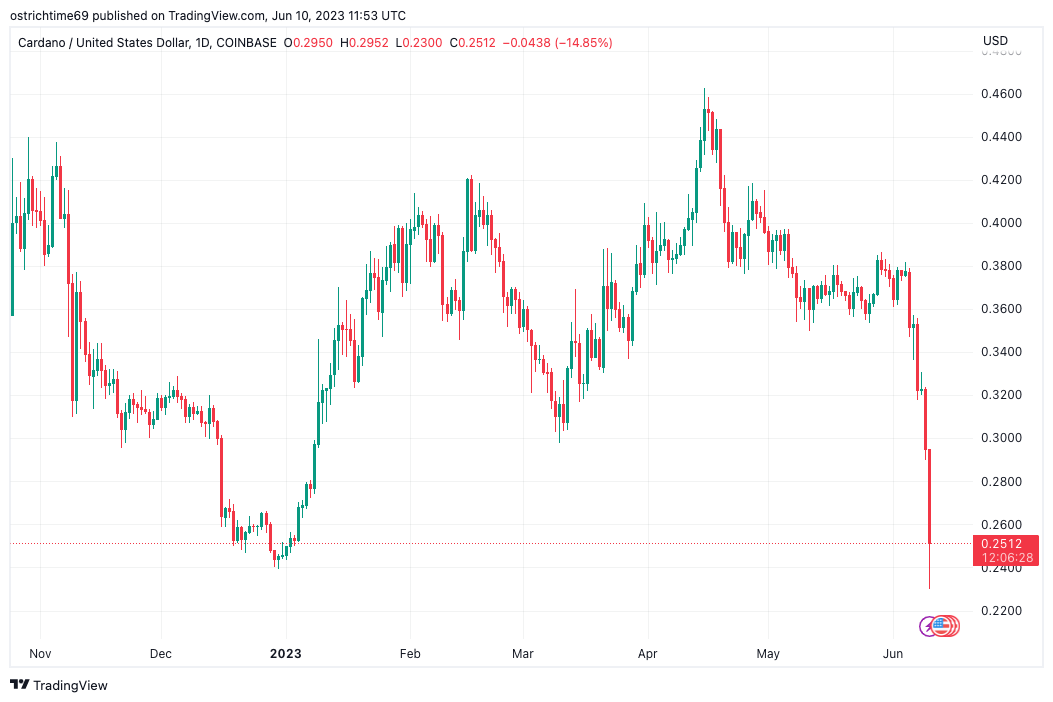
“As expected, following this week’s action on the regulatory front, we saw some delistings causing market selloff,” Kris Marszalek, CEO of Crypto.com, responded.
“I guess we are in the ‘then they fight you’ stage on the crypto adoption curve. Make no mistake: crypto industry will go through this and emerge stronger than ever.”
Crypto.com confirmed that it would halt its U.S. institutional trading service beginning June 21.
BTC price 200-week trend line support fails
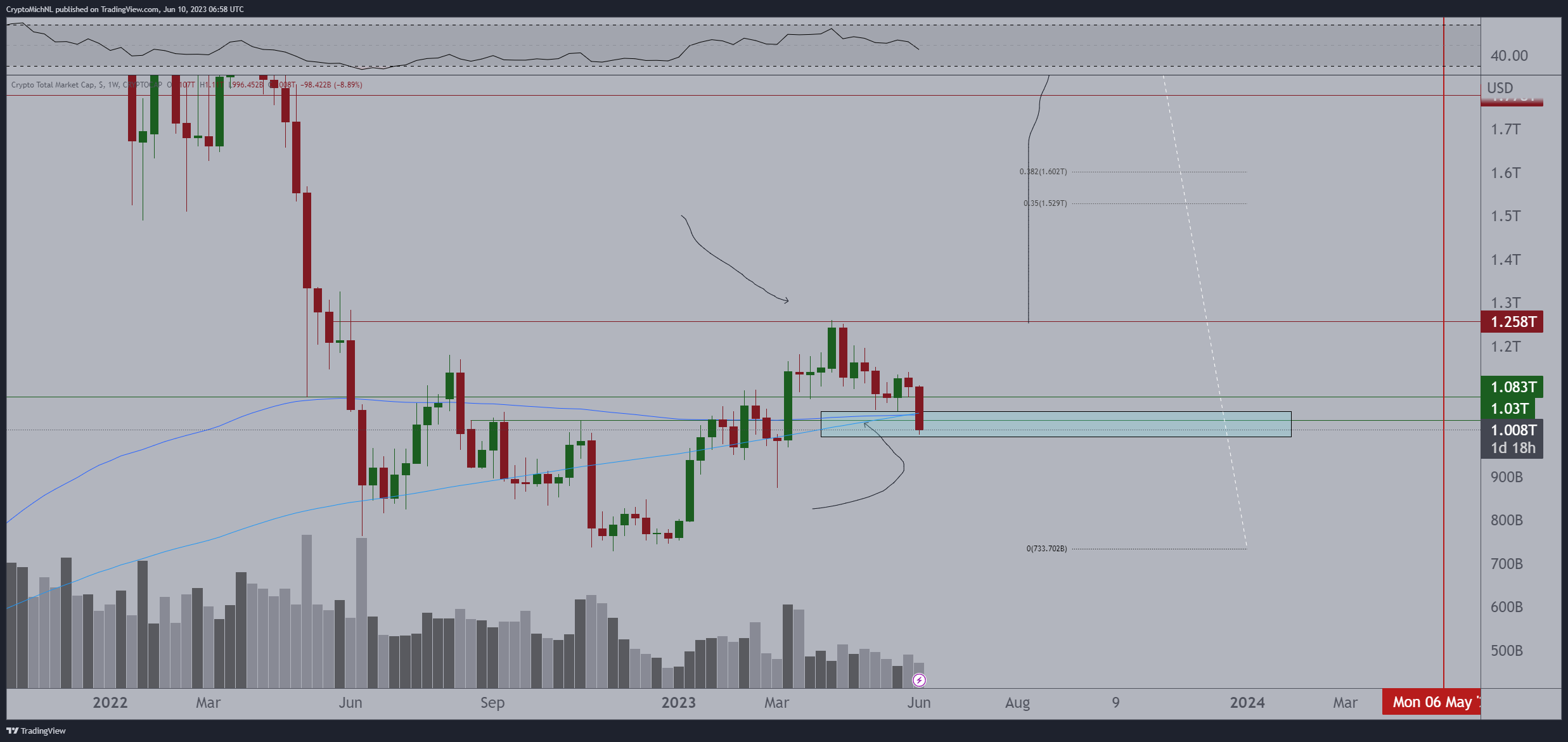
The events had a major impact on the overall cryptocurrency market cap, with Michaël van de Poppe, founder and CEO of trading firm Eight, warning that worse may be to come.
Related: Bitcoin, Ethereum to shake off ‘toothless adversary’ SEC as FOMC looms
As with BTC/USD, should the total crypto cap tally lose its 200-week moving average (MA), this would constitute a clear bear signal. Bitcoin’s moving average trend line currently stands at near $26,400.
“This is not the weekly candle you’d want to see on the total market capitalization for Crypto,” he told Twitter followers alongside a chart.
“Losing the 200-Week MA shouts for downwards continuation on the trend.”
Van de Poppe, like some other popular traders, nonetheless revealed interest in altcoin buys at lower prices.
Accompanying him was Crypto Tony, who predicted “incredible entries” on the table for 2023.
These #Altcoin drops get me way too excited in Crypto as they really do not come by that often
Got some incredible entries lined up later this year. I will share a few later today with you all and they are super realistic .. WHO IS READY
— Crypto Tony (@CryptoTony__) June 10, 2023
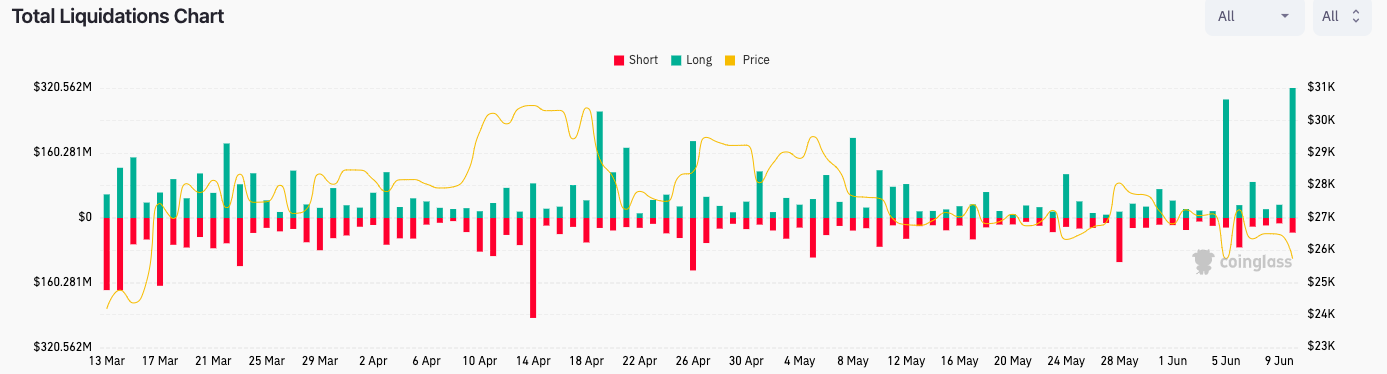
For existing traders, however, the damage was done — long liquidations totaled $320 million for June 10, according to data from CoinGlass, with the day not yet over.
Another $70 million in short positions also evaporated.
Magazine: Home loans using crypto as collateral: Do the risks outweigh the reward?
This article does not contain investment advice or recommendations. Every investment and trading move involves risk, and readers should conduct their own research when making a decision.
Source link

Cardano (ADA), along with numerous other major altcoins, experienced a significant downturn in recent days, causing considerable losses for investors. However, the downward trajectory of prices observed across the cryptocurrency market did not provide a reassuring signal for a potential reversal in the near future.
As panic and uncertainty gripped the crypto space, holders of Cardano and other altcoins found themselves questioning the stability and future prospects of these digital assets.
What factors contributed to this market-wide decline, and what lies ahead for Cardano amidst this turbulent period?
Bearish Trend Emerges As Cardano (ADA) Price Plummets
A recent report shed light on the alarming bearish scenario for Cardano (ADA) on its price charts.
Currently valued at $0.248073 according to CoinGecko, ADA has suffered a significant decline of 22.2% within the past 24 hours, further exacerbating the downward trend. Over the span of the last seven days, the cryptocurrency has experienced a staggering downturn, plummeting by 34.2%.

Source: Coingecko
A recent report emphasized the bearish landscape depicted by Cardano (ADA) on its charts, specifically noting its current price, and the breach below the $0.348 mark.
This development set the stage for bears to take control of the market across higher timeframes. The report highlighted the significance of this downward movement, as it not only signaled a shift in momentum but also posed challenges for Cardano’s price recovery.
Related Reading: ApeCoin Holders Suffer Financial Pain As 95% Endure Negative Returns
With the breach of the crucial support level, bears gained the upper hand in dictating market dynamics, particularly on longer timeframes. This bearish sentiment cast a shadow over Cardano’s performance, making it increasingly difficult for the ADA token to regain lost ground and establish upward momentum.
The report’s analysis underscored the implications of bears dominating the market, emphasizing the obstacles Cardano might face in its price trajectory.
In an attempt to alter the prevailing trend, the bulls made a late May push and managed to establish a high at $0.386. However, their efforts to sustain this shift in market sentiment were futile as they failed to capitalize on this change in character.
The failure to maintain the bullish momentum has left Cardano investors and market participants on edge, grappling with concerns about the cryptocurrency’s future trajectory.
Cardano (ADA) market cap currently at $8.5 billion. Chart: TradingView.com
SEC’s Security Label And Lawsuits Intensify Market Jitters
Adding to the already gloomy market sentiment, the US Securities and Exchange Commission (SEC) dealt a significant blow to Cardano by classifying ADA as a security. This categorization triggered a wave of apprehension among investors, leading many to flee from the cryptocurrency markets.
Cardano’s IOG Dismisses SEC’s Claim that ADA is a Security #Cardano #cardanofeed #ADA #crypto #cardanocommunity #bitcoin #CoinMarketCap #blockchain #cryptocurrency #CardanoADA #btc $ADAhttps://t.co/rOjRcaWXJN
— Cardano Feed ($ADA) (@CardanoFeed) June 9, 2023
Compounding the unease, the SEC filed lawsuits against Coinbase and Binance, further exacerbating the panic surrounding the already bleak market outlook in the crypto sphere.
(This site’s content should not be construed as investment advice. Investing involves risk. When you invest, your capital is subject to risk)
Featured image from iStock
Source link


Tether (USDT) De-Pegs As Crypto Market Stumbles

US prosecutors say SBF will be tried on original 8 criminal charges — for now

Bitcoin Price Takes A Beating Below $25K Amid Fed Hawkish Tone

Binance launches Bitcoin mining cloud services amid SEC crackdown in the US

Here’s Why Solana’s Recovery Won’t Be Easy

Institutional crypto broker FPG halts withdrawals after $20M cyberattack

Bitcoin Price Plunges Further Post Fed Decision, $24K Next?

Bitcoin dips below $25K for the first time in 3 months

Metrics Soar Higher Across The Board

French financial markets ombudsman reports jump in crypto-related mediations

XRP Bullish Trend Strengthens, Why A Breakout Could Be Coming

Aave proposal to freeze alleged Curve founder’s loans draws controversy

GRT Soars 13% As The Graph Prepares To Integrate Arbitrum

Here’s what happened in crypto today

Maker (MKR) Records Positive Moves As Majority Of Coins Bleed

Judge rules LBRY video platform’s token is a security in case brought by the US SEC

Will the Bitcoin mining industry collapse? Analysts explain why crisis is really opportunity

Silvergate Capital’s crypto-to-fiat transfers decrease by $50B compared to Q3 2021

Exchange Outflows Shows Bitcoin, Ethereum Accumulation Trend Continues

Bitcoin Dropped Below 2017 All-Time-High but Could Sellers be Getting Exhausted? – Blockchain News, Opinion, TV and Jobs
BNM DAO Token Airdrop

What does the Coinbase Premium Gap Tell us about Investor Activity? – Blockchain News, Opinion, TV and Jobs
Fed policy and crumbling market sentiment could send the total crypto market cap back under $1T
New Minting Services

Can Cardano’s July hard fork prevent ADA price from plunging 60%?

Friends or Enemies? – Blockchain News, Opinion, TV and Jobs

LUNA2 Recovers 70% In Nine Days From Historic Lows

SEC’s Chairman Gensler Takes Aggressive Stance on Tokens – Blockchain News, Opinion, TV and Jobs

Enjoy frictionless crypto purchases with Apple Pay and Google Pay | by Jim | @blockchain | Jun, 2022

A String of 200 ‘Sleeping Bitcoins’ From 2010 Worth $4.27 Million Moved on Friday
-
 SEC7 months ago
Judge rules LBRY video platform’s token is a security in case brought by the US SEC
-
 Antminer11 months ago
Will the Bitcoin mining industry collapse? Analysts explain why crisis is really opportunity
-
 Banking8 months ago
Silvergate Capital’s crypto-to-fiat transfers decrease by $50B compared to Q3 2021
-
 Bitcoin8 months ago
Exchange Outflows Shows Bitcoin, Ethereum Accumulation Trend Continues
-
 Altcoins12 months ago
Bitcoin Dropped Below 2017 All-Time-High but Could Sellers be Getting Exhausted? – Blockchain News, Opinion, TV and Jobs
-
Uncategorized1 year ago
BNM DAO Token Airdrop
-
 Binance11 months ago
What does the Coinbase Premium Gap Tell us about Investor Activity? – Blockchain News, Opinion, TV and Jobs
-
 Asia11 months ago
Fed policy and crumbling market sentiment could send the total crypto market cap back under $1T