
Bitcoin
Bitcoin dips below $25K for the first time in 3 months


The price of Bitcoin (BTC) has fallen below the $25,000 mark for the first time since March 17 following a hawkish Fed announcement amidanother turbulent week for the crypto industry.
Within the span of 30 minutes on June 15, the price of Bitcoin fell 4% from $25,867 to $24,819 according to data from TradingView. At the time of publication Bitcoin has regained ground and is holding just above $25,000.
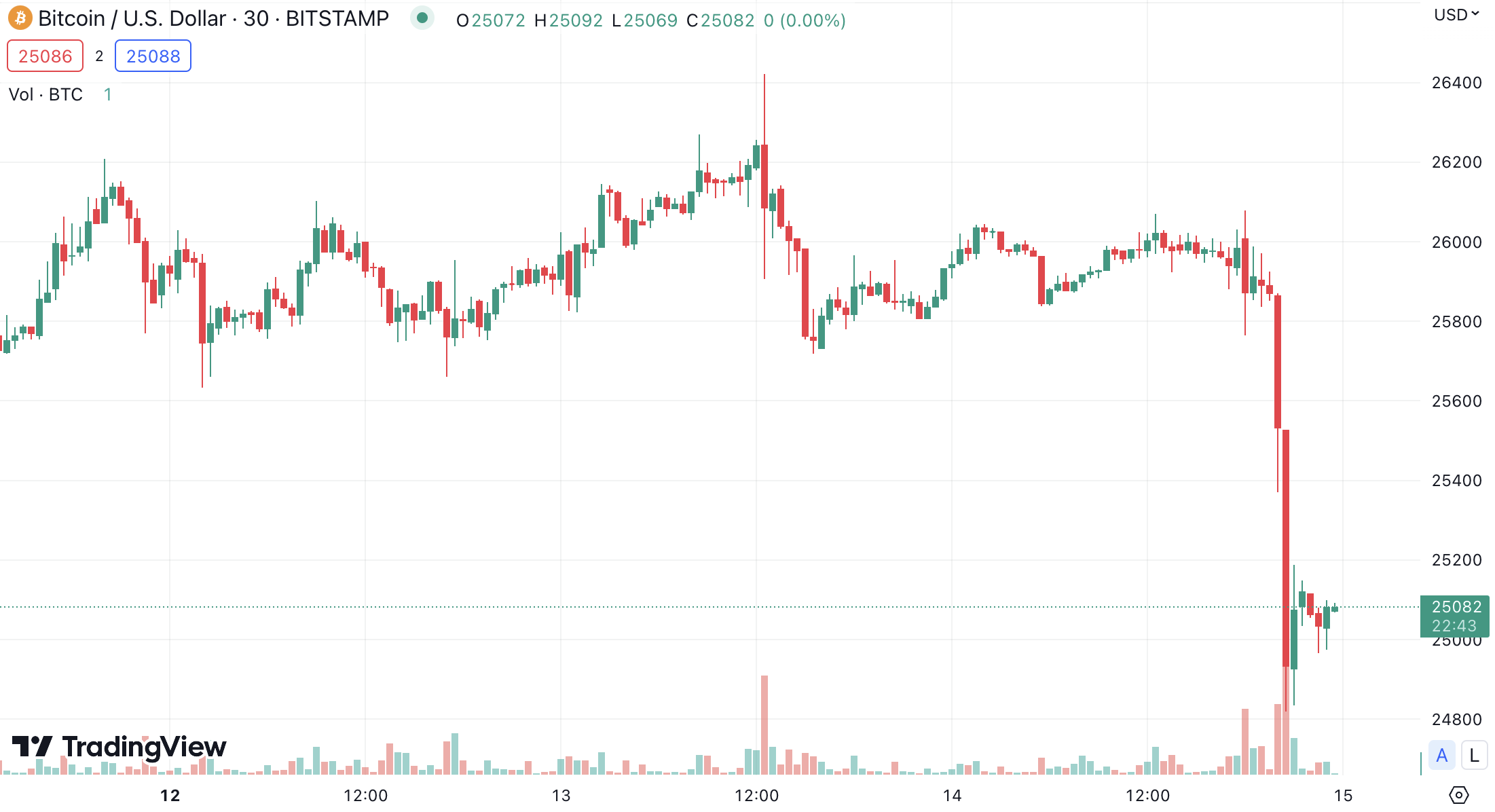
Over the past week Bitcoin had been holding around the $26,000 region as the market came to grips with the SEC’s legal action against crypto exchange heavyweights Coinbase and Binance as well as increasing macroeconomic uncertainty around interest rate signals from the United States Federal Reserve.
The sharp drop in price arrived roughly three hours after the Federal Reserve announced a pause on interest rate hikes, following a fifteen-month-long campaign of rate increases to combat surging inflation.
While the market was almost unanimously expecting a rate pause, the Federal Open Markets Committee statement hinted at further rate hikes in the future, which typically blunts investor excitement for risk assets like cryptocurrencies.
According to eToro Market Analyst Josh Gilbert, Federal Reserve chair Jerome Powell has made it quite clear that this is only a temporary pause, something that could spell further trouble for Bitcoin in the long-term.
“Much of the positivity we’ve seen from risk assets this year, including Bitcoin, is built on the expectation that inflation will fall and interest rates will peak, and then begin to be cut,” Gilbert said.
Inflation is moving in the right direction but the comments from Jerome Powell signify that rates could stay higher for longer, which would put Bitcoin on the back foot.”
Related: SEC, CPI and a ‘strong rebound’ — 5 things to know in Bitcoin this week
The second largest cryptocurrency by market cap, Ether (ETH), also took a hit, falling more than 5% from $1,727 to $1,631 in the same time frame. Altcoins were not spared from the bearish sentiment either, with many of the tokens labeled as securities in the SEC’s lawsuits stumbling another than 3%.
Cardano (ADA) is currently down 3.4% in the last 24 hours, while Polygon (MATIC) and Solana (SOL) fell 3.3% and 2.8% respectively.
According to Cointelegraph analyst Marcel Pechman, current options data for Bitcoin suggests a further slide to the downside, especially when considering the regulatory hostility towards the crypto industry on U.S. soil combined with the likelihood of further rate increases from the Fed in the coming months.
Magazine: Bitcoin is on a collision course with ‘Net Zero’ promises
Update (June 15, 1:40am UTC): This article has been updated to include comments from eToro market analyst Josh Gilbert.
Source link






Bitcoin price started a fresh decline below the $25,500 support. BTC is now at a risk of more losses toward the $24,000 support zone.
- Bitcoin is gaining bearish momentum below the $25,500 support.
- The price is trading below $25,500 and the 100 hourly Simple moving average.
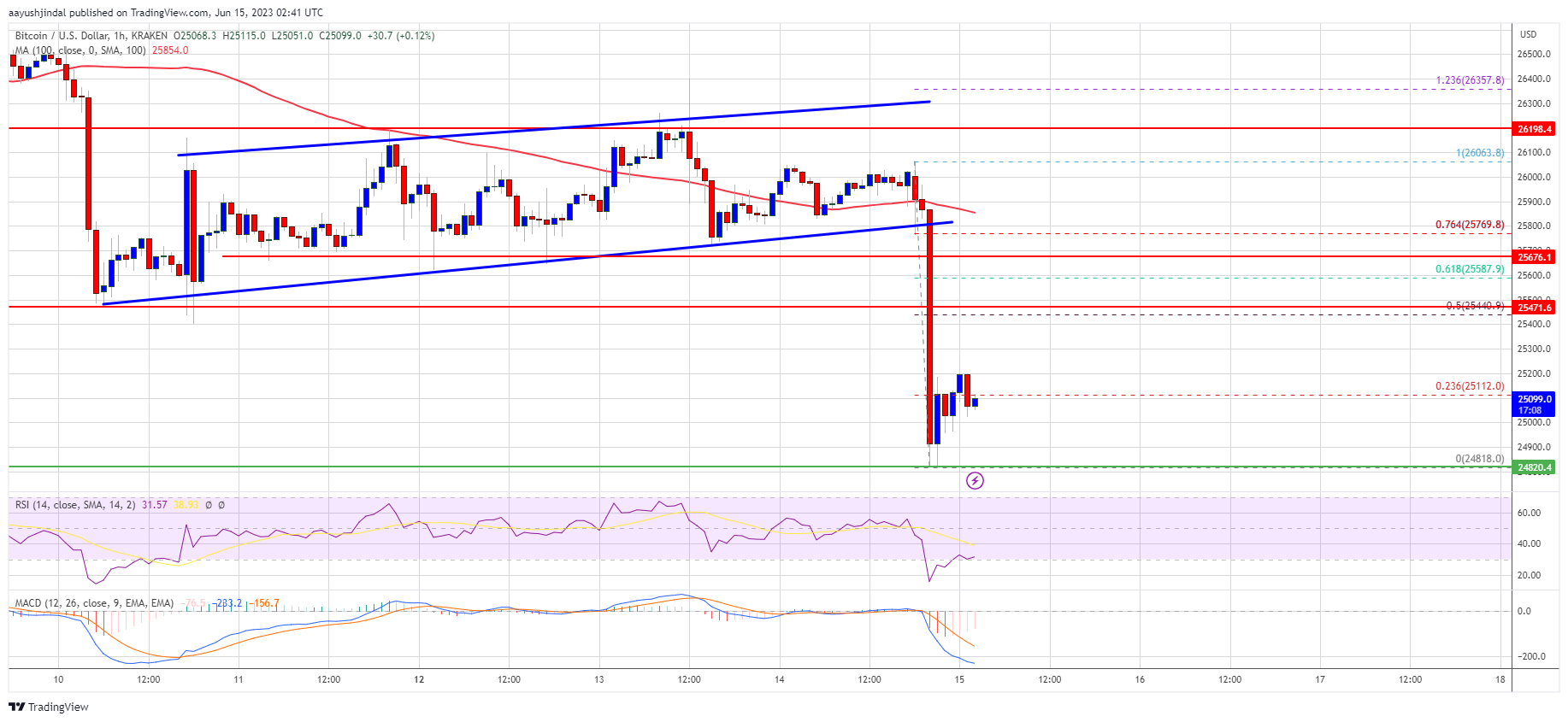
- There was a break below a key rising channel with support near $25,800 on the hourly chart of the BTC/USD pair (data feed from Kraken).
- The pair could correct higher but upsides might be limited above $25,500.
Bitcoin Price Extends Decline
Bitcoin price failed to start a fresh increase above the $26,200 resistance zone. BTC failed to remain in a positive zone after the Fed interest rate decision and declined below the $25,500 support.
The price declined below the $25,400 support to trade to a new weekly low. Besides, there was a break below a key rising channel with support near $25,800 on the hourly chart of the BTC/USD pair. There was a move below the $25,000 support zone.
A low is formed near $24,818 and the price is now consolidating losses. It is trading near the 23.6% Fib retracement level of the recent decline from the $26,063 swing high to the $24,818 low.
Bitcoin price is now trading below $25,500 and the 100 hourly Simple moving average. Immediate resistance is near the $25,200 level.
Source: BTCUSD on TradingView.com
The first major resistance is near the $25,500 level. It is close to the 50% Fib retracement level of the recent decline from the $26,063 swing high to the $24,818 low. A clear move above the $25,500 resistance might start a fresh increase. The next major resistance is near the $26,000 level, above which the bulls might send BTC toward the $26,500 resistance zone.
More Losses in BTC?
If Bitcoin’s price fails to clear the $25,500 resistance, it could continue to move down. Immediate support on the downside is near the $24,800 level and the recent low.
The next major support is near the $24,500 level, below which the price might gain bearish momentum. In the stated case, the price could drop toward the $24,000 support in the near term.
Technical indicators:
Hourly MACD – The MACD is now gaining pace in the bearish zone.
Hourly RSI (Relative Strength Index) – The RSI for BTC/USD is below the 50 level.
Major Support Levels – $24,800, followed by $24,500.
Major Resistance Levels – $25,200, $25,500, and $26,000.
Source link

The crypto market remains volatile after the June 14 Federal Open Market Committee (FOMC) announcement and presser with Fed Chairman Jerome Powell revealed that the central bank would pause rate hikes for June.
While this move aligned with investors’ expectations, the crypto market has yet to show any bullish momentum. Powell also mentioned that at least two more rate hikes would be needed in the future.
Bitcoin price started the day up, trading above $26,000, but it has since retraced to a 24-hour low of $25,791 after the FOMC announcement. Some analysts are predicting that a drop to $25,000 is inevitable based on the current state of BTC derivatives data.
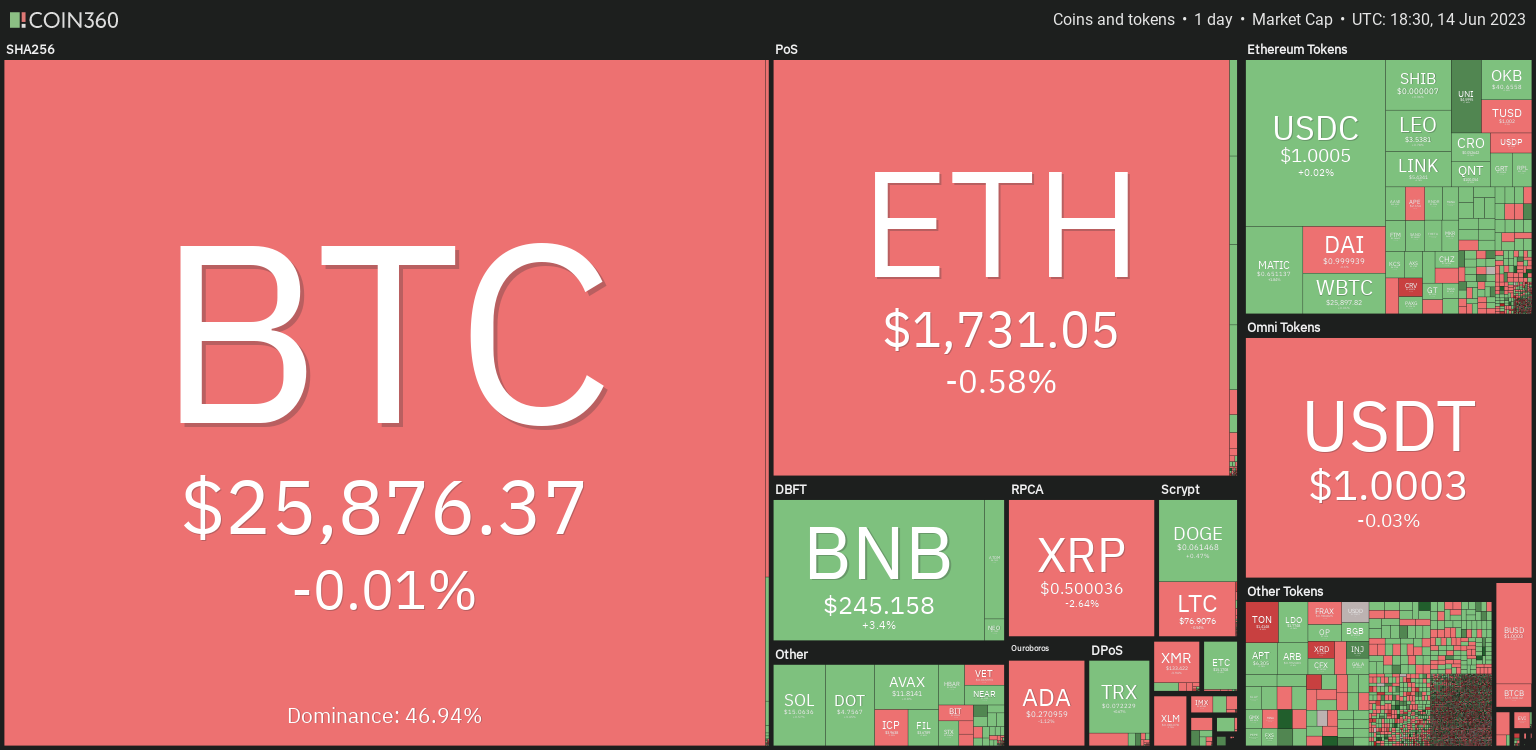
The muted crypto price action and lack of a bullish response to today’s rate hike pause could be the lingering effect of the SEC’s charges against Binance and Coinbase exchange.
Related: ‘Holy shit, I’ve seen that!’ — Coldie’s Snoop Dogg, Vitalik and McAfee NFTs
FOMC tanks crypto and some equities
The stock market dropped sharply on June 14 after the FOMC decision with the Dow dropping 200 points minutes after the announcement. Another major equity index, the S&P 500 hit a 13-month high.
While Powell decided to pause interest rate hikes, the Federal Reserve reiterated the focus to bring down elevated inflation.
In the policy issuance, the Federal Reserve stated,
“In determining the extent of additional policy firming that may be appropriate to return inflation to 2 percent over time, the Committee will take into account the cumulative tightening of monetary policy, the lags with which monetary policy affects economic activity and inflation, and economic and financial developments.”
The wording shows a potential return to interest rate hikes in the future. To date, crypto prices are still highly correlated with the Dow and S&P 500 and most major banks still expect the U.S. to experience a sharp recession at some point in 2023. This has not stopped major stock indices from reaching yearly highs after the United States debt ceiling deal.
According to U.S. Bank analysis which incorporates more than 1,000 data points, investor sentiment about the current state of the economy remains low.
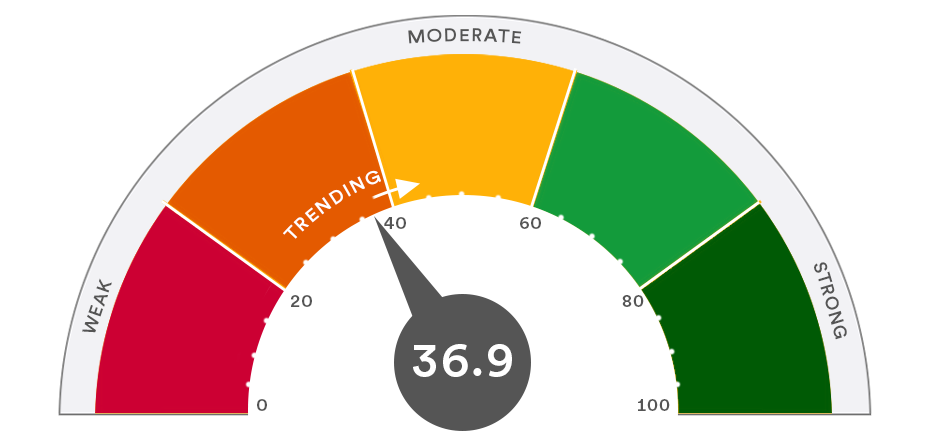
According to Robert Haworth, Senior Investment Strategy Director at U.S. Bank,
“Overall, the U.S. economy is slowing, but not reaching recession.”
The pausing of rate hikes is causing volatility across equities and cryptocurrencies.
Crypto sector regulation is still the main threat
Regulation has been a constant in the recent cryptocurrency news cycle. While the EU unveiled a digital asset framework, MiCA, the United States seems intent to regulate through SEC enforcement.
On June 5 and June 6, the United States Securities and Exchange Commission filed civil lawsuits against two of the largest centralized exchanges in crypto, Binance and Coinbase. The SEC claims that 61 different cryptocurrencies, representing $100 billion in value, are securities.
One of the 61 crypto tokens listed was Algorand (ALGO), a token that in 2019, Gensler called a “great technology” which seems to contradict this latest enforcement action.
Other top crypto tokens specifically mentioned as securities include Binance USD (BUSD), Binance Coin (BNB), Solana (SOL), Cardano (ADA), Polygon (MATIC), Filecoin (FIL), Cosmos (ATOM), The Sandbox (SAND), Decentraland (MANA), Axie Infinity (AXS) and COTI.
The recent SEC action adds to a long history of disputes, misconceptions or mistrust over the actual use case of digital assets. After the FTX implosion, some feel U.S. lawmakers are angry with the crypto industry. The most recent battle is centered on how centralized exchanges can use customer funds.
Not all lawmakers are comfortable with Gensler’s actions. United States Rep. Warren Davidson (OH) introduced the “SEC Stabilization Act” into the House of Representatives on June 12. The bill would remove Gensler as Chair and redistribute power amongst a committee.
TVL and volume remain low
The attack on centralized exchanges has also increased Bitcoin exchange inflow and outflow. Exchange inflows indicate increased sell-side pressure while outflows are typical to self-custody assets.
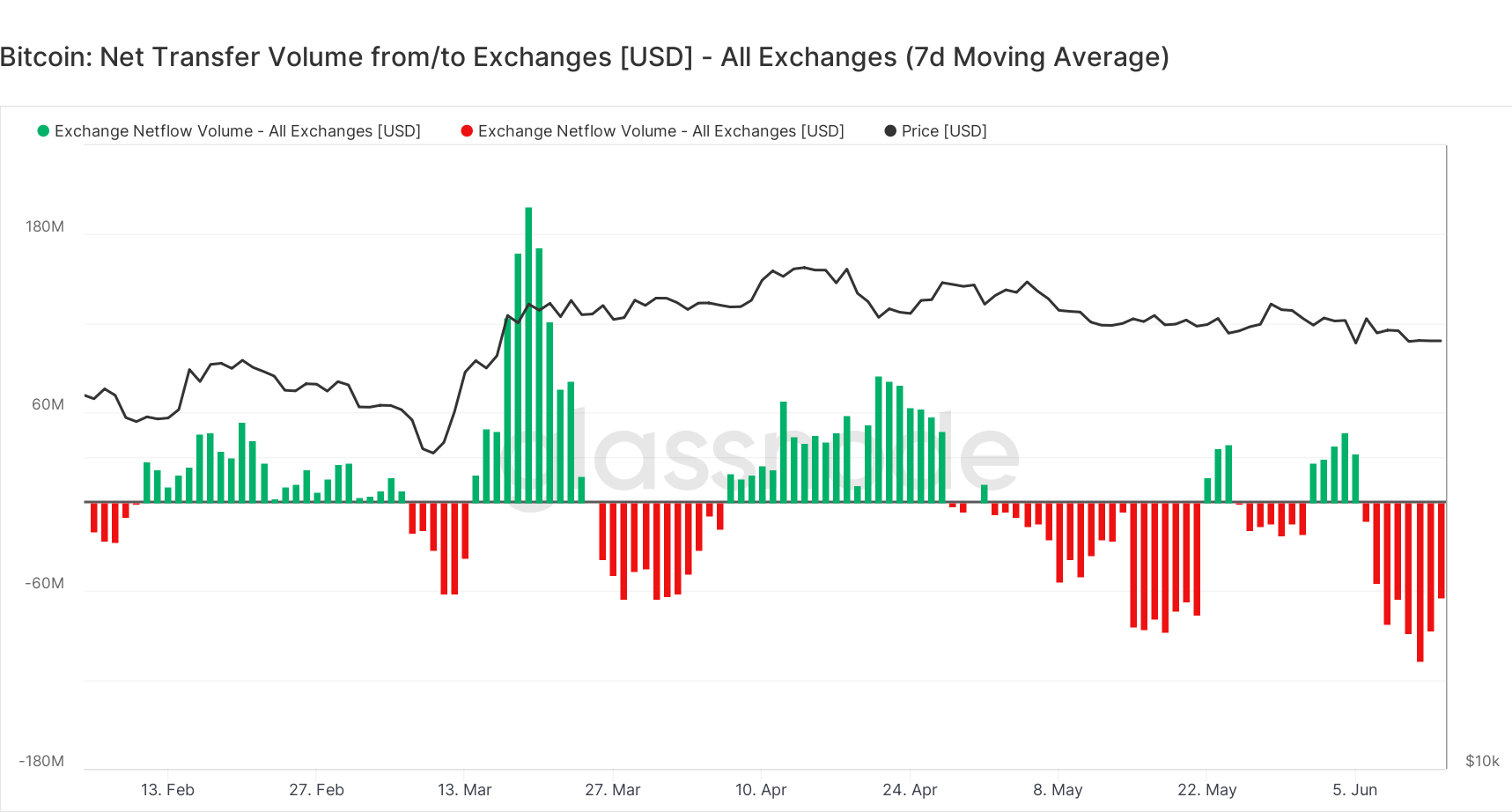
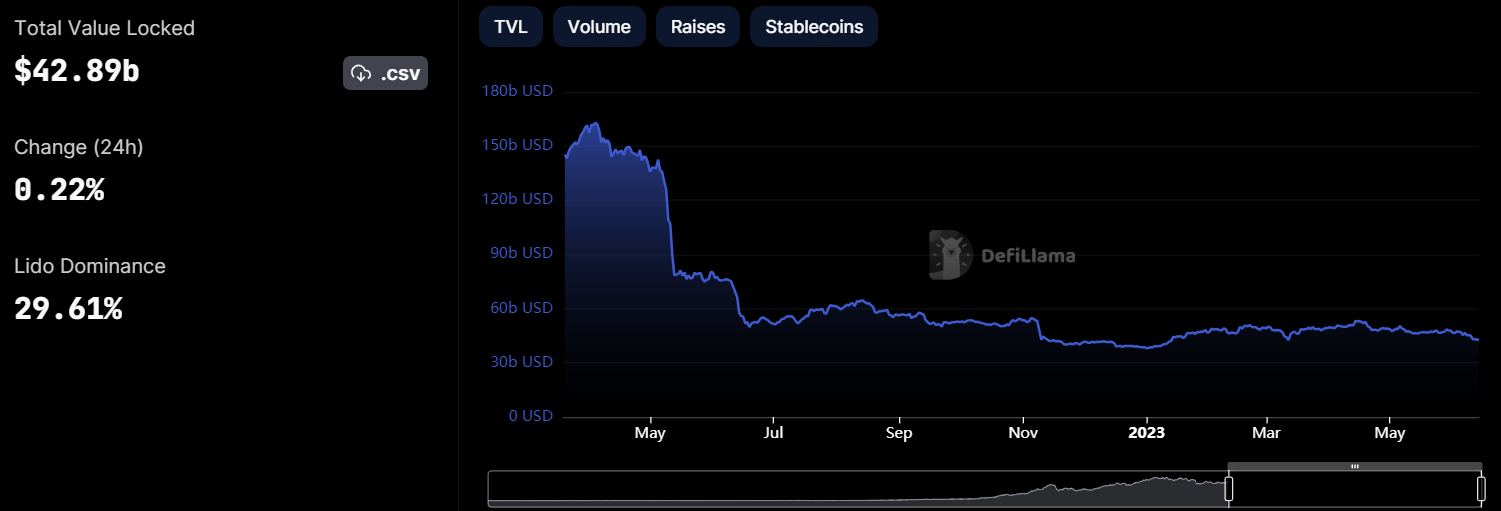
Despite the netflow movement to on-chain self-custody, DeFi has not witnessed growth. The total value locked metric (TVL) is a common way to examine the health and sentiment of the crypto market. According to DeFiLlama, TVL across all protocols dropped 0.5% in the past 24-hours and shed $120 billion since April 5, 2022.
Related: Crypto industry ‘destined’ to be BTC-focused due to regulators: Michael Saylor
With heavy macro headwinds, upcoming rate hikes and low volume, it is likely the volatility in crypto will remain for the foreseeable future.
This article does not contain investment advice or recommendations. Every investment and trading move involves risk, and readers should conduct their own research when making a decision.
This article is for general information purposes and is not intended to be and should not be taken as legal or investment advice. The views, thoughts, and opinions expressed here are the author’s alone and do not necessarily reflect or represent the views and opinions of Cointelegraph.
Source link

Exchanges pledged $2.5B to user protection funds amid FTX’s collapse: Report

Tether (USDT) De-Pegs As Crypto Market Stumbles

US prosecutors say SBF will be tried on original 8 criminal charges — for now

Bitcoin Price Takes A Beating Below $25K Amid Fed Hawkish Tone

Binance launches Bitcoin mining cloud services amid SEC crackdown in the US

Here’s Why Solana’s Recovery Won’t Be Easy

Institutional crypto broker FPG halts withdrawals after $20M cyberattack

Bitcoin Price Plunges Further Post Fed Decision, $24K Next?

Bitcoin dips below $25K for the first time in 3 months

Metrics Soar Higher Across The Board

French financial markets ombudsman reports jump in crypto-related mediations

XRP Bullish Trend Strengthens, Why A Breakout Could Be Coming

Aave proposal to freeze alleged Curve founder’s loans draws controversy

GRT Soars 13% As The Graph Prepares To Integrate Arbitrum

Here’s what happened in crypto today

Judge rules LBRY video platform’s token is a security in case brought by the US SEC

Will the Bitcoin mining industry collapse? Analysts explain why crisis is really opportunity

Silvergate Capital’s crypto-to-fiat transfers decrease by $50B compared to Q3 2021

Exchange Outflows Shows Bitcoin, Ethereum Accumulation Trend Continues

Bitcoin Dropped Below 2017 All-Time-High but Could Sellers be Getting Exhausted? – Blockchain News, Opinion, TV and Jobs
BNM DAO Token Airdrop

What does the Coinbase Premium Gap Tell us about Investor Activity? – Blockchain News, Opinion, TV and Jobs
Fed policy and crumbling market sentiment could send the total crypto market cap back under $1T
New Minting Services

Can Cardano’s July hard fork prevent ADA price from plunging 60%?

Friends or Enemies? – Blockchain News, Opinion, TV and Jobs

LUNA2 Recovers 70% In Nine Days From Historic Lows

SEC’s Chairman Gensler Takes Aggressive Stance on Tokens – Blockchain News, Opinion, TV and Jobs

Enjoy frictionless crypto purchases with Apple Pay and Google Pay | by Jim | @blockchain | Jun, 2022

A String of 200 ‘Sleeping Bitcoins’ From 2010 Worth $4.27 Million Moved on Friday
-
 SEC7 months ago
Judge rules LBRY video platform’s token is a security in case brought by the US SEC
-
 Antminer11 months ago
Will the Bitcoin mining industry collapse? Analysts explain why crisis is really opportunity
-
 Banking8 months ago
Silvergate Capital’s crypto-to-fiat transfers decrease by $50B compared to Q3 2021
-
 Bitcoin8 months ago
Exchange Outflows Shows Bitcoin, Ethereum Accumulation Trend Continues
-
 Altcoins12 months ago
Bitcoin Dropped Below 2017 All-Time-High but Could Sellers be Getting Exhausted? – Blockchain News, Opinion, TV and Jobs
-
Uncategorized1 year ago
BNM DAO Token Airdrop
-
 Binance11 months ago
What does the Coinbase Premium Gap Tell us about Investor Activity? – Blockchain News, Opinion, TV and Jobs
-
 Asia11 months ago
Fed policy and crumbling market sentiment could send the total crypto market cap back under $1T