
Binance
Binance launches Bitcoin mining cloud services amid SEC crackdown in the US


Crypto exchange Binance announced the launch of new subscription-based could mining products dedicated to Bitcoin (BTC) mining.
Starting June 15, users that are interested in Bitcoin mining but lack the equipment can subscribe to Binance’s cloud mining services and purchase hashrates for the same. Hashrate is the computing power required for confirming and legitimizing Bitcoin transactions over the blockchain.
Binance is currently selling 1 Terahash per second (Th/s) at $10.7280, which is split between the hashrate and electricity costs at $1.17 and $9.558 respectively. A higher number of hashrate increases the probability of a higher income in terms of the Bitcoin earned through mining.
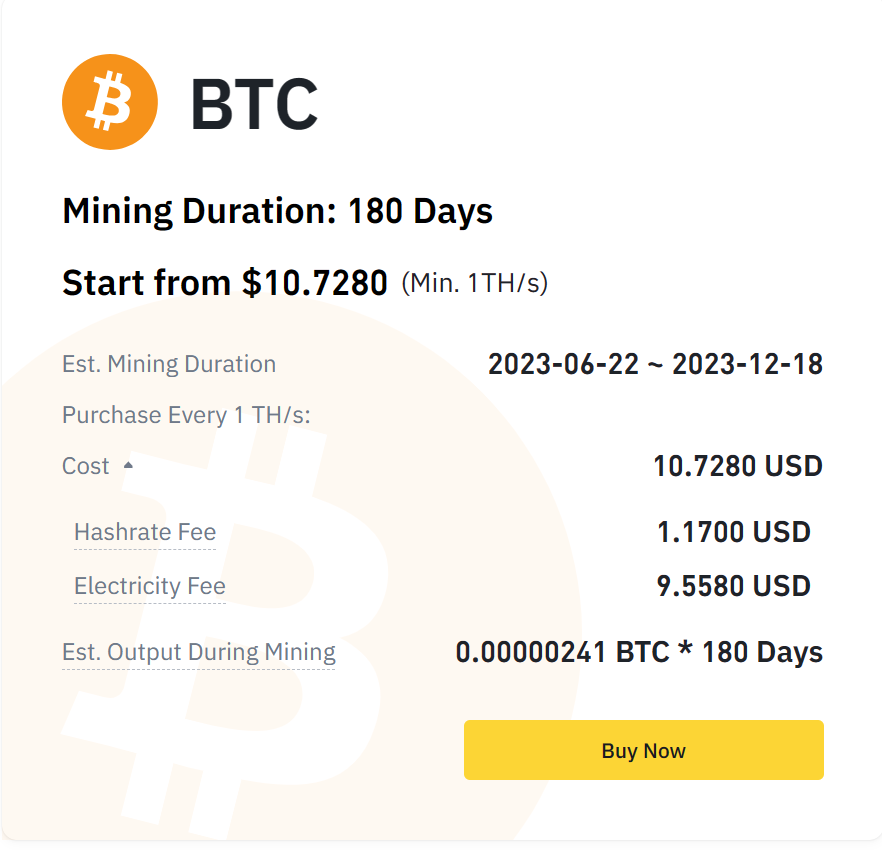
Binance’s BTC mining subscription service will be active for 180 days, or roughly six months. For each TH/s purchased, users will be able to earn 0.0004338 BTC during the timeline.
As the product is launched on Binance’s global website, the service is not available for crypto investors residing in the United States. In a previous statement to Cointelegraph about the recent Securities and Exchange Commission (SEC) crackdown in the US, Binance clarified that “Binance.com is a separate entity and our users will not be impacted by issues at Binance.US.”
Related: Binance applies to deregister in Cyprus, says focus is on ‘larger markets’
To fight against the allegations of SEC, Binance.US hired former SEC enforcement co-director George Canellos as part of its legal team.
Reacting the alleged development, “Binance is clearly preparing for a criminal prosecution and continuing to hire the best defense attorneys in the world,” said former SEC internet enforcement chief John Reed Stark on Twitter.
The legal scrutiny began when SEC alleged that Binance’s US arm was operating as an unregistered exchange, broker and clearing agency. Following the SEC’s actions, on June 9, Binance.US announced the suspension of the U.S dollar deposits and potentially pausing fiat withdrawals starting as early as June 13.
Source link








Binance has decided to reverse its plan to delist a number of privacy coins in Europe after it said it has revised operations in order to comply with local regulations.
In a comment from the cryptocurrency exchange recevied on June 26, Binance said that:
“After carefully considering feedback from our community and several projects, we have revised how we classify privacy coins on our platform to comply with EU-wide regulatory requirements.”
It also commented that since it operates as an exchange registered in various EU jurisdictions, it is “obliged” to follow local regulations that require exchanges to, “be able to monitor transactions for coins listed on our platform.”
Initially, Binance was to delist privacy tokens for users in France, Italy, Spain and Poland, rendering them no longer able to buy or sell 12 privacy tokens beginning on June 26.
The coins affected by the decision were to include: Decred (DCR), Dash (DASH), ZEC, Horizen (ZEN), PIVX (PIVX), Navcoin (NAV), Secret (SCRT), Verge (XVG), Firo (FIRO), Beam (BEAM), XMR and MobileCoin (MOB).
However, since the decision has been retracted various tokens have taken to Twitter to reassure community members. The Verge Currency posted its update as early as June 22:
We are pleased to inform you that $XVG will remain unaffected by @binance‘s trading restrictions on #privacy coins in certain EU countries.
Verge utilizes a public #blockchain with visible transactions, amounts, and wallet addresses. #vergefam #crypto #ISO20022
— VergeCurrency (XVG) (@vergecurrency) June 22, 2023
The Secret Network also posted an update saying that it is among the currencies in which Binance will not delist.
Related: Binance eyes United Arab Emirates as ‘focal point’ for future operations
These decisions from Binance come as the EU has been ironing out its standards for digital assets with its new Markets in Crypto-Assets (MiCA) regulations, which were signed into law on May 31.
With clear-cut regulations, EU officials aimed to make Europe a hub for crypto and digital assets. In July it plans to launch a MiCA consultation process, as the framework for the laws suggested an 18-month timeline to take full effect.
Companies in the industry, such as cryptocurrency payments service provider Ripple, have welcomed the MiCA regulations due to regulatory clarity.
Magazine: Tornado Cash 2.0: The race to build safe and legal coin mixers
Source link


The Belgian Financial Services and Markets Authority (FSMA) has ordered major cryptocurrency exchange Binance to stop offering crypto exchange and custody wallet services.
In a June 23 notice, the FSMA said that by Binance offering crypto-related services “from countries that are not members of the European Economic Area,” the exchange was violating Belgian laws on Anti-Money Laundering and Combating the Financing of Terrorism. The financial regulator said Binance must cease “with immediate effect” all related services in Belgium.
According to the FSMA, Binance controlled an estimated 19 companies outside of the European Economic Area — European Union nations as well as Iceland, Liechtenstein and Norway — involved in its operations or technical support that did not appear in the terms and conditions Belgium users read when signing up for services. The regulator said it had made “several requests for information” from Binance but did not receive satisfactory answers identifying the services its companies provided.
“In spite of the opportunities offered to Binance on several occasions, the latter has failed to demonstrate, with due documentation and proof, that the exchange services between virtual currencies and legal currencies and the custody wallet services that it offers and provides within Belgium are carried out by means of a legal entity governed by the law of another member state of the European Economic Area that is duly authorized by its home member state to carry out these activities, including within Belgium,” said the FSMA.
As part of the order, Binance will be required to contact all its Belgium-based clients and return all crypto and private keys the exchange held. A Binance spokesperson told Cointelegraph the company was “disappointed” with the FSMA’s decision and it planned to review the regulator’s notice.
Related: Belgian FSMA surveys crypto investors before taking on new ad regulation authority
The FSMA is just one of several national regulators taking action against Binance, as the United States Securities and Exchange Commission is currently pursuing a lawsuit against the exchange and its U.S. entity for alleged violations of securities laws. Christophe De Beukelaer, a member of the Belgian parliament, announced in January 2022 that he planned to receive his government salary in Bitcoin (BTC) for a year.
Magazine: Binance humiliated, HK needs 100K crypto workers, China’s AI unicorn: Asia Express
Update (June 23 at 6:45 PM UTC): This article has been updated to include an attempt to reach out to Binance for comment.
Source link

The fate of Binance USD (BUSD), the stablecoin introduced by Binance, hangs in the balance as its market capitalization has experienced a significant decline of over 80% in 2023.
From November 2022 to June of the current year, BUSD’s market capitalization has plummeted from USD23 billion to USD4 billion. Notably, the capitalization suffered an 18% loss in May alone, as reported by CCData, an analysis company.
TrueUSD (TUSD) Gains Traction As BUSD Market Cap Declines
As the market capitalization of BUSD continues to decline and reach a critical level, representing less than 5% of the overall stablecoin market capitalization, Binance has begun actively promoting the adoption of TrueUSD (TUSD).
While TUSD’s market capitalization still falls slightly below that of BUSD, currently standing at over USD3.1 billion, it has surpassed BUSD in terms of trading volumes. According to data provided by CCData, the trading volumes of TUSD have tripled, indicating a growing interest and usage of the stablecoin.
Related Reading: Mask Foundation Moves 2.5 Million Tokens To Exchanges, Huge Dip Incoming?
TrueUSD (TUSD), introduced in 2017 by TrustToken, has emerged as the fifth-largest stablecoin in the market, trailing closely behind BUSD. Functioning as an Ethereum-based ERC-20 token, TUSD secures its value with dollar reserves deposited in multiple US-based banking entities. The company behind TUSD ensures a 1:1 convertibility with the US currency, instilling confidence in its stability and reliability among users.
As BUSD’s market capitalization experiences a significant decline, the growing popularity and trading volumes of TUSD serve as a testament to the increasing demand for an alternative stablecoin option. Also, Binance’s shift towards promoting TUSD suggests a strategic response to the changing landscape of stablecoin usage and market dynamics.
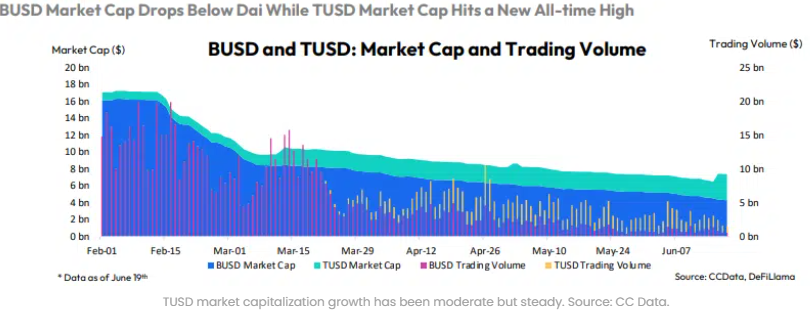
The steep decline in BUSD’s market capitalization can be attributed to its impending discontinuation. In February 2023, NewsBTC reported that Paxos would cease issuing the BUSD stablecoin due to an ongoing lawsuit filed by the United States Securities and Exchange Commission (SEC).
As per Paxos’ official statement, BUSD will be redeemable until February 24, 2024, marking the potential date for its exit from the market.
Investors Move To USDT As It Nears Its All-Time High Capitalization
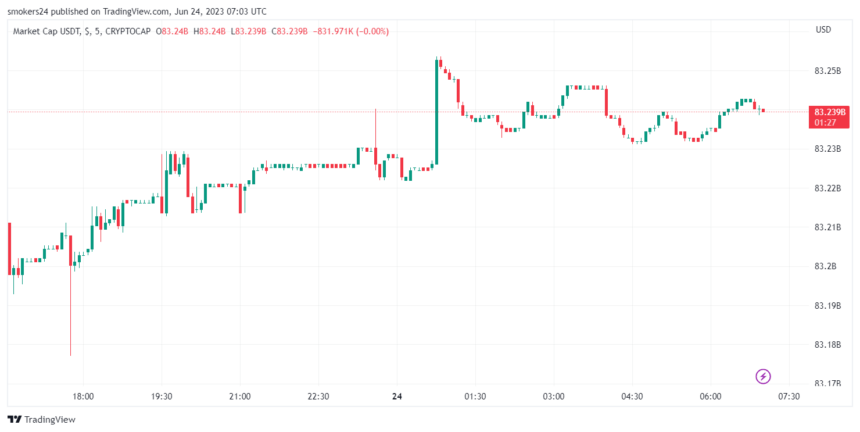
As the market capitalization of Tether (USDT) continues to rise steadily, approaching its all-time high, investors are taking notice and making strategic moves. According to data from CoinMarketCap, USDT’s current market capitalization stands at $82.9 billion (USD), close to its previous peak of $83.2 billion, reached in May 2022. This upward trajectory has prompted investors to diversify their portfolios and explore alternative stablecoin options.
Related Reading: Bitcoin Just Gained Over 18% In Seven Days: What’s Happened When This Has Occurred In The Past?
Also, Investors are drawn to USDT due to its stability and pegging to the US dollar, offering a reliable store of value amidst market fluctuations. With its widespread acceptance and liquidity, USDT has become a preferred choice for traders, providing a convenient and secure means of preserving their capital during volatile market conditions.
At press time, USDT was trading at $0.9780 per coin with a 24-hour price increase of 1.38%.
Featured image from iStock, charts from Tradingview and CCData
Source link

Injective (INJ) Continues To Build Momentum, Jumps Nearly 27% In A Single Week

$27 trillion AUM is perched over Bitcoin and crypto: CoinShares CSO

Ethereum Price Lacks Momentum Above $1,900 But Dips Likely To Be Limited

Robinhood to axe 7% of full-time staff in latest round of layoffs: Report

Crypto Investment Inflows Reach One-Year High, Reveals CoinShares

Yes, the Secret Service has an NFT collection, and no, it’s not for sale

How A Morning Star Pattern Could Awaken Altcoins

Swiss central bank announces plans for wholesale CBDC pilot with ‘real money’: Report

Chainlink Bulls Must Defend Support Zone To Prepare For Another Rally

What is generative AI?

Kaspa (KAS) Takes Altcoin Market By Storm With 60% Growth

Optimism network transactions surged 67% following Bedrock upgrade — Nansen

XRP Buybacks Were On The Table

How to use DeFi the right way — This latest guide can help

Bybit Expands Global Presence With Cyprus Crypto License

Judge rules LBRY video platform’s token is a security in case brought by the US SEC

Silvergate Capital’s crypto-to-fiat transfers decrease by $50B compared to Q3 2021

Will the Bitcoin mining industry collapse? Analysts explain why crisis is really opportunity

Exchange Outflows Shows Bitcoin, Ethereum Accumulation Trend Continues

Bitcoin Dropped Below 2017 All-Time-High but Could Sellers be Getting Exhausted? – Blockchain News, Opinion, TV and Jobs
BNM DAO Token Airdrop

What does the Coinbase Premium Gap Tell us about Investor Activity? – Blockchain News, Opinion, TV and Jobs
Fed policy and crumbling market sentiment could send the total crypto market cap back under $1T
New Minting Services

Can Cardano’s July hard fork prevent ADA price from plunging 60%?

SEC’s Chairman Gensler Takes Aggressive Stance on Tokens – Blockchain News, Opinion, TV and Jobs

Friends or Enemies? – Blockchain News, Opinion, TV and Jobs

LUNA2 Recovers 70% In Nine Days From Historic Lows

Enjoy frictionless crypto purchases with Apple Pay and Google Pay | by Jim | @blockchain | Jun, 2022

Block News Media Live Stream
-
 SEC8 months ago
Judge rules LBRY video platform’s token is a security in case brought by the US SEC
-
 Banking8 months ago
Silvergate Capital’s crypto-to-fiat transfers decrease by $50B compared to Q3 2021
-
 Antminer11 months ago
Will the Bitcoin mining industry collapse? Analysts explain why crisis is really opportunity
-
 Bitcoin8 months ago
Exchange Outflows Shows Bitcoin, Ethereum Accumulation Trend Continues
-
 Altcoins12 months ago
Bitcoin Dropped Below 2017 All-Time-High but Could Sellers be Getting Exhausted? – Blockchain News, Opinion, TV and Jobs
-
Uncategorized1 year ago
BNM DAO Token Airdrop
-
 Binance11 months ago
What does the Coinbase Premium Gap Tell us about Investor Activity? – Blockchain News, Opinion, TV and Jobs
-
 Asia11 months ago
Fed policy and crumbling market sentiment could send the total crypto market cap back under $1T