Binance
SEC and Binance.US strike a temporary agreement on asset access

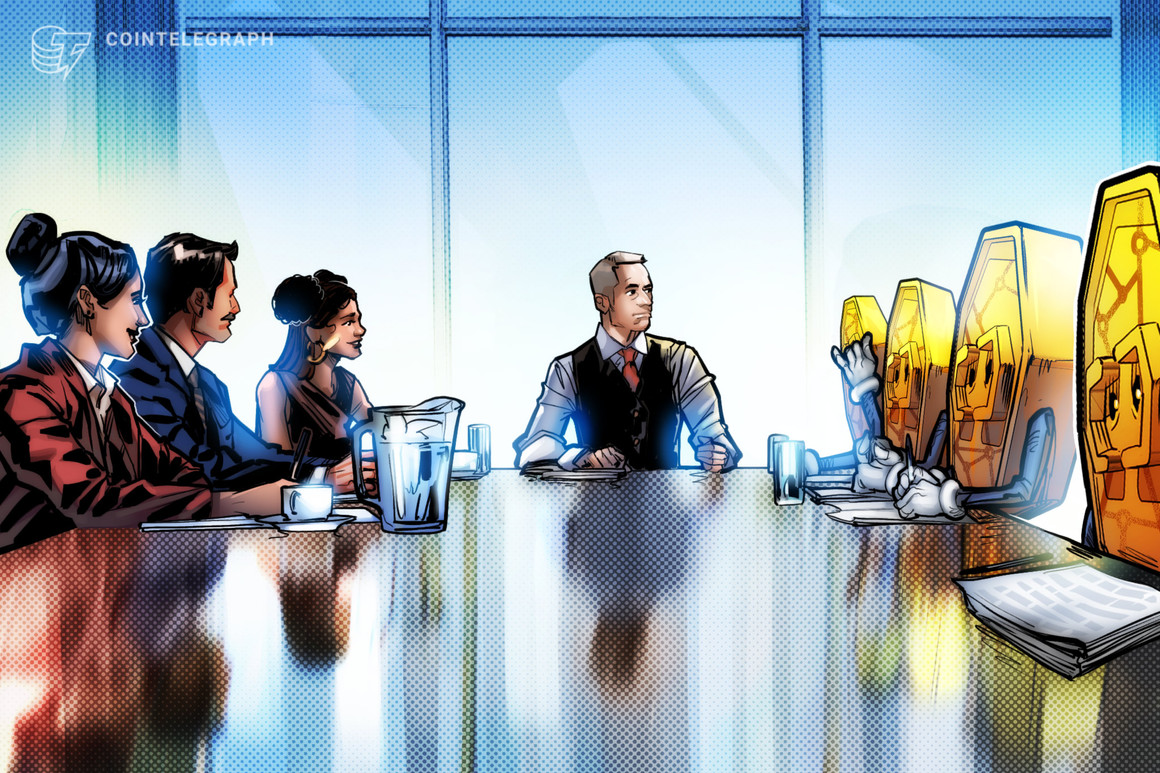

Binance, Binance.US, and the Securities and Exchange Commission (SEC) reportedly revealed an agreement, late Friday, June 16, temporarily limiting access to customer funds exclusively to Binance.US employees.
According to reports, the proposed agreement, pending approval from the overseeing federal judge, outlines measures for Binance.US to prevent any access by Binance Holdings officials to private keys of wallets, hardware wallets, or root access to Binance.US’s Amazon Web Services tools. Additionally, the U.S.-based crypto trading platform will disclose comprehensive information on business expenses, including estimated costs, in the upcoming weeks.
The proposed agreement has emerged as a direct response to a motion filed by the SEC aiming to freeze the entirety of Binance.US’s assets during the ongoing legal proceedings related to securities-related charges. The regulatory body expressed apprehension that without a granted TRO, there might be a risk of funds being transferred offshore or crucial records being deliberately destroyed.
However, Binance.US’s legal representatives strongly opposed this notion, contending that imposing a complete freeze on all assets would essentially be equivalent to administering an excessively severe “death penalty” upon the company.
During a hearing earlier this week, Judge Amy Berman Jackson, presiding over the District Court for the District of Columbia, advised the involved parties that it would be more advantageous for them to reach an agreement on a proposed stipulation rather than relying on her to formulate a restraining order. The judge emphasized that a temporary restraining order carries a limited duration of two weeks, which might prove inadequate for a comprehensive and thorough hearing. This is particularly true considering the substantial volume of exhibits already submitted, amounting to over 4,000 pages.
Related: Binance under investigation in France since February 2022: Report
The proposed agreement includes additional provisions such as the creation of new crypto wallets by Binance.US, which will be inaccessible to employees of the global exchange. Furthermore, Binance.US commits to providing additional information to the SEC and agreeing to an accelerated discovery schedule. Notably, customers based in the United States will retain the ability to withdraw funds throughout this period.
If accepted, the proposed agreement will partially address the SEC’s concerns while the broader lawsuit progresses. The SEC recently sued Binance and Binance.US for trading unregistered securities and alleged commingling of funds and poor practices. However, the proposed agreement does not encompass the broader lawsuit.
Magazine: Binance humiliated, HK needs 100K crypto workers, China’s AI unicorn
Source link







Crypto exchange Binance announced the launch of new subscription-based could mining products dedicated to Bitcoin (BTC) mining.
Starting June 15, users that are interested in Bitcoin mining but lack the equipment can subscribe to Binance’s cloud mining services and purchase hashrates for the same. Hashrate is the computing power required for confirming and legitimizing Bitcoin transactions over the blockchain.
Binance is currently selling 1 Terahash per second (Th/s) at $10.7280, which is split between the hashrate and electricity costs at $1.17 and $9.558 respectively. A higher number of hashrate increases the probability of a higher income in terms of the Bitcoin earned through mining.
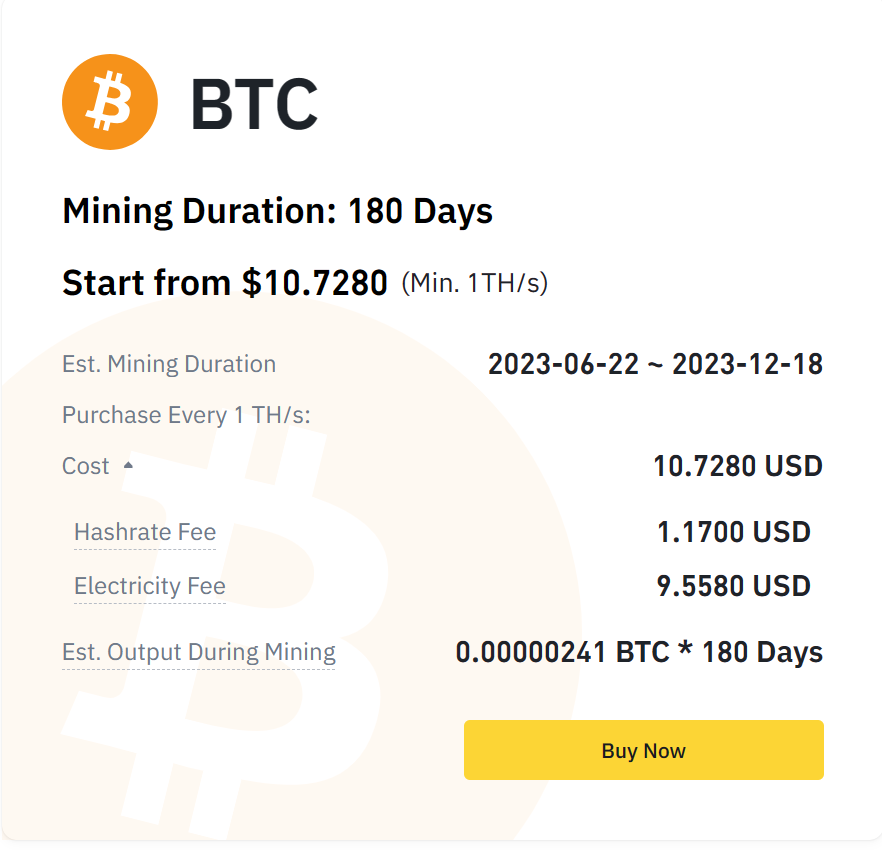
Binance’s BTC mining subscription service will be active for 180 days, or roughly six months. For each TH/s purchased, users will be able to earn 0.0004338 BTC during the timeline.
As the product is launched on Binance’s global website, the service is not available for crypto investors residing in the United States. In a previous statement to Cointelegraph about the recent Securities and Exchange Commission (SEC) crackdown in the US, Binance clarified that “Binance.com is a separate entity and our users will not be impacted by issues at Binance.US.”
Related: Binance applies to deregister in Cyprus, says focus is on ‘larger markets’
To fight against the allegations of SEC, Binance.US hired former SEC enforcement co-director George Canellos as part of its legal team.
Reacting the alleged development, “Binance is clearly preparing for a criminal prosecution and continuing to hire the best defense attorneys in the world,” said former SEC internet enforcement chief John Reed Stark on Twitter.
The legal scrutiny began when SEC alleged that Binance’s US arm was operating as an unregistered exchange, broker and clearing agency. Following the SEC’s actions, on June 9, Binance.US announced the suspension of the U.S dollar deposits and potentially pausing fiat withdrawals starting as early as June 13.
Source link

The crypto market remains volatile after the June 14 Federal Open Market Committee (FOMC) announcement and presser with Fed Chairman Jerome Powell revealed that the central bank would pause rate hikes for June.
While this move aligned with investors’ expectations, the crypto market has yet to show any bullish momentum. Powell also mentioned that at least two more rate hikes would be needed in the future.
Bitcoin price started the day up, trading above $26,000, but it has since retraced to a 24-hour low of $25,791 after the FOMC announcement. Some analysts are predicting that a drop to $25,000 is inevitable based on the current state of BTC derivatives data.
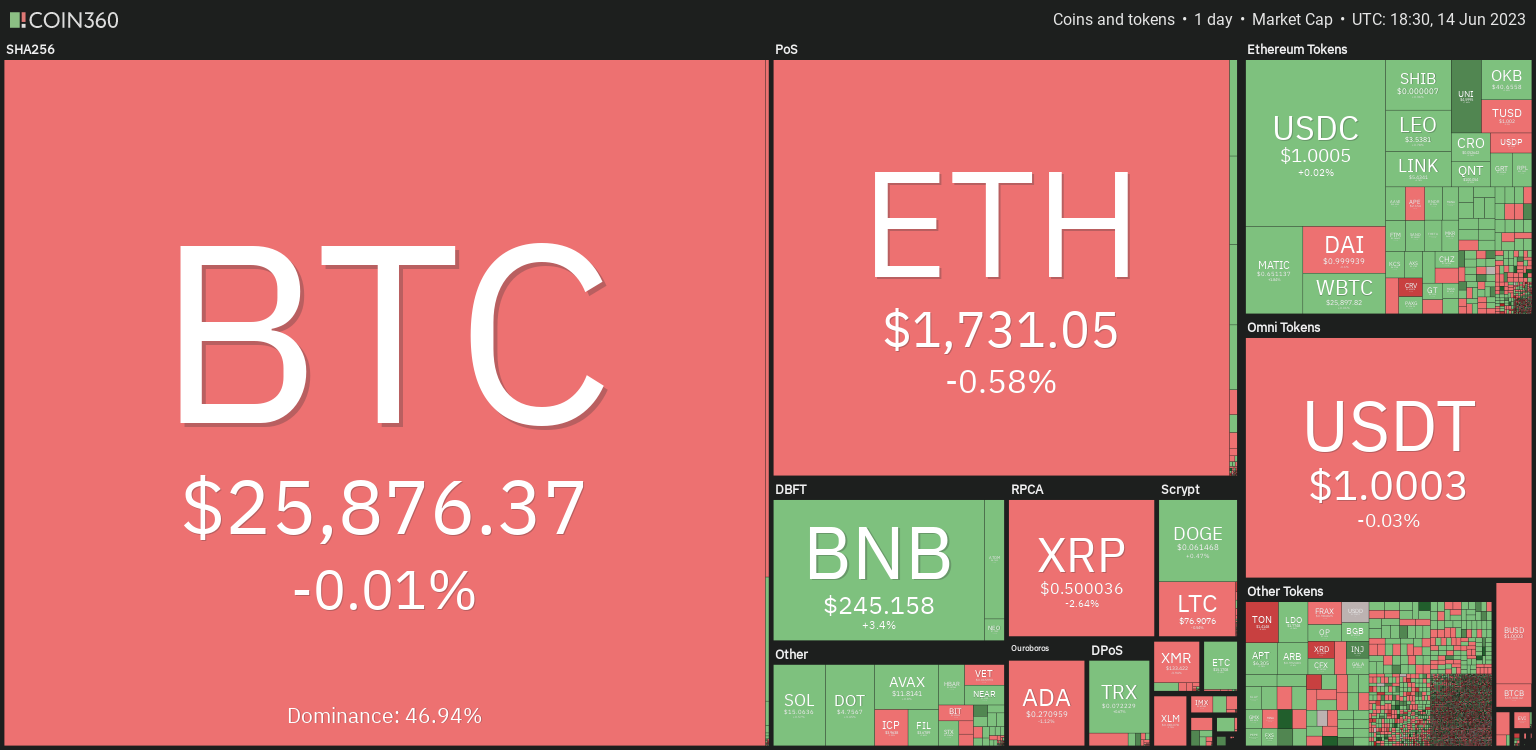
The muted crypto price action and lack of a bullish response to today’s rate hike pause could be the lingering effect of the SEC’s charges against Binance and Coinbase exchange.
Related: ‘Holy shit, I’ve seen that!’ — Coldie’s Snoop Dogg, Vitalik and McAfee NFTs
FOMC tanks crypto and some equities
The stock market dropped sharply on June 14 after the FOMC decision with the Dow dropping 200 points minutes after the announcement. Another major equity index, the S&P 500 hit a 13-month high.
While Powell decided to pause interest rate hikes, the Federal Reserve reiterated the focus to bring down elevated inflation.
In the policy issuance, the Federal Reserve stated,
“In determining the extent of additional policy firming that may be appropriate to return inflation to 2 percent over time, the Committee will take into account the cumulative tightening of monetary policy, the lags with which monetary policy affects economic activity and inflation, and economic and financial developments.”
The wording shows a potential return to interest rate hikes in the future. To date, crypto prices are still highly correlated with the Dow and S&P 500 and most major banks still expect the U.S. to experience a sharp recession at some point in 2023. This has not stopped major stock indices from reaching yearly highs after the United States debt ceiling deal.
According to U.S. Bank analysis which incorporates more than 1,000 data points, investor sentiment about the current state of the economy remains low.
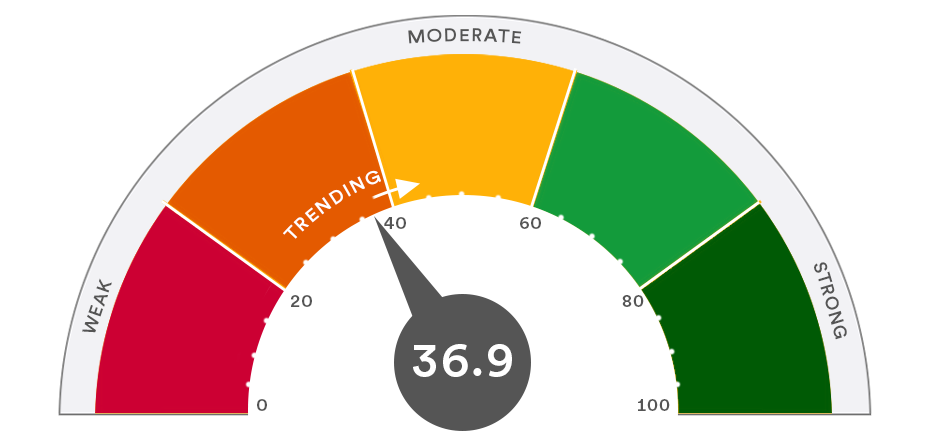
According to Robert Haworth, Senior Investment Strategy Director at U.S. Bank,
“Overall, the U.S. economy is slowing, but not reaching recession.”
The pausing of rate hikes is causing volatility across equities and cryptocurrencies.
Crypto sector regulation is still the main threat
Regulation has been a constant in the recent cryptocurrency news cycle. While the EU unveiled a digital asset framework, MiCA, the United States seems intent to regulate through SEC enforcement.
On June 5 and June 6, the United States Securities and Exchange Commission filed civil lawsuits against two of the largest centralized exchanges in crypto, Binance and Coinbase. The SEC claims that 61 different cryptocurrencies, representing $100 billion in value, are securities.
One of the 61 crypto tokens listed was Algorand (ALGO), a token that in 2019, Gensler called a “great technology” which seems to contradict this latest enforcement action.
Other top crypto tokens specifically mentioned as securities include Binance USD (BUSD), Binance Coin (BNB), Solana (SOL), Cardano (ADA), Polygon (MATIC), Filecoin (FIL), Cosmos (ATOM), The Sandbox (SAND), Decentraland (MANA), Axie Infinity (AXS) and COTI.
The recent SEC action adds to a long history of disputes, misconceptions or mistrust over the actual use case of digital assets. After the FTX implosion, some feel U.S. lawmakers are angry with the crypto industry. The most recent battle is centered on how centralized exchanges can use customer funds.
Not all lawmakers are comfortable with Gensler’s actions. United States Rep. Warren Davidson (OH) introduced the “SEC Stabilization Act” into the House of Representatives on June 12. The bill would remove Gensler as Chair and redistribute power amongst a committee.
TVL and volume remain low
The attack on centralized exchanges has also increased Bitcoin exchange inflow and outflow. Exchange inflows indicate increased sell-side pressure while outflows are typical to self-custody assets.
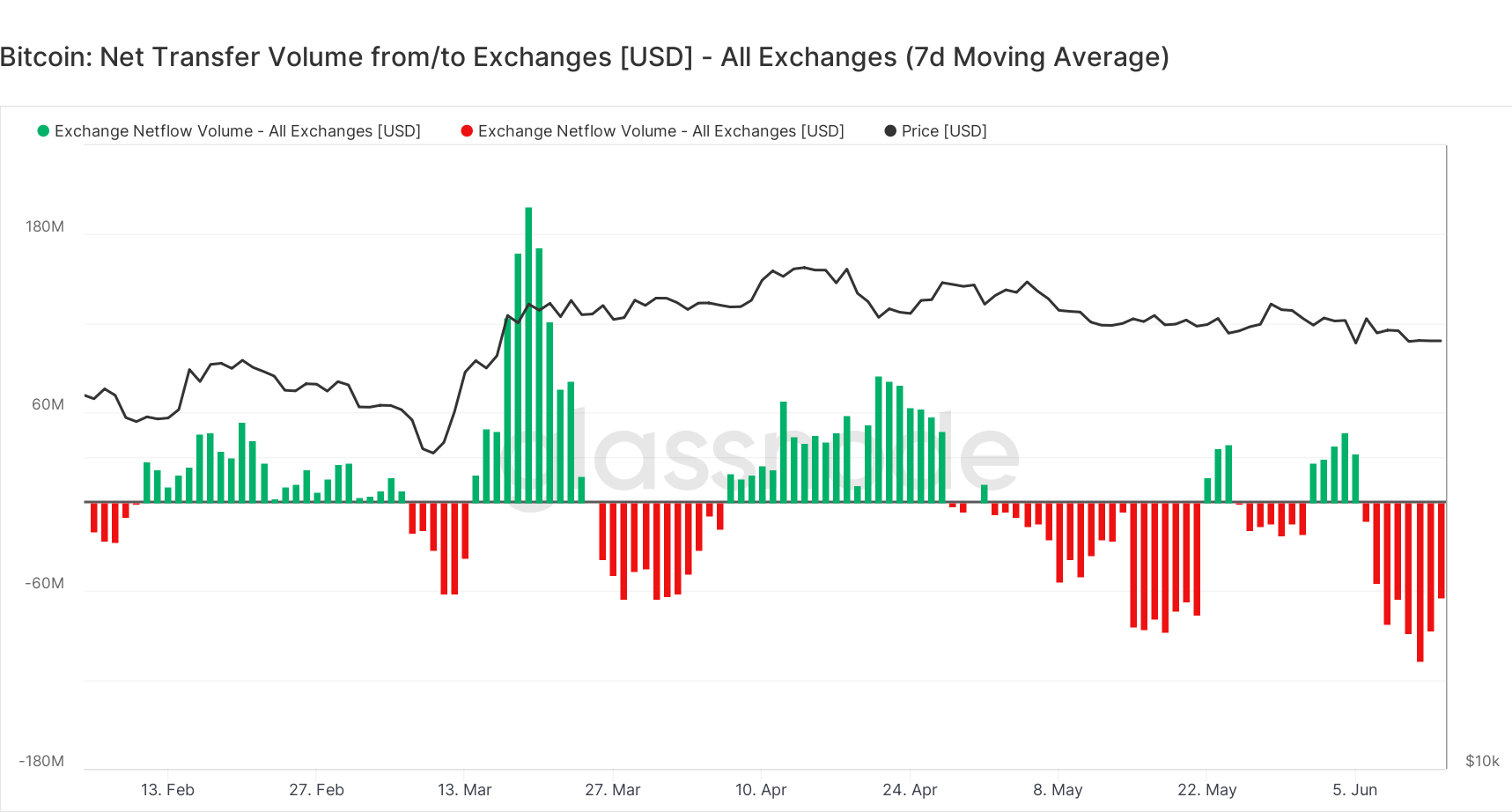
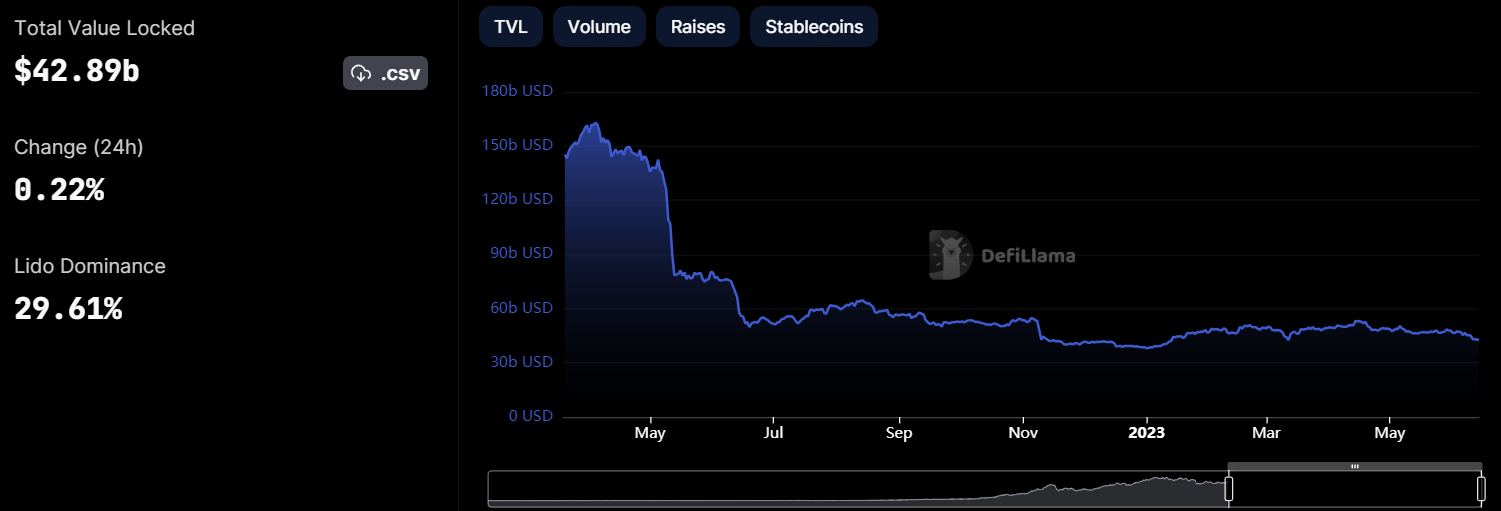
Despite the netflow movement to on-chain self-custody, DeFi has not witnessed growth. The total value locked metric (TVL) is a common way to examine the health and sentiment of the crypto market. According to DeFiLlama, TVL across all protocols dropped 0.5% in the past 24-hours and shed $120 billion since April 5, 2022.
Related: Crypto industry ‘destined’ to be BTC-focused due to regulators: Michael Saylor
With heavy macro headwinds, upcoming rate hikes and low volume, it is likely the volatility in crypto will remain for the foreseeable future.
This article does not contain investment advice or recommendations. Every investment and trading move involves risk, and readers should conduct their own research when making a decision.
This article is for general information purposes and is not intended to be and should not be taken as legal or investment advice. The views, thoughts, and opinions expressed here are the author’s alone and do not necessarily reflect or represent the views and opinions of Cointelegraph.
Source link

Tether responds to account deactivation controversy, raises compliance checks

Shiba Inu Positive Social Sentiment Sparks Bullish Speculation

5 AI tools for learning and research

PEPE Jumps 10% In 24 Hours, Sparking Speculation Of A Rally

SEC and Binance.US strike a temporary agreement on asset access

Curve pool imbalance triggers USDT depeg concerns: Finance Redefined

Cardano founder Charles Hoskinson goes hunting for aliens & UFOs

‘We had to change strategies,’ says SEC enforcement director on recent actions: Report

Crypto payments platform Wyre shutters citing bear market conditions

Assessing Ripple-Colombia Central Bank Partnership

Nike teases upcoming ‘Airphoria’ NFT sneaker hunt on Fortnite

Bitcoin Market Dominance Peaks In Nearly Two Years, Here’s Why

Ethereum network upgrade and uptick in Arbitrum active users could trigger an ARB price reversal

XRP Allegedly Attacked By SEC’s Hinman For Ethereum’s Benefit

On-chain sleuth ZachXBT sued for libel after claiming plaintiff drained funds from project

Judge rules LBRY video platform’s token is a security in case brought by the US SEC

Will the Bitcoin mining industry collapse? Analysts explain why crisis is really opportunity

Silvergate Capital’s crypto-to-fiat transfers decrease by $50B compared to Q3 2021

Exchange Outflows Shows Bitcoin, Ethereum Accumulation Trend Continues

Bitcoin Dropped Below 2017 All-Time-High but Could Sellers be Getting Exhausted? – Blockchain News, Opinion, TV and Jobs
BNM DAO Token Airdrop

What does the Coinbase Premium Gap Tell us about Investor Activity? – Blockchain News, Opinion, TV and Jobs
Fed policy and crumbling market sentiment could send the total crypto market cap back under $1T
New Minting Services

Can Cardano’s July hard fork prevent ADA price from plunging 60%?

Friends or Enemies? – Blockchain News, Opinion, TV and Jobs

SEC’s Chairman Gensler Takes Aggressive Stance on Tokens – Blockchain News, Opinion, TV and Jobs

LUNA2 Recovers 70% In Nine Days From Historic Lows

Enjoy frictionless crypto purchases with Apple Pay and Google Pay | by Jim | @blockchain | Jun, 2022

A String of 200 ‘Sleeping Bitcoins’ From 2010 Worth $4.27 Million Moved on Friday
-
 SEC7 months ago
Judge rules LBRY video platform’s token is a security in case brought by the US SEC
-
 Antminer11 months ago
Will the Bitcoin mining industry collapse? Analysts explain why crisis is really opportunity
-
 Banking8 months ago
Silvergate Capital’s crypto-to-fiat transfers decrease by $50B compared to Q3 2021
-
 Bitcoin8 months ago
Exchange Outflows Shows Bitcoin, Ethereum Accumulation Trend Continues
-
 Altcoins12 months ago
Bitcoin Dropped Below 2017 All-Time-High but Could Sellers be Getting Exhausted? – Blockchain News, Opinion, TV and Jobs
-
Uncategorized1 year ago
BNM DAO Token Airdrop
-
 Binance11 months ago
What does the Coinbase Premium Gap Tell us about Investor Activity? – Blockchain News, Opinion, TV and Jobs
-
 Asia11 months ago
Fed policy and crumbling market sentiment could send the total crypto market cap back under $1T