
Hackers
Curve pool imbalance triggers USDT depeg concerns: Finance Redefined

Welcome to Finance Redefined, your weekly dose of essential decentralized finance (DeFi) insights — a newsletter crafted to bring you the most significant developments from the past week.
On June 15, an imbalance in Curve Finance’s 3pool led to a Tether (USDT) depeg scare as the stablecoin’s weightage in the pool rose above 70%, leading to heavy selling. Tether’s chief technology officer claimed these market conditions are stress tests for the stablecoin and played down the depeg “FUD.”
In other news, a crypto trading bot programmed to execute arbitrage trades borrowed $200 million to make just over $3 in profit.
Uniswap, the decentralized exchange protocol, released its version 4 code on June 13, making way for new liquidity pools.
DeFi lending platform Sturdy Finance was drained for $800,000. The protocol’s team offered a $100,000 bounty for returning the funds and reopened its stablecoin market on June 16. In another exploit, the Hashflow protocol was drained for $600,000; however, Hashflow assured users they would be “made whole.”
The top 100 DeFi tokens had another bearish week, with most of the crypto tokens trading at three-month lows.
Curve pool imbalance triggers USDT depeg concerns, Tether CTO calls it FUD
USDT slightly deviated from its United States dollar peg on June 15 due to an imbalance in Curve’s 3pool. The price of USDT fell by 0.3% to around 0.997 as its weightage in the curve 3pool increased to over 70% from the usual 33.1%.
Curve’s 3pool is a stablecoin pool for decentralized finance holding a massive amount of liquidity in the three top stablecoins: USDT, USD Coin (USDC) and Dai (DAI). A significant rise in the weightage of a particular stablecoin in the pool indicates heavy selling of that asset.
Continue reading
Crypto trading bot borrows $200 million for a $3 gain
A crypto trading bot programmed to perform arbitrage trades made various complex moves within the Ethereum blockchain — including taking a $200 million flash loan — to secure a mere $3.24 profit.
On June 14, blockchain analysis firm Arkham Intelligence shared a breakdown of the bot’s movements. According to the firm, the transaction was made by an arbitrage bot that uses flash loans.
Continue reading
Uniswap releases version 4 code, allowing for new types of liquidity pools
Uniswap Labs has released a draft of the code for Uniswap v4, announcing the move in a June 13 blog post from Uniswap’s founder, Hayden Adams. The new code features “hooks,” or plugins that allow developers to create custom liquidity pools.
Uniswap is the largest decentralized crypto exchange by volume. Its latest version, v3, was deployed on May 4, 2021.
Continue reading
Attacker drains $800,000 from DeFi protocol Sturdy Finance
DeFi protocol Sturdy Finance has lost 442 Ether (ETH), worth almost $800,000 when writing, to a security exploit. The attacker exploited a vulnerability that eventually manipulated a faulty price oracle, allowing them to drain funds from the protocol.
On June 12, blockchain security firm PeckShield alerted Sturdy Finance and reported a transaction that seemed to be related to price manipulation. Almost an hour later, the DeFi protocol said it was aware of the exploit and responded by pausing all markets and assuring its users that no additional funds were at risk.
Sturdy Finance reopened its stablecoin market on June 16, nearly three days after the exploit. The DeFi protocol also offered a $100,000 bounty to anyone who could help bring an arrest or recover the funds
Continue reading
Hashflow assures users will be made whole following $600,000 exploit
Crypto trading platform Hashflow has assured affected users will be “made whole” following an exploit that saw at least $600,000 in digital assets removed from the platform. On June 14, blockchain security firm PeckShield reported an ongoing issue with the Hashflow trading platform.
A couple of hours later, Hashflow alerted users that it was addressing the current situation related to contract approvals as flagged by PeckShield.
Continue reading
DeFi market overview
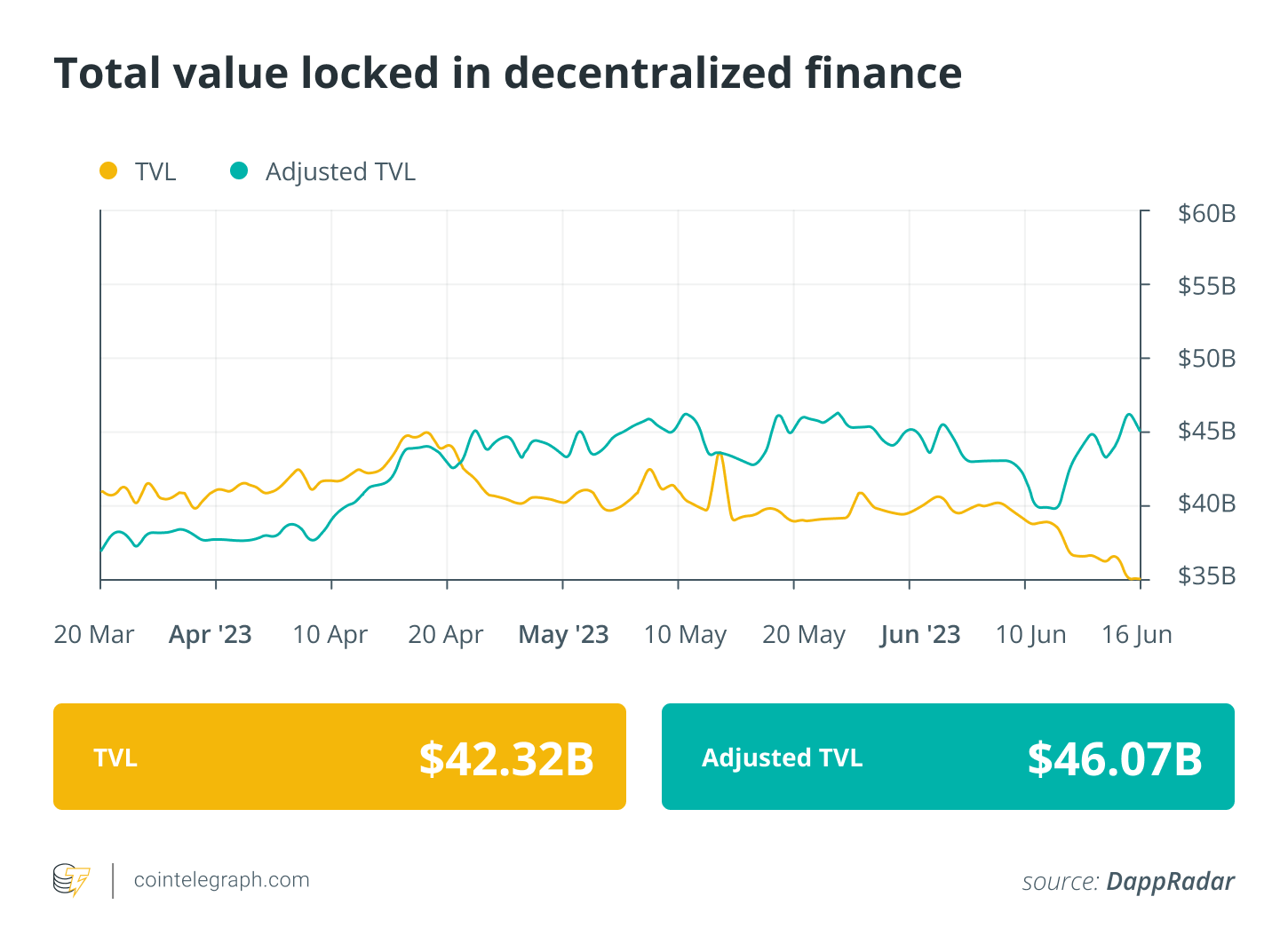
DeFi’s total market value saw a bearish decline this past week. Data from Cointelegraph Markets Pro and TradingView shows that DeFi’s top 100 tokens by market capitalization had a bearish week, with most tokens trading in the red. The total value locked in DeFi protocols remained below the $50 billion mark.
Thanks for reading our summary of this week’s most impactful DeFi developments. Join us next Friday for more stories, insights and education regarding this dynamically advancing space.
Source link







Atomic Wallet, a noncustodial decentralized wallet, has been hit by a staggering exploit, leading to users reporting losses of their entire cryptocurrency portfolios. This unforeseen breach has sent shockwaves through the crypto community, as Atomic Wallet’s fundamental premise relies on users assuming full responsibility for storing their assets securely.
The losses from the Atomic Wallet heist have now skyrocketed to over $100 million, according to an analysis conducted by Elliptic. This alarming figure highlights the severity of the attack, which compromised an estimated 5,500 crypto wallets.
Despite the magnitude of the incident, Atomic Wallet has yet to provide any explanation regarding the root cause of these substantial losses. This has led to mounting concerns from frustrated users who anxiously await clarification and reassurance from the company. Meanwhile, at the time of publication, the company’s last update on Twitter was on June 7.
Frustrated Atomic Wallet users have taken to Twitter to express their annoyance at the way the company is handling the issue. Twitter user Ezra Carlson shared, tagging Atomic Wallet, “why won’t AM give me a straight answer about why they didn’t warn me, knowing full well that they were being hacked, that it was not safe to use AM last week before I made a transfer to my wallet that was then hacked.”
@AtomicWallet why won’t AM give me a straight answer about why they didn’t warn me, knowing full well that they were being hacked, that it was not safe to use AM last week before I made a transfer to my wallet that was then hacked.
— Ezra Carlson (@ezziecarlson) June 13, 2023
Another user, “Real Deal Crypto,” called out Atomic Wallet for its lack of updates pertaining to the situation, saying, “Your last update was five days ago - SERIOUSLY?!?!”
@AtomicWallet Your last update was five days ago - SERIOUSLY?!?!
— RealDealCrypto (@hokiefan691S) June 13, 2023
On June 3, Atomic Wallet acknowledged reports of compromised wallets in a tweet but downplayed the impact, stating that “less than 1%” of its user base had been affected. However, the staggering sum of the losses suggests a significant breach.
At the moment less than 1% of our monthly active users have been affected/reported. Last drained transaction was confirmed over 40h ago.
Security investigation is ongoing. We report victim addresses to major exchanges & blockchain analytics to trace and block the stolen funds.
— Atomic - Crypto Wallet (@AtomicWallet) June 5, 2023
Related: Atomic Wallet hack losses top $35M, on-chain sleuth reports
Elliptic has linked the heist to the notorious Lazarus Group, believed to be responsible for stealing over $2 billion in crypto assets through various thefts. According to Elliptic, this disclosure marks the first time a significant crypto heist has been openly attributed to the Lazarus Group since its $100 million exploit of Horizon Bridge in June 2022.
Following the heist, Elliptic shared that it was collaborating with international investigators and exchanges and mobilizing its resources to recover the stolen assets. The firm’s attempts have allegedly resulted in the freezing of over $1 million worth of the stolen funds so far. However, the blockchain analysis company noted that “in response to the freezing of these funds, the thief has begun to change their behavior. In particular, they have turned to the Russia-based Garantex exchange to launder the stolen assets.”
The recent attack joins a series of notable breaches, including the recent exploit of Jimbos Protocol, resulting in a loss of $7.5 million, and a malicious proposal that seized control of Tornado Cash’s governance in May. According to a Chainalysis report, it is estimated that crypto hackers absconded with a staggering $3.8 billion in 2022, with a significant portion attributed to attacks linked to North Korea and a large number of exploits targeting decentralized finance protocols.
Magazine: Should crypto projects ever negotiate with hackers? Probably
Source link

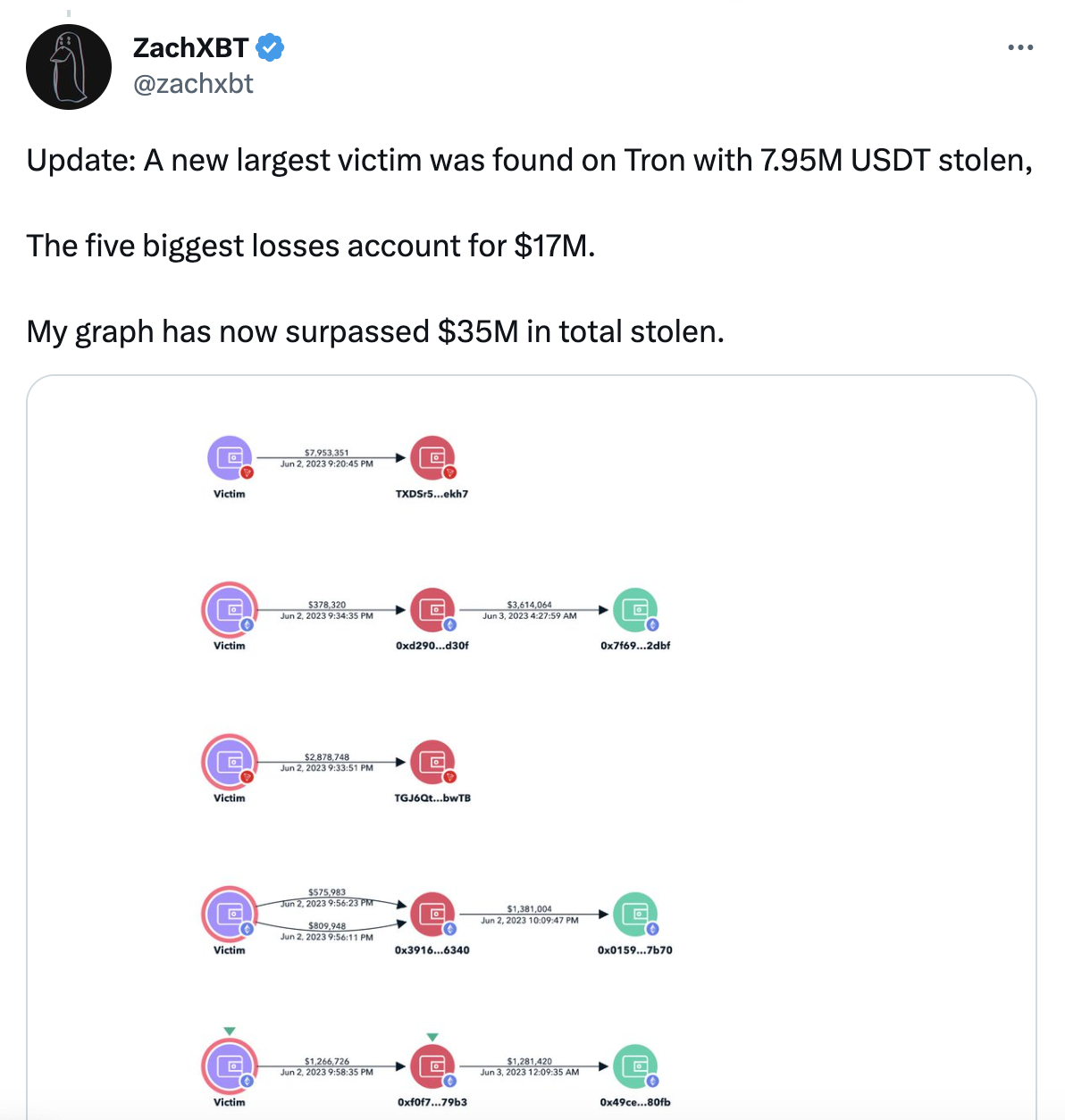
At least $35 million worth of crypto assets have been stolen from Atomic Wallet users since June 2, according to an analysis from on-chain sleuth ZachXBT. The five largest losses account for $17 million.
According to Atomic Wallet on Twitter, the cause of the attack is being investigated. Reports have surfaced of tokens being lost, transaction histories being erased, and even entire crypto portfolios being stolen.
An independent investigation carried out by pseudonymous Twitter ZachXBT, known for tracing crypto stolen funds and assisting hacked projects, has found the largest victim lost $7.95 million in Tether (USDT). “Think it could surpass $50m. Keep finding more and more victims, sadly,” commented ZachXBT.
Atomic Wallet claims to have over 5 million users around the world. Cointelegraph spoke with a long-time Atomic’s client who is now a victim of the security breach. “I felt terrible because I am a cybersecurity expert by profession,” said Emre, a Turkish resident who lost nearly $1 million in crypto assets received from bug bounty programs. His stolen tokens include Bitcoin (BTC), Dogecoin (DOGE), Litecoin (LTC), Ethereum (ETH), USDT, USD Coin (USDC), Binance Coin (BNB), and Polygon (MATIC).
“They say they’re looking into it, but they don’t have anything concrete yet,” Emre continued. The funds held at Atomic Wallet were destined for the establishment of a cybersecurity firm in Turkey.
Atomic is a noncustodial-decentralized wallet, meaning users are responsible for assets stored in the application. As usual, its Terms of Service do not accept any liability for on-chain damages suffered by users. “Under no circumstances will Atomic Wallet be liable to you for damages arising out of the services exceeding $50,” says one excerpt.
Update: The investigation is still ongoing in a joint effort with the leading security companies. The team is working on possible attack vectors. Nothing yet confirmed.
Support team is collecting victim addresses. Reached out to major exchanges and blockchain analytics companies…
— Atomic - Crypto Wallet (@AtomicWallet) June 4, 2023
There has been little information provided by Atomic Wallet to users so far. “Support team is collecting victim addresses. Reached out to major exchanges and blockchain analytics companies to trace and block the stolen funds,” Atomic’s team said in a tweet from June 4 — its second official communication.
Those contacting Atomic have been asked to answer over 20 questions about internet providers, use of virtual private networks (VPNs), and storage of seed phrases.
In Telegram’s community channels, some pointed out the exploit could have originated via an outdated dependency package. Dependency packages describe the relationship between activities to be performed within a program, including the order in which they should be performed, and the libraries needed to perform these activities.
The attack joins a growing list of crypto hacks. Most recent cases include Jimbos Protocol $7.5 million exploit and a malicious proposal that took over Tornado Cash’s governance in May. A Chainalysis report estimates that crypto hackers stole $3.8 billion last year, mostly through North Korean-linked attacks exploiting decentralized finance protocols.
Cointelegraph reached out to Atomic Wallet, but did not receive an immediate response.
Magazine: Should crypto projects ever negotiate with hackers? Probably
Source link

Atomic Wallet has been apparently exploited, with users on Twitter reporting complete losses of their crypto portfolios. Atomic is a noncustodial-decentralized wallet, meaning users are responsible for assets stored in the application.
“We have received reports of wallets being compromised. We are doing all we can to investigate and analyse the situation. As we have more information, we will share it accordingly,” said Atomic’s team on Twitter on June 3.
A number of users have commented on the post reporting losses, claiming funds were wiped out from their digital wallet app. On-chain sleuth ZachBTX, known for tracing stolen funds and assisting hacked projects, is taking part in the investigation. At the time of writing, it’s unclear how the attack was carried out. Atomic claims to have over 5 million users.
God damn, All of my hard working money has been vanished from atomic wallet only!!!! This is your responsibility to secure the funds, What will happened to our funds? please do not copy paste anything here! just give all clear answer, Many users are faced with this today!!
— Tom (@Christomos03) June 3, 2023
Twitter users have also reported that funds on the Atomic Wallet app have been stolen in the past. “This happened to my BTC 6 months ago with Atomic. They simply replied back to protect your pw, seed phrase, blah blah… I told them NOT even possible! All I do is use U to exchange and then move crypto out. My response to them, I will use U no MORE then! Now I was right!,” wrote a user in response to the post.
The attack joins a growing list of crypto hacks taking place every week. Decentralized Finance (DeFi) app Jimbos Protocol was exploited on May 28, resulting in a loss of 4,000 Ether worth around $7.5 million. Tornado Cash, a decentralized crypto mixer, was also recently hacked. On May 20, an attacker successfully granted 1.2 million votes to a malicious proposal, gaining full control of the protocol’s governance.
Crypto hackers stole an estimated $3.8 billion last year, mainly from North Korea-linked attackers and DeFi protocols, according to a Chainalysis report. Another analysis from TRM Labs reveals that while the number of incidents remained the same in the first quarter of 2023, the average hack size dropped to $10.5 million from nearly $30 million in the first quarter of 2022.
“Unfortunately, this slowdown is most likely a temporary reprieve rather than a long-term trend,” TRM Labs noted, warning that just a few large-scale attacks could tip the scales again.
Magazine: Should crypto projects ever negotiate with hackers? Probably
Source link

Apple to fix gaming? SEC hates Metaverse, Logan Paul trolled on Steam – Cointelegraph Magazine

Bitcoin bulls look to re-establish control — Will BNB, LTC, OKB and QNT follow?

Is the cryptocurrency market about to break its 10-week losing streak?

Shiba Inu (SHIB) Burn Rate Suffers 87% Decline In Single Week

Aptos Gains 18% In Last Week

Quant Soars 20% After Partnership With Bank Of England, BIS For CBDC Project

Bitcoin Retailers Buying The Dip As BTC Soars Above $26,000

How to write effective ChatGPT prompts for better results

Binance sends cease and desist notice to fraudulent Nigerian entity
Grayscale Bitcoin Trust nears 2023 highs on BlackRock ETF filing as buyers step up

Bitcoin Price Rebounds $1,000 From $25,000 Support Level – What Are Whales Up To?

Binance CEO CZ deems SEC’s request for emergency relief unwarranted

Floki Inu Dull, Motionless Following Binance Metaverse Integration

CZ, Powell and more rally to fund legal fees for on-chain sleuth ZachXBT, surpassing $1M

Implications for XRP, SEC credibility and more

Judge rules LBRY video platform’s token is a security in case brought by the US SEC

Silvergate Capital’s crypto-to-fiat transfers decrease by $50B compared to Q3 2021

Will the Bitcoin mining industry collapse? Analysts explain why crisis is really opportunity

Exchange Outflows Shows Bitcoin, Ethereum Accumulation Trend Continues

Bitcoin Dropped Below 2017 All-Time-High but Could Sellers be Getting Exhausted? – Blockchain News, Opinion, TV and Jobs
BNM DAO Token Airdrop

What does the Coinbase Premium Gap Tell us about Investor Activity? – Blockchain News, Opinion, TV and Jobs
Fed policy and crumbling market sentiment could send the total crypto market cap back under $1T
New Minting Services

Can Cardano’s July hard fork prevent ADA price from plunging 60%?

SEC’s Chairman Gensler Takes Aggressive Stance on Tokens – Blockchain News, Opinion, TV and Jobs

Friends or Enemies? – Blockchain News, Opinion, TV and Jobs

LUNA2 Recovers 70% In Nine Days From Historic Lows

Enjoy frictionless crypto purchases with Apple Pay and Google Pay | by Jim | @blockchain | Jun, 2022

A String of 200 ‘Sleeping Bitcoins’ From 2010 Worth $4.27 Million Moved on Friday
-
 SEC7 months ago
Judge rules LBRY video platform’s token is a security in case brought by the US SEC
-
 Banking8 months ago
Silvergate Capital’s crypto-to-fiat transfers decrease by $50B compared to Q3 2021
-
 Antminer11 months ago
Will the Bitcoin mining industry collapse? Analysts explain why crisis is really opportunity
-
 Bitcoin8 months ago
Exchange Outflows Shows Bitcoin, Ethereum Accumulation Trend Continues
-
 Altcoins12 months ago
Bitcoin Dropped Below 2017 All-Time-High but Could Sellers be Getting Exhausted? – Blockchain News, Opinion, TV and Jobs
-
Uncategorized1 year ago
BNM DAO Token Airdrop
-
 Binance11 months ago
What does the Coinbase Premium Gap Tell us about Investor Activity? – Blockchain News, Opinion, TV and Jobs
-
 Asia11 months ago
Fed policy and crumbling market sentiment could send the total crypto market cap back under $1T