Bitcoin
Bitcoin Price Aims $26,200 But 100 SMA Hold The Key In Short-Term


Bitcoin price is attempting a recovery wave above the $25,200 resistance. BTC must clear the 100 hourly SMA to continue higher in the near term.
- Bitcoin is slowly recovering higher above the $25,200 support.
- The price is trading below $25,750 and the 100 hourly Simple moving average.
- There is a key bearish trend line forming with resistance near $25,680 on the hourly chart of the BTC/USD pair (data feed from Kraken).
- The pair could rise further if it clears $25,750 and the 100 hourly Simple moving average.
Bitcoin Price Attempts Recovery
Bitcoin price remained in a bearish zone below the $26,200 resistance zone. BTC extended its decline below the $25,500 support and even spiked below $25,000.
A low is formed near $24,751 and the price is now attempting a recovery wave. There was a clear move above the $25,000 and $25,200 resistance levels. The price climbed above the 50% Fib retracement level of the downward move from the $26,062 swing high to the $24,751 low.
Bitcoin price is now trading below $25,750 and the 100 hourly Simple moving average. Besides, there is a key bearish trend line forming with resistance near $25,680 on the hourly chart of the BTC/USD pair.
The pair is now facing resistance near the trend line and the 100 hourly Simple moving average. It is close to the 61.8% Fib retracement level of the downward move from the $26,062 swing high to the $24,751 low. The next major resistance is near the $25,750 level.
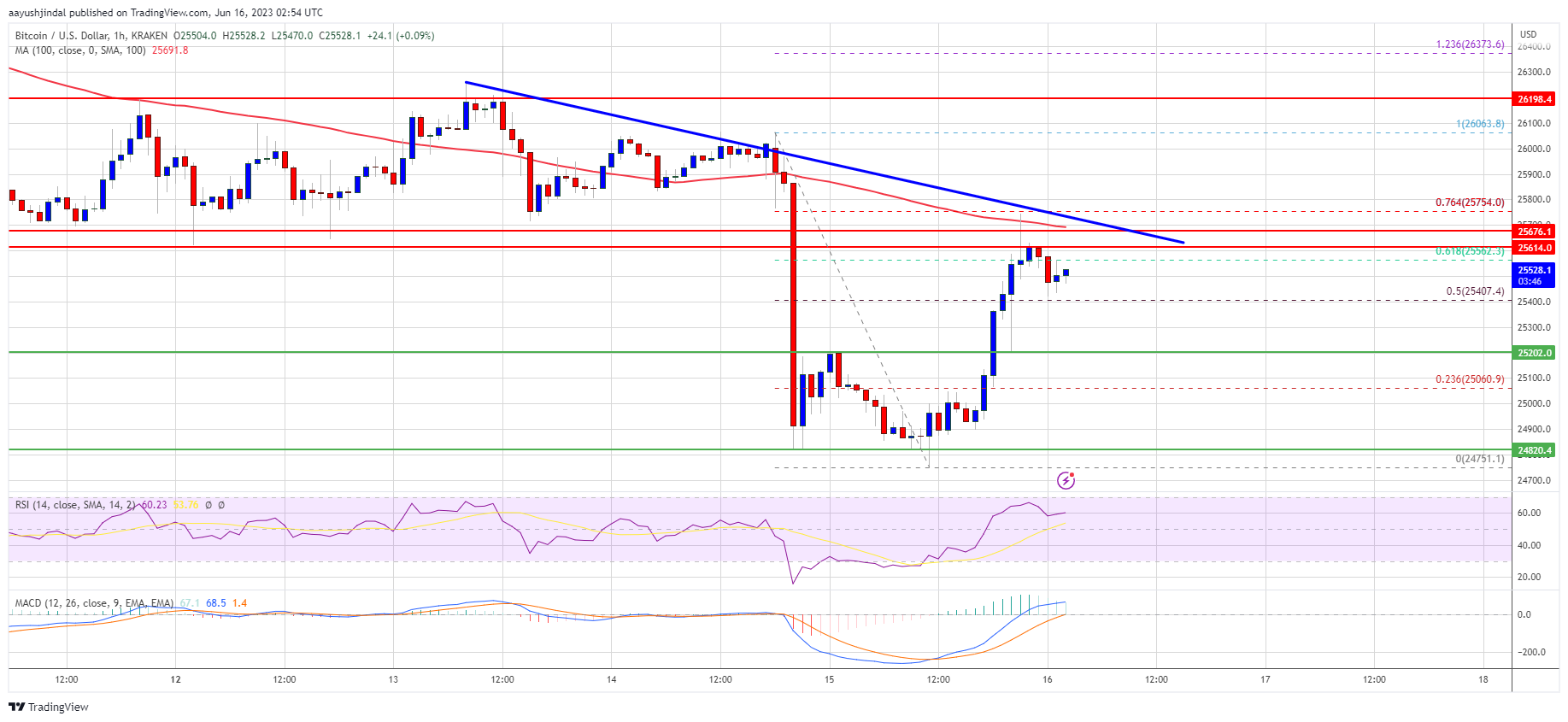
Source: BTCUSD on TradingView.com
A clear move above the $25,750 resistance might start a fresh increase. The next major resistance is near the $26,200 level, above which the bulls might send BTC toward the $26,500 resistance zone.
Fresh Decline in BTC?
If Bitcoin’s price fails to clear the $25,750 resistance, it could start another decline. Immediate support on the downside is near the $25,200 level.
The next major support is near the $24,820 level, below which the price might start another major decline. In the stated case, the price could drop toward the $24,000 support in the near term.
Technical indicators:
Hourly MACD – The MACD is now losing pace in the bearish zone.
Hourly RSI (Relative Strength Index) – The RSI for BTC/USD is above the 50 level.
Major Support Levels – $25,200, followed by $24,820.
Major Resistance Levels – $25,680, $25,750, and $26,200.
Source link




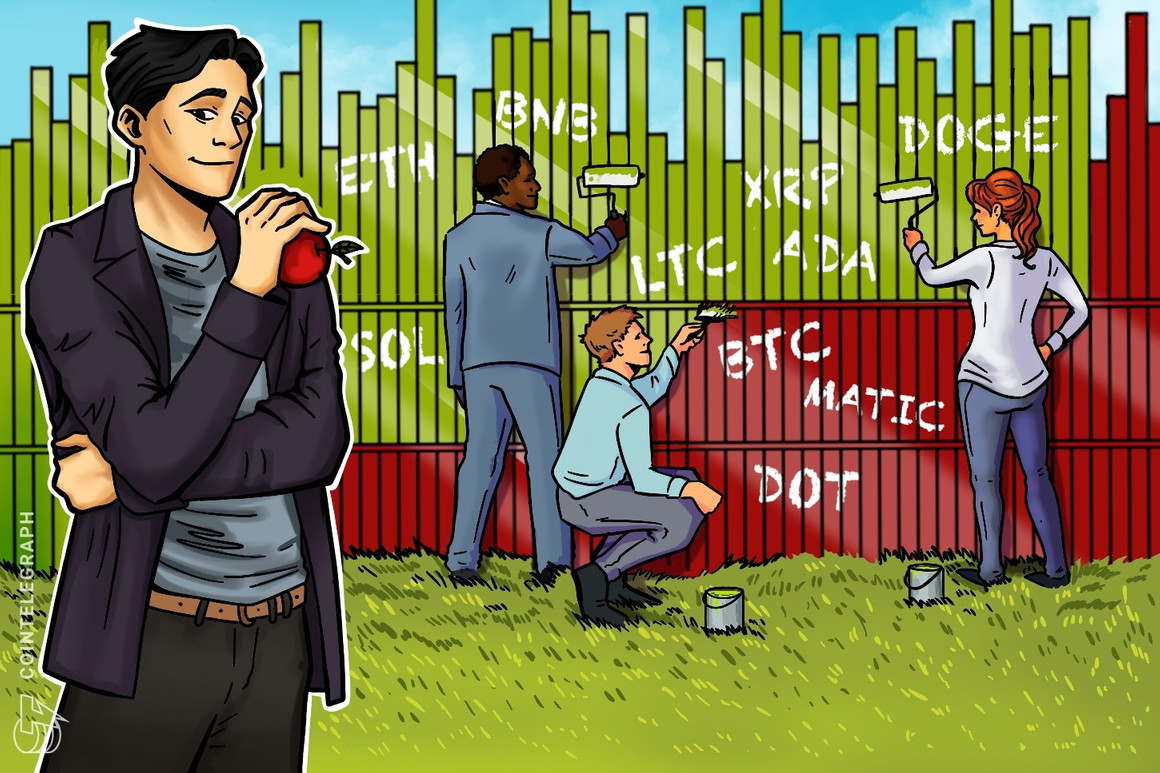

Bitcoin has reclaimed the $26,000 level, but will large cap altcoins follow BTC’s rebound?
Source link

Bitcoin CME Futures BTC1 front month continuous contract price action closes over the weekend, making Friday evening the closing bell for the week. This Friday’s close saw price recover above a crucial level that in the past led to a bullish impulse in crypto. Here is a closer look at why bulls could be ready to charge in the coming weeks.
Using BTC CME Futures As A Crypto Crystal Ball
Large institutional traders don’t just trade spot BTCUSD, nor do they trade on Binance, ByBit, or another crypto platform. When they want to speculate and trade using derivatives contracts, they look to the Chicago Mercantile Exchange, better known as CME Group.
Unlike the 24/7, always-on crypto market, CME Group charts close down for the weekend and holidays much like stocks. Due to this behavior, the chart often features gaps that don’t appear on standard BTCUSD price charts. Discrepancies between BTC CME Futures charts and BTCUSD charts can lead to fakeouts and shakeouts.
Because Bitcoin CME Futures does stop on Friday for the weekend, it also can provide early clues as to how spot price charts might close on Sunday night. In this case, BTC Futures has reclaimed the Bollinger Band basis line, often referred to as the “mid-BB”.
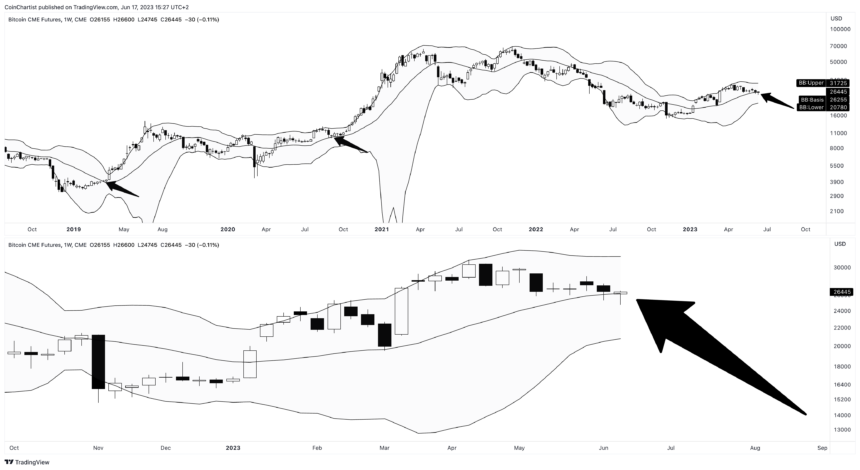
Is the third time the charm? | BTCUSD on TradingView.com
Bitcoin Price Recovers Above The Bollinger Band Basis Line
The basis line on the Bollinger Bands is a 20-period simple moving average. The tool’s creator, John Bollinger, then adds an upper and lower band set at two standard deviations of the SMA. This causes the bands to expand and contract with market volatility.
Like any moving average, it can act as dynamic support and resistance, holding up price action or preventing it from pushing along further. Following this Friday’s BTC Futures weekly close, Bitcoin has made it back above the mid-BB, possibly confirming it as support.
In the upper portion of the chart above, Bitcoin goes on an impulsive uptrend after holding above the basis line in 2019 and 2020. The lower portion depicts a closer look at this latest weekly close. Unless there is a massive collapse before Sunday night, BTCUSD technicals should follow suit. And if history repeats, a bull run could follow.
Is Bitcoin ready for a strong rally higher after reclaiming the key level as support? This chart was featured in issue #8 of CoinChartist (VIP) alongside a dozen other exclusive crypto charts. Click here to learn more.
Source link
Guest post by Giovanni Populo
The SEC has charged two major cryptocurrency exchanges: Binance and Coinbase. A common charge between both exchanges is that they offered unregistered securities on their platforms.
1.1 Security vs. Commodity
A security is a financial asset that represents an investment and has an inherent value. It can be traded on a secondary market and its value is derived from a claim on assets or earnings. The Howey Test, established by the Supreme Court and very well-known by the market, is often used to determine whether an asset is a security. The test has four requirements:
- Investment of Money: There must be an investment of money or some form of contribution.
- Common Enterprise: The money must be invested in a common enterprise, meaning that the fortunes of the investor and the promoter are interlinked.
- Expectation of Profit: The investor must have an expectation of profit.
- Efforts of Others: The investor must enter into the investment with the expectation that they will receive a return or profit on their investment. This profit could come in the form of dividends, revenue share, price appreciation, or other financial returns. The key point is that the investor is motivated by the prospect of a financial gain from their investment.
A commodity, on the other hand, is a basic good that is used as an input in the production of other goods or services. Its value is derived from its inherent properties and usefulness. While there isn’t a specific test like the Howey Test for commodities, they generally have the following characteristics:
- Interchangeability: Commodities of the same type are identical to each other, regardless of who produced them.
- Used in Production: Commodities are often used as inputs in the production of other goods or services.
- Inherent Value: The value of a commodity comes from its inherent properties and usefulness, not from the efforts of others.
- Traded on Commodity Markets: Commodities can be bought and sold on commodity markets.
1.2 Easy-to-Understand Examples
An example of security could be a share of stock in Apple Inc. When you buy a share of Apple Stock ($A ), you are buying a piece of the company and have a claim on part of the company’s assets and earnings.
An example of a commodity could be the lithium used in the production process of the iPhone, which is later on transformed into batteries. Lithium from different sources is considered identical and interchangeable. Its price is uniform across the market, barring quality differentials.
II. Applying the Concept to Cryptocurrencies
Bitcoin and Ethereum were NOT mentioned by the SEC in any of the lawsuits, which suggests that their interpretation is more towards commodities than securities – or at least they are not sure about them. In recent hearings, SEC representatives have been inconsistent in their stance, raising concerns over its capacity to interpret digital assets.
But, what would be the technical interpretation of such assets, considering current market understanding and past rulings?
2.1 Bitcoin (BTC)
Bitcoin is a decentralized digital currency without a central bank or single administrator. It can be sent from user to user on the peer-to-peer Bitcoin network without the need for intermediaries.
Let’s see how the Howey Test looks would apply:
- Investment of Money? Check.
- Common Enterprise? Nope, Bitcoin’s value is not tied to the fortunes of a separate enterprise.
- Expectation of Profit? Check, many people buy Bitcoin with the expectation of profit.
- Efforts of Others? Nope, Bitcoin’s value does not come predominantly from the efforts of others.
What about commodities?
- Interchangeability? Check.
- Used in Production: Somewhat. Bitcoin is not used as a direct input in production, but rather energy is. However, Bitcoin is used for the production of the information registry that we usually call blockchain.
- Inherent Value: Check.
- Traded on Commodity Markets: Check.
General market interpretation tends to think of $BTC as a Commodity.
Note: This is not an official classification, but rather an opinion based on common sense and talks by SEC representatives that signal the same direction. As mentioned previously, the SEC is still debating such classifications, and as of now, there are no concrete answers by US government agencies.
2.2 Ethereum (ETH)
Ethereum is an open-source, blockchain-based platform that enables developers to build and deploy decentralized applications (dApps). Its native cryptocurrency is called Ether (ETH).
Let’s try the Howey Test again:
- Investment of Money: Check.
- Common Enterprise: Nope, Ether’s value is not tied to the fortunes of a separate enterprise.
- Expectation of Profit: Check, many people buy Ether with the expectation of profit.
- Efforts of Others: No, Ether’s value does not come predominantly from the efforts of others.
What about the commodity characteristics?
- Interchangeability? Check.
- Used in Production: Check.
- Inherent Value: Check.
- Traded on Commodity Markets: Check.
General market interpretation, in the case of $ETH, is split due to staking features, but considering just the checklists above, closer to a Commodity than Security.
Note: Same as the previous note, not a formal legal classification, but rather just market opinion.
It is important to understand that crypto assets are very new compared to traditional assets, and the classification guidelines covered above were built only for the latter – TradFi. As proposed by Gabriel Shapiro on Twitter, we should start discussing alternative classifications when dealing with digital assets, as to consider the new variables introduced by blockchain technology. As he proposes, digital assets could be a security and a commodity at the same time, depending on different requirements. His idea would work as below:
Security
- Insiders’ tokens (even if from end-user distributions)
- Tokens sold by insiders to third parties, if the relevant system is not yet functional and decentralized
Commodity
- Tokens from “end user distributions” (mining, airdrop, etc. for a functional system)
- Tokens intrinsically relating to a functional, decentralized system
- Stablecoins
In short, this would interpret tokens as security or commodity depending on how it was acquired (investors, ICOs), use case (e.g. utility vs. stablecoin), and ecosystem decentralization level.
Clearly, such a proposal makes a lot of sense to the crypto market, since it applies key features and characteristics to classify an asset as one or the other. This is just one example of an alternative approach, but that should serve as motivation for us to contribute to the discussion and create our own versions of it.
The legal drama involving the U.S. Securities and Exchange Commission (SEC) and major cryptocurrency exchanges, Binance and Coinbase, has left the crypto world speculating on the potential implications and outcomes. The charges in question pertain to the alleged offering of unregistered securities, including but not limited to ADA, SOL, MATIC, and BNB. As it is critical to understand, these are currently just allegations and the legal process is yet to run its course. The final decision on these cases could serve as a regulatory beacon, profoundly impacting the crypto industry at large. So, what could these implications look like under different scenarios?
In one scenario, the SEC emerges victorious in its lawsuits, setting a precedent for stricter regulatory oversight of crypto exchanges. This would likely mean a redefinition of what constitutes security within the crypto domain, potentially based on parallels drawn from the projects the SEC has claimed to be securities. In this scenario, it’s plausible that we’ll witness an influx of enforcement actions against other platforms that fall within similar operational characteristics. A heavier regulatory environment could stifle innovation or push it offshore, leading to a challenging environment for U.S-based exchanges and Web3 projects. This scenario seems to be unlikely given the complexity of crypto assets and the evolving dynamics of the crypto market. Moreover, as some experts suggest, imposing traditional security laws on crypto assets could create more regulatory confusion rather than clarity.
The other sees the SEC losing the lawsuits, resulting in a much broader interpretation of cryptocurrencies as commodities. This could potentially loosen the grip of regulatory oversight, providing room for the crypto industry to flourish. Yet, the downside is that without proper guidelines, there could be an increased risk for investors, which could, in turn, affect the overall market stability.
Looking ahead, we find ourselves at a crossroads. The conclusion of these legal cases will significantly influence the regulatory landscape for crypto in the U.S. and likely globally. If I were to guess, I’d suggest that the degree of decentralization within networks could become a determining factor in classifying something as a security. Brand new regulation for digital assets also seems to be a likely outcome.
Looking beyond the immediate challenges, we need to continue fostering open discussions around digital asset classifications and encouraging innovation within the regulatory frameworks. We should support efforts that aim to find a balance between facilitating crypto’s immense potential and safeguarding the interests of all participants. After all, the goal is to ensure that the crypto industry thrives, regardless of the legal and regulatory environment it operates in.
Always forward-looking, always ahead of the game. Let’s keep the conversation going.
Source link

Price analysis 6/16: BTC, ETH, BNB, XRP, ADA, DOGE, SOL, MATIC, LTC, DOT

Gary Gensler’s job at risk, BlackRock’s first spot Bitcoin ETF…

BUSD falls to fourth position among stablecoins

Crypto outflows surge, a16z’s UK office, and the silent altcoins ban

Bitcoin Recovers Above Critical Level, Why Bulls Could Be Ready To Charge

The Great Battle of Asset Classification – Blockchain News, Opinion, TV and Jobs

3 key Ether price metrics point to growing resistance at the $1,750 level

Binance Coin (BNB) Faces Sideways Movement, Bears Threaten Further Sell-Off

US court approves SEC-Binance.US agreement

Polygon (MATIC) Witnesses High Volatility Amid Positive Developments

Meta’s new ‘Voicebox’ AI is a text-to-speech tool that learns like ChatGPT

ZachXBT Slapped With Defamation Lawsuit For MachiBigBrother Exposé

Tether responds to account deactivation controversy, raises compliance checks

Shiba Inu Positive Social Sentiment Sparks Bullish Speculation

5 AI tools for learning and research

Judge rules LBRY video platform’s token is a security in case brought by the US SEC

Silvergate Capital’s crypto-to-fiat transfers decrease by $50B compared to Q3 2021

Will the Bitcoin mining industry collapse? Analysts explain why crisis is really opportunity

Exchange Outflows Shows Bitcoin, Ethereum Accumulation Trend Continues

Bitcoin Dropped Below 2017 All-Time-High but Could Sellers be Getting Exhausted? – Blockchain News, Opinion, TV and Jobs
BNM DAO Token Airdrop

What does the Coinbase Premium Gap Tell us about Investor Activity? – Blockchain News, Opinion, TV and Jobs
Fed policy and crumbling market sentiment could send the total crypto market cap back under $1T
New Minting Services

Can Cardano’s July hard fork prevent ADA price from plunging 60%?

Friends or Enemies? – Blockchain News, Opinion, TV and Jobs
SEC’s Chairman Gensler Takes Aggressive Stance on Tokens – Blockchain News, Opinion, TV and Jobs

LUNA2 Recovers 70% In Nine Days From Historic Lows

Enjoy frictionless crypto purchases with Apple Pay and Google Pay | by Jim | @blockchain | Jun, 2022

A String of 200 ‘Sleeping Bitcoins’ From 2010 Worth $4.27 Million Moved on Friday
-
 SEC7 months ago
Judge rules LBRY video platform’s token is a security in case brought by the US SEC
-
 Banking8 months ago
Silvergate Capital’s crypto-to-fiat transfers decrease by $50B compared to Q3 2021
-
 Antminer11 months ago
Will the Bitcoin mining industry collapse? Analysts explain why crisis is really opportunity
-
 Bitcoin8 months ago
Exchange Outflows Shows Bitcoin, Ethereum Accumulation Trend Continues
-
 Altcoins12 months ago
Bitcoin Dropped Below 2017 All-Time-High but Could Sellers be Getting Exhausted? – Blockchain News, Opinion, TV and Jobs
-
Uncategorized1 year ago
BNM DAO Token Airdrop
-
 Binance11 months ago
What does the Coinbase Premium Gap Tell us about Investor Activity? – Blockchain News, Opinion, TV and Jobs
-
 Asia11 months ago
Fed policy and crumbling market sentiment could send the total crypto market cap back under $1T