
Altcoins
Polygon Sees Surge In Whale Buying: Recovery In The Cards?


Polygon (MATIC), a blockchain scalability platform, finds itself in the grip of negative sentiment that casts a shadow over its prospects for a strong price recovery. The crypto market has been a volatile space, prone to sudden shifts in sentiment, and MATIC is no exception.
The recent downturn in the sentiment surrounding MATIC has left investors and traders cautiously observing the price charts.
Once considered a promising project in the crypto space, Polygon’s potential for growth has been impeded by the recent actions of the US Securities and Exchange Commission against altcoins.
Will the negative sentiment continue to hinder MATIC’s potential for a strong price recovery?
Polygon Whales Unfazed By US Regulatory Pressure?
The latest data on MATIC reveals that the pressure from US regulators has not seemed to totally unsettle some prominent investors, as evidenced by a notable increase in whale transactions exceeding $1 million in recent days.
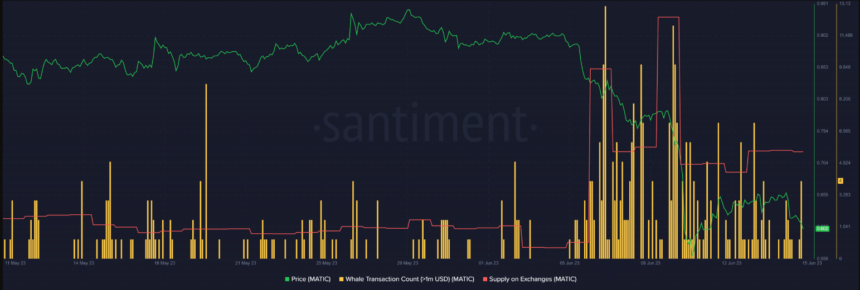
Source: Santiment
However, despite the increase in whale appetite, the cryptocurrency has failed to sustain a strong upward momentum at the time of writing.

Source: CoinMarketCap
CoinMarketCap reports MATIC’s current price as $0.5818, reflecting a decline of 2.33% within the past 24 hours. Additionally, the cryptocurrency has witnessed a substantial slump of 25.93% over the past seven days.
In addition to the impact of regulatory pressure, the movements of MATIC’s supply on exchanges, which serves as an indicator of short-term selling pressure, have exhibited rapid fluctuations during the same period.
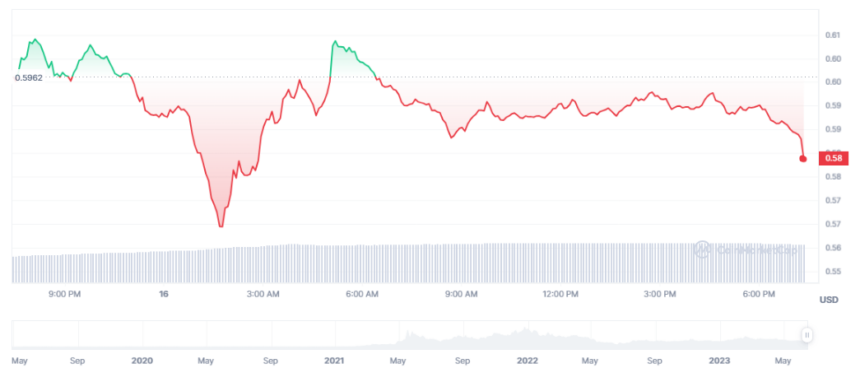
MATIC 24-hour price movement. Source: CoinMarketCap
It experienced a sharp increase, followed by a decline, and then another spike before eventually easing at the time of publication.
These developments indicate that the selling pressure on MATIC remains a significant concern, primarily due to the prevailing regulatory uncertainty.
MATIC market cap currently at $5.4 billion. Chart: TradingView.com
Fed’s Pause On Rate Hikes Fails To Stabilize Crypto Markets
On the whole, financial markets have continued to exhibit volatile movements, causing cryptocurrencies to decouple from the performance of traditional equities markets.
The recent downturn in the crypto market seems to be linked to the press conference held by Federal Reserve Chairman Jerome Powell on June 14, during which he announced that the central bank would temporarily halt rate hikes for the month of June.
While this decision aligned with investors’ expectations, it had an unexpected effect on the crypto market. Instead of stabilizing, the market experienced a reversal in its course and resumed the ongoing sell-off that has persisted for the past three weeks.
The presence of substantial macroeconomic challenges, coupled with the anticipation of future rate hikes and low trading volume, suggests that the volatility in the cryptocurrency market is likely to persist in the foreseeable future.
The prevailing headwinds, including economic factors on a larger scale, have contributed to the unpredictability and turbulence in the crypto market.
Featured image from Analytics Insight
Source link







Like a strong cup of highly-caffeinated coffee or the sound of a rooster crowing at the crack of dawn, some things have the potential to be a real eye-opener.
When it comes to altcoins, crypto investors could get a wake up alarm they won’t be able to ignore. Keep reading to learn all about the morning star pattern that recently appeared on the weekly chart of several blue chip cryptocurrencies.
Why Crypto Could Be In For A Good “Morning”
Earlier in June, the United States SEC launched an onslaught of enforcement action against Binance and Coinbase. Many top altcoins were named as securities in the case. This list explicitly mentioned MATIC, SOL, and a handful of others.
The result was a deep selloff, severely worsened as US-based institutions began unloading altcoin holdings en masse without care of market impact.
However, following the news that BlackRock and several other institutions were filing for Bitcoin ETFs, the market staged a strong recovery.
The rebound was especially powerful in altcoins, which have been extremely oversold in the midst of the ongoing regulatory uncertainty. The sharp turnaround was also enough to form a morning star pattern in many top cryptocurrencies
.
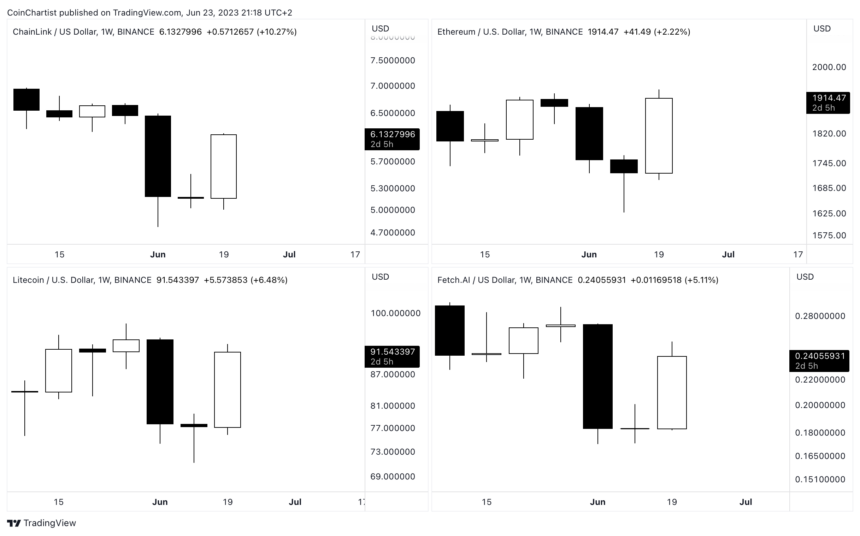
Top altcoins have formed a morning star pattern | ETHUSD on TradingView.com
The Morning Star Pattern: A Wake Up Call For Altcoins
A morning star pattern has formed on blue chip altcoins like Ethereum, Litecoin, Chainlink, and Fetch.ai. This type of Japanese candlestick pattern is a potential bullish reversal pattern with powerful implications.
The pattern solidified with Sunday night’s weekly close, but to fully confirm must be followed by further upside. This upside is expected to materialized within 3-5 candlesticks, or in this case, weeks.
With many of these more fundamentally-sound and regulator-friendly coins recovering most of what they lost in June, follow through could spark a more significant bullish trend across the brutalized altcoin space.
This chart originally appeared in Issue #9 of CoinChartist (VIP). Get 10% off a year subscription with this link: https://coinchartist.substack.com/NEWSBTC
Source link


Digital pound will be pseudonymous with a focus on privacy: BoE CBDC chief

Tezos Releases Nairobi, XTZ Bulls Unmoved As Bears Dominate

Will $30K be a new springboard for Bitcoin bulls?

TRX Could Surge And Revisit $0.085

Riot Platforms to add 33,000 Bitcoin miners ahead of 2024 halving

Injective (INJ) Continues To Build Momentum, Jumps Nearly 27% In A Single Week

$27 trillion AUM is perched over Bitcoin and crypto: CoinShares CSO

Ethereum Price Lacks Momentum Above $1,900 But Dips Likely To Be Limited

Robinhood to axe 7% of full-time staff in latest round of layoffs: Report

Crypto Investment Inflows Reach One-Year High, Reveals CoinShares

Yes, the Secret Service has an NFT collection, and no, it’s not for sale

How A Morning Star Pattern Could Awaken Altcoins

Swiss central bank announces plans for wholesale CBDC pilot with ‘real money’: Report

Chainlink Bulls Must Defend Support Zone To Prepare For Another Rally

What is generative AI?

Judge rules LBRY video platform’s token is a security in case brought by the US SEC

Silvergate Capital’s crypto-to-fiat transfers decrease by $50B compared to Q3 2021

Will the Bitcoin mining industry collapse? Analysts explain why crisis is really opportunity

Exchange Outflows Shows Bitcoin, Ethereum Accumulation Trend Continues

Bitcoin Dropped Below 2017 All-Time-High but Could Sellers be Getting Exhausted? – Blockchain News, Opinion, TV and Jobs
BNM DAO Token Airdrop

What does the Coinbase Premium Gap Tell us about Investor Activity? – Blockchain News, Opinion, TV and Jobs
Fed policy and crumbling market sentiment could send the total crypto market cap back under $1T
New Minting Services

Can Cardano’s July hard fork prevent ADA price from plunging 60%?

SEC’s Chairman Gensler Takes Aggressive Stance on Tokens – Blockchain News, Opinion, TV and Jobs

Friends or Enemies? – Blockchain News, Opinion, TV and Jobs

LUNA2 Recovers 70% In Nine Days From Historic Lows

Enjoy frictionless crypto purchases with Apple Pay and Google Pay | by Jim | @blockchain | Jun, 2022

Block News Media Live Stream
-
 SEC8 months ago
Judge rules LBRY video platform’s token is a security in case brought by the US SEC
-
 Banking8 months ago
Silvergate Capital’s crypto-to-fiat transfers decrease by $50B compared to Q3 2021
-
 Antminer11 months ago
Will the Bitcoin mining industry collapse? Analysts explain why crisis is really opportunity
-
 Bitcoin8 months ago
Exchange Outflows Shows Bitcoin, Ethereum Accumulation Trend Continues
-
 Altcoins12 months ago
Bitcoin Dropped Below 2017 All-Time-High but Could Sellers be Getting Exhausted? – Blockchain News, Opinion, TV and Jobs
-
Uncategorized1 year ago
BNM DAO Token Airdrop
-
 Binance11 months ago
What does the Coinbase Premium Gap Tell us about Investor Activity? – Blockchain News, Opinion, TV and Jobs
-
 Asia11 months ago
Fed policy and crumbling market sentiment could send the total crypto market cap back under $1T