
Asia
Binance kicks off transition to new platform in Japan



After five years out of the Japanese market, crypto exchange Binance has begun the process of establishing a new and fully regulated subsidiary in the country. The move follows the acquisition of the regulated crypto exchange Sakura Exchange Bitcoin (SEBC) in November 2022.
As part of the deal, SEBC will cease its current services by May 31 and reopen as Binance Japan in the coming weeks. Users of the exchange’s global platform in the country will have to register with the new entity. The migration will be available after August 1, 2023, and will include a new identity verification process (KYC) to comply with local requirements.
Any remaining funds on the SEBC exchange will be automatically converted to Japanese yen and transferred to users’ bank accounts beginning in June, Binance previously disclosed.
With a narrowing regulatory landscape, the exchange’s strategy for expanding its global reach has been to acquire local regulated entities. Binance made a similar move in Singapore in 2021, in Malaysia in 2022, and in Thailand most recently. In Japan, it shut down operations in 2018, after failing to obtain an independent license from local regulators.
Related: Japan’s crypto Anti-Money Laundering measures to start in June
According to a notice on its website, the exchange will not provide derivative services in Japan. Binance’s global version will not accept new derivative accounts from users in the country.
Additionally, residents in Japan using the global platform will not be able to increase or open new options positions after June 9. Pending orders will be canceled, and existing positions must be closed before June 23, said the exchange. Binance Leveraged Tokens will not be available for trade or subscription.
“In the future, we plan to continue to enrich our service offerings in Japan and will work closely with regulators to possibly provide derivatives services in a fully compliant manner,” the company wrote.
Japan was one of the first nations to introduce crypto regulations. The local laws contributed to the speedy recovery of funds in February at FTX Japan, a subsidiary of the now-bankrupted crypto exchange FTX. Japan’s regulations requires crypto exchanges to separate client funds from other assets.
Magazine - Crypto City: Guide to Osaka, Japan’s second-biggest city
Source link








China and Singapore will collaborate “on concrete initiatives that will catalyze capital flows to support a credible and inclusive transition to a low carbon future for our countries and the region.”
Source link


Conflux, a regulatory-compliant public blockchain based in China, seeks to deploy Uniswap v3 on its network, according to a proposal on Uniswap’s governance forum on April 7. The move comes days after the Uniswap v3 code license expired, enabling developers to fork the protocol and deploy their own decentralized exchange.
As per the proposal, the deployment would provide “access to millions of potential new users, particularly in the Chinese and Asian markets.” According to Conflux, the blockchain experienced a spike in traffic in the first quarter of 2023. The network has a market capitalization of nearly $1 billion and has $45 million in total value locked on-chain.
“Currently, 84% of worldwide blockchain applications are submitted in China. Compared to the UK and the US, 11% and 14%. […] This shows that China is one of the most mature markets in Web3, and exposure is important for all projects,” said Conflux in the proposal.
An #RFC (Request for Comments) regarding the deployment of @Uniswap V3 on Conflux #eSpace has been submitted on Uniswap’s governance forum.
We welcome everyone to join the discussion!
Read the full proposal and discuss here: https://t.co/3QaeDGI2XP pic.twitter.com/Ar8sWSGnvG
— Conflux Network Official (@Conflux_Network) April 7, 2023
Regulatory crackdowns in the United States and Europe would also benefit the crypto industry’s growth in Asian markets, claimed Conflux, noting that over 80 crypto companies are planning to establish an office in Hong Kong, providing a crypto bridge to mainland China.
Ambre Soubiran, CEO of institutional crypto market data provider Kaiko, holds a similar view. “The U.S. being more stringent these days than ever on crypto and Hong Kong regulating in a more favorable way […] is going to clearly shift the center of gravity of crypto assets trading and investments more towards Hong Kong,” he noted in a recent interview.
Aside from potential market reach, incentives offered for projects building on top of Uniswap v3 on the Conflux Network are the creation of liquidity pools for CFX token trading pairs — specifically, CFX-USDT, CFX-BTC, and CFX-ETH. These liquidity pools would be worth $2 million and locked for two years. The Conflux Foundation would also provide $1 million in “liquidity incentives.”
Conflux is a layer-1 blockchain operating using a hybrid proof-of-work and proof-of-stake mechanism. In a recent development, the network announced a partnership with China Telecom to develop a blockchain SIM (BSIM) card. The BSIM will offer a secure place to store digital private keys and will be able to call upon the said signature to transfer money to other users. In addition, a “one-click direct check” functionality will allow users to check for transaction information and status progress in real time.
Magazine: Zhu Su’s exchange did $13.64 in volume akshually, Huobi in crisis - Asia Express
Source link

Islamic banking and finance is a system based on the principles of Shariah, or Islamic law, which, among many other things, prohibits the charging or paying of interest on loans and emphasizes ethical and equitable financial transactions.
One of the more notable traits of Islamic banking is its prohibition on charging or paying interest on loans, which is the basis of conventional banking.
Instead, Islamic finance is based on profit and loss-sharing agreements between the lender and the borrower. The lender shares the investment risk with the borrower, and both parties share the profits or losses.
Sharia law permits investment in intangible goods like stocks, bonds and digital assets like cryptocurrencies. Sharia-compliant assets do not have to be backed by physical goods as long as they have real utility. Additionally, Sharia only permits investments in businesses and projects that are not harmful to society (so no gambling, alcohol or tobacco).
Transparency is essential to Islamic finance, and all financial transactions must be disclosed to all parties involved. Islamic finance is also supervised by Shariah boards, which comprise Islamic scholars who ensure that all financial transactions comply with the principles of Shariah.
Islamic finance offers several products and services, including mudarabah, musharakah, murabaha, ijara, and sukuk.
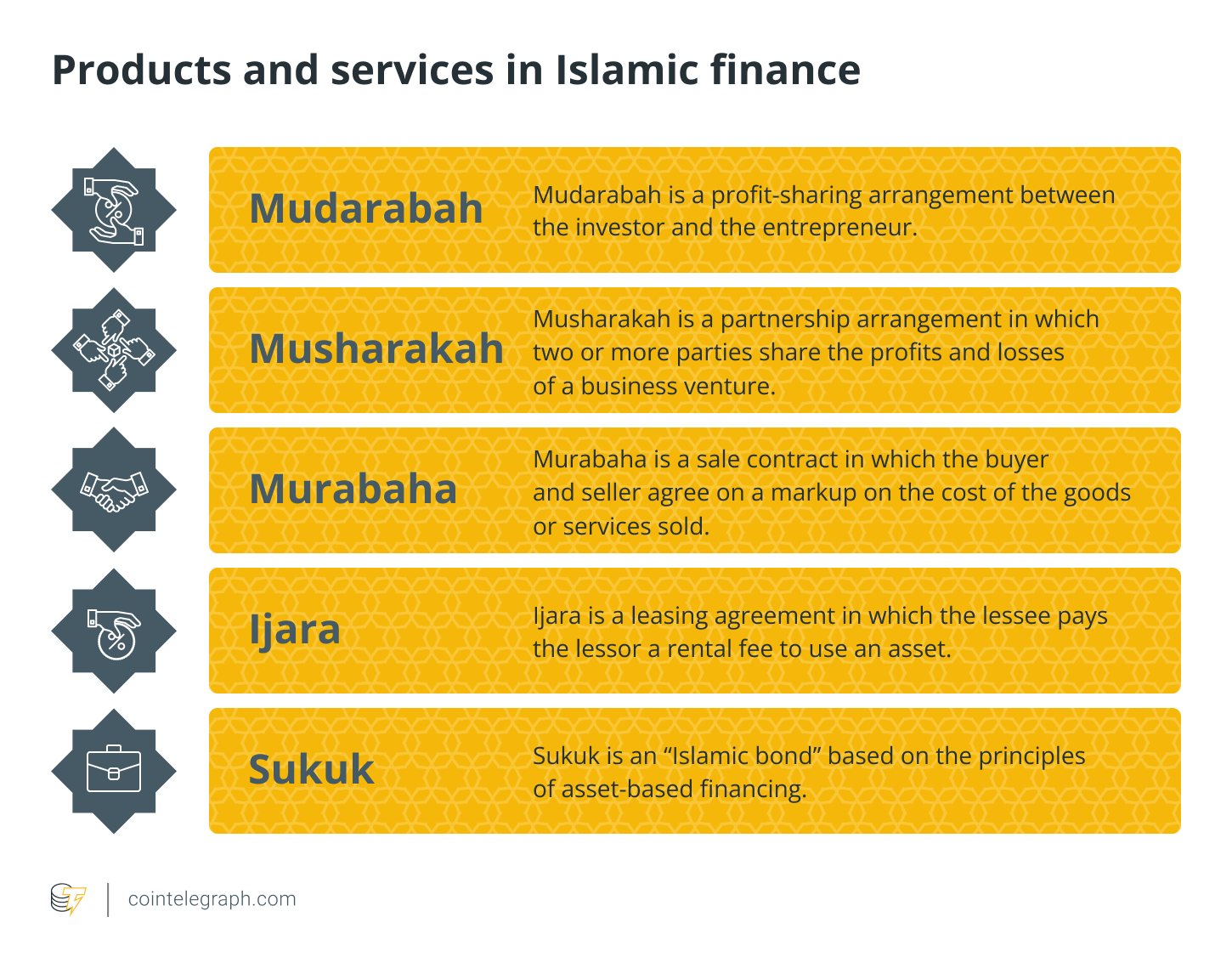
What makes a Sharia-compliant cryptocurrency?
To develop a compliant cryptocurrency, a team of experts in Islamic finance and technology — including Islamic scholars, financial experts and developers — come together to determine the design and features of the cryptocurrency.
This team will ensure the coin is based on a profit-and-loss sharing system rather than interest-based lending. This means that investors share in the profits and losses of the business venture rather than receiving a fixed rate of return on their investment.
Recent: Unwinding the hyperbole: Are US-based crypto firms really being ‘choked’?
Once the cryptocurrency is ready for issuance, a Shariah supervisory board must review and certify the coin before Muslim investors can start using it. This certification process involves a detailed review of the cryptocurrency’s features and design.
One example of a Sharia-compliant digital asset is Islamic Coin (ISLM), built on the Haqq Network blockchain. In June 2022, Islamic Coin gained a Fatwa (a ruling by Islamic authority) for its Sharia compliance.
Like many cryptocurrencies, it follows a deflationary model, preventing new coins from being created on a whim. In addition, whenever a new ISLM is minted on the network, 10% is sent to the Evergreen DAO, a decentralized autonomous organization that invests the proceeds into Islamic charities or online projects. The contribution of funds to charity follows zakat — one of the pillars of Islam.
Islamic cryptocurrencies need the right design
Sharia-compliant cryptocurrencies are a relatively new and evolving development in digital currencies.
While designed to comply with the principles of Islamic finance, they are not without controversy, and there is an ongoing debate among Islamic scholars about whether the cryptocurrencies are truly compatible with Shariah. Andrey Kuznetsov, a co-founder of the Haqq Network, told Cointelegraph:
“Developing a Bitcoin environment that supports Sharia law is also difficult. This involves forming alliances with financial institutions, states, and other parties to ensure that the coin is broadly recognized and can be used per Islamic ideals.”
One concern from the perspective of Islamic financial scholars is the issue of crypto as a speculative investment — which is not permitted as it contains “gharar” — meaning “uncertainty, hazard or risk,” or “the sale of what is not present.”
Mohammed AlKaff AlHashmi, a co-founder of Islamic Coin, told Cointelegraph, “Sharia prohibits and treats as void transactions that rely on chance or speculation rather than an effort to produce a return.”
However, he added, “This principle does not prohibit commercial speculation in a business or trading transactions, as Sharia laws are smart and flexible enough to adopt tech changes in every era.”
According to AlHashmi, a cryptocurrency can comply with Islamic law if “developed with the right intentions, for example, actual utility,” rather than “purely for trading or speculation.”
As such, whether a coin can be considered halal or permissible comes down to a matter of design, according to Kuznetsov. “The use and architecture of a cryptocurrency are the determining factors in whether or not it complies with Sharia law,” he said.
He pointed to cryptocurrency use cases, including payment or value storage, which could be more easily considered Sharia-compliant.
Stablecoins, for example, can be seen as a form of asset-based financing, which is a principle of Islamic finance. Stablecoins like USD Coin (USDC) and Tether (USDT) are backed by real-world asset reserves. Some cryptocurrencies have even been created specifically for Islamic finance, such as OneGram, which is backed by gold reserves.
Kuznetsov concluded, “While there are challenges to creating and adopting Sharia-compliant coins, we can overcome these challenges with the proper mix of instruction, legislation and technical ingenuity.”
Expanding access to crypto
When it comes to the benefits of Sharia-compliant cryptocurrencies, there is potential for attracting additional users from countries where Islam is the predominant religion since it would reduce any concerns religious investors may have about cryptocurrency.
AlHashmi said, “Increasing Muslims’ access to financial services is one of the possible benefits of cryptocurrencies that comply with Sharia law. In addition, sharia-compliant cryptocurrencies may provide a mechanism for Muslims who have been denied access to conventional banking to conduct financial transactions in accordance with their religious views.” He continued to say:
Recent: Bitcoin in Senegal: Why is this African country using BTC?
“More capital investment in Islamic banking might also be a favorable outcome. To the extent that cryptocurrencies can be made Sharia-compatible, they may be able to entice Muslims looking for investments that respect their religious principles. Because of this, there may be greater progress and expansion in the Islamic finance industry, which is good for the economy as a whole.”
As the financial world continues to evolve and new technologies emerge, it will be important for Muslim investors to carefully consider the compatibility of these new developments with the principles of Islamic finance, and ensure that they align with this system’s ethical and social goals.
Source link

5 AI tools for learning and research

PEPE Jumps 10% In 24 Hours, Sparking Speculation Of A Rally

SEC and Binance.US strike a temporary agreement on asset access

Curve pool imbalance triggers USDT depeg concerns: Finance Redefined

Cardano founder Charles Hoskinson goes hunting for aliens & UFOs

‘We had to change strategies,’ says SEC enforcement director on recent actions: Report

Crypto payments platform Wyre shutters citing bear market conditions

Assessing Ripple-Colombia Central Bank Partnership

Nike teases upcoming ‘Airphoria’ NFT sneaker hunt on Fortnite

Bitcoin Market Dominance Peaks In Nearly Two Years, Here’s Why

Ethereum network upgrade and uptick in Arbitrum active users could trigger an ARB price reversal

XRP Allegedly Attacked By SEC’s Hinman For Ethereum’s Benefit

On-chain sleuth ZachXBT sued for libel after claiming plaintiff drained funds from project

Percentage Of ETH Addresses In Profit Reaches 5-Month Low

Think AI tools aren’t harvesting your data? Guess again

Judge rules LBRY video platform’s token is a security in case brought by the US SEC

Will the Bitcoin mining industry collapse? Analysts explain why crisis is really opportunity

Silvergate Capital’s crypto-to-fiat transfers decrease by $50B compared to Q3 2021

Exchange Outflows Shows Bitcoin, Ethereum Accumulation Trend Continues

Bitcoin Dropped Below 2017 All-Time-High but Could Sellers be Getting Exhausted? – Blockchain News, Opinion, TV and Jobs
BNM DAO Token Airdrop

What does the Coinbase Premium Gap Tell us about Investor Activity? – Blockchain News, Opinion, TV and Jobs
Fed policy and crumbling market sentiment could send the total crypto market cap back under $1T
New Minting Services

Can Cardano’s July hard fork prevent ADA price from plunging 60%?

Friends or Enemies? – Blockchain News, Opinion, TV and Jobs

SEC’s Chairman Gensler Takes Aggressive Stance on Tokens – Blockchain News, Opinion, TV and Jobs

LUNA2 Recovers 70% In Nine Days From Historic Lows

Enjoy frictionless crypto purchases with Apple Pay and Google Pay | by Jim | @blockchain | Jun, 2022

A String of 200 ‘Sleeping Bitcoins’ From 2010 Worth $4.27 Million Moved on Friday
-
 SEC7 months ago
Judge rules LBRY video platform’s token is a security in case brought by the US SEC
-
 Antminer11 months ago
Will the Bitcoin mining industry collapse? Analysts explain why crisis is really opportunity
-
 Banking8 months ago
Silvergate Capital’s crypto-to-fiat transfers decrease by $50B compared to Q3 2021
-
 Bitcoin8 months ago
Exchange Outflows Shows Bitcoin, Ethereum Accumulation Trend Continues
-
 Altcoins12 months ago
Bitcoin Dropped Below 2017 All-Time-High but Could Sellers be Getting Exhausted? – Blockchain News, Opinion, TV and Jobs
-
Uncategorized1 year ago
BNM DAO Token Airdrop
-
 Binance11 months ago
What does the Coinbase Premium Gap Tell us about Investor Activity? – Blockchain News, Opinion, TV and Jobs
-
 Asia11 months ago
Fed policy and crumbling market sentiment could send the total crypto market cap back under $1T